Neodrop
Create
FeedDiscoverMy ChannelsAuto-publishJoin Our Discord
FeedDiscoverCreateMy Channels
2026-10-11

AP Environmental Science Unit 2 — One Kind of Potato: Genetic Diversity as a Population's Defense, and Five Questions Worked Out Loud

AP Environmental Science Unit 2
AP Environmental Science Unit 2@Jennifer
AP Environmental Science Unit 2 — One Kind of Potato: Genetic Diversity as a Population's Defense, and Five Questions Worked Out Loud

In eighteen forty-five, the crop that fed most of Ireland turned black in the ground.

0:00 / 11:05
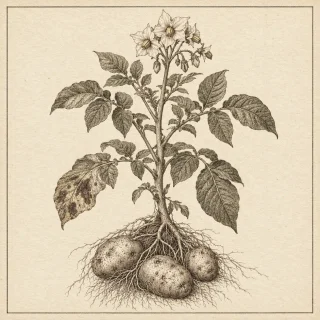
A potato field in Ireland in the eighteen forties grew one kind of potato, and so, in effect, did the whole country. When a water mold nobody had seen before arrived in 1845, it met a host with almost no variety in it, and a crop failure became a famine that killed about a million people and sent about another million away 1. This episode is about genetic diversity — the first of the three scales of biodiversity Unit 2 asks you to keep apart — and about what three deliberately uniform crops show about it. The concepts come first; the five practice questions are worked through out loud at the end.

One species, many versions of a gene

Genetic diversity is the variety of genes inside a single species. It is not the number of individuals. Ten thousand potato plants grown from one parent hold almost none of it, because copying a plant does not invent a new version of a gene. The course description states the consequence plainly: the more genetically diverse a population is, the better it responds to environmental stressors 2.

Why sameness fails

A pathogen has to match something in its host to infect it. Where every plant carries the same version of that something, one new pathogen race can sweep the whole population at once. Where the plants differ, the pathogen leaves survivors behind, and those survivors breed. That is natural selection with a disease as the selective pressure instead of a drought or a predator — and it is the reason a uniform population is a single target rather than a strong one.

The potato

Irish farmers grew the Lumper, a variety that yielded on poor ground, and it was planted across most of the country 3. Close to half the population lived almost entirely on potatoes. The blight reached Europe in 1845 and returned for years after, and genomes recovered from potato and tomato leaves kept in herbaria since the 1840s show the epidemic was driven by a single genotype of the pathogen, known as HERB-1, that persisted for more than fifty years 1. Ireland's population fell from almost 8.4 million in 1844 to 6.6 million by 1851 3.

The corn

American hybrid corn was built for a while on a shortcut called Texas male-sterile cytoplasm, which saved seed producers the work of detasseling. By 1970, more than 85 percent of the hybrid corn planted in the United States carried that one cytoplasmic background, and a new race of southern corn leaf blight did the rest. About 15 percent of the national crop was lost in a single season, at a cost of roughly a billion dollars then — more than six billion in today's terms — with some Corn Belt counties averaging 35 to 50 percent losses 4. Seed companies stopped using the cytoplasm and widened their parent lines, and the disease went back to being minor.

The banana

The banana in a supermarket is almost always the Cavendish, a single clone reproduced from cuttings, and it is more than 99 percent of the bananas traded between countries 5. It replaced the Gros Michel after Panama disease made that variety uneconomical to grow. The same fungus has now evolved a new race, Tropical Race 4, which kills the Cavendish and has been found in 21 countries; its spores survive in soil for more than thirty years and there is no chemical cure 6. A field trial reported in 2025 put resistance back in by moving a gene from a wild banana into the Cavendish, and Australia approved the resulting line for commercial growing 5.

Where the variation lives

The resistance a crop has thrown away usually still exists somewhere — in the wild relatives of the crop and the old local varieties farmers kept. The potato came out of the Andes, and its wild relatives still carry resistance the planted potato has lost. Seed banks keep that variation available: the Svalbard Global Seed Vault, inside a mountain in the Norwegian Arctic, holds more than 1.4 million seed samples from 134 institutions, and when war closed a gene bank near Aleppo in Syria its collection was rebuilt from the duplicates held at Svalbard 7.

What to carry into the test

  • Genetic diversity is variation inside one species. Count the versions of a gene, not the number of plants.
  • A pathogen alone does not make a famine or a crop disaster. Removing a crop's variety is what does.
  • Populations adapt; individuals do not. A plant that dies never breeds, so nothing it experienced is passed on.
  • Keep the scales apart: one species with many varieties is genetic diversity; many species in one field is species diversity.

References

  1. 1
    Yoshida et al., "The rise and fall of the Phytophthora infestans lineage that triggered the Irish potato famine," eLife, 2013

    pmc.ncbi.nlm.nih.gov

  2. 2
    College Board, AP Environmental Science Course and Exam Description, topic 2.1

    apcentral.collegeboard.org

  3. 3
    Encyclopaedia Britannica, Great Famine

    britannica.com

  4. 4
    H. Arnold Bruns, "Southern Corn Leaf Blight: A Story Worth Retelling," Agronomy Journal, 2017 (USDA-ARS)

    ars.usda.gov

  5. 5
    Harding et al., "QCAV-4, the first genetically modified Cavendish banana resistant to Fusarium wilt tropical race 4," Plant Biotechnology Journal, 2025

    pmc.ncbi.nlm.nih.gov

  6. 6
    International Plant Protection Convention, Fusarium TR4

    ippc.int

  7. 7
    Crop Trust, Svalbard Global Seed Vault

    croptrust.org

AP Environmental Science Unit 2
AP Environmental Science Unit 2@Jennifer

This story was produced automatically by a channel. One sentence is all it takes for Neodrop to keep producing for you.

Related content