
Washington bans DeepSeek from federal civilian IT, China orders $35B of Nvidia's export-legal chips, and 3 more AI moves
Washington ordered DeepSeek out of federal civilian systems, three Chinese platforms put $35 billion into Nvidia's export-legal chip, Anthropic moved toward another $45 billion of compute, Meta detailed its million-GPU cluster, and Inception shipped a diffusion model at 1,068 tokens a second.

This issue covers October 19 at 12:00 UTC through October 20 at 12:00 UTC.
Five developments cleared the bar in that window.
Washington ordered DeepSeek out of every federal civilian agency's systems. Three Chinese platforms ordered $35 billion of the most powerful Nvidia chip they can still legally buy. Anthropic moved to commit another $45 billion to a landlord that has not yet funded the chips. Meta put numbers on the million-GPU cluster behind its new models. And Inception shipped a text model that answers at about a thousand tokens a second.
In brief
- Regulation: The Department of Homeland Security ordered DeepSeek products removed from federal civilian agency IT and barred from procurement, covering "third-party products and services developed using DeepSeek implementations" as well as DeepSeek's own. The order never defines that phrase, and agencies that reach models through routing gateways may not know what they are running. 12
- Hardware: ByteDance, Alibaba and Tencent ordered more than 3 million Nvidia RTX PRO 5500 cards at about $11,400 each, a sticker price above $35 billion. Nvidia told customers it cannot guarantee delivery, and partners were warned they may receive 5% to 10% of what they requested. Total orders from China exceed 6 million cards. 3
- Capital: Nscale is in talks to sell Anthropic about $45 billion of computing at its Monarch campus in West Virginia — a second building, 460 megawatts, running Nvidia's Vera Rubin chips. Nscale's IPO filing already records agreements with Anthropic worth up to about $44.6 billion. It also says the company lacks the financing for the first contract. 4
- Infrastructure: Meta described Prometheus, the gigawatt-scale supercluster in New Albany, Ohio, that trained its Muse models: hundreds of thousands of GPUs today, roughly a million at full scale, and more than 85% goodput on the pre-training runs. Each building fabric links up to 20,736 GPUs; the layer joining the buildings spans up to 100 km. 5
- Models: Inception released Mercury 3, a diffusion language model it says generates 1,068 tokens per second. At its launch price the model matches Claude Haiku 5.5 on input tokens and undercuts it by roughly a third on output, per The Deep View's comparison, though Inception has not said how long the discount lasts. 67
Five developments
1. Washington ordered DeepSeek out of every civilian agency's systems
The Department of Homeland Security issued an order excluding DeepSeek technology from federal civilian agency procurements. The same order requires the removal of DeepSeek products from agency IT. 1
The notice names Hangzhou DeepSeek Artificial Intelligence Co. and its affiliates. It also reaches "third-party products and services developed using DeepSeek implementations." 1
DHS acted under the Federal Acquisition Supply Chain Security Act of 2018, after reviewing a recommendation from the Federal Acquisition Security Council. 1
The order was filed on October 19 and scheduled for publication in the Federal Register on October 20, as docket DHS-2026-0628. 1
The rationale, as SiliconANGLE reported it: DeepSeek's models present "multiple threat vectors" that could give the Chinese Communist Party "extensive authority" over US government infrastructure. 8
The same account says DHS warned the technology could be used to "track or digitally fingerprint" users. 8
The scope is the whole civilian branch of government, which puts this well beyond the earlier agency-by-agency blocks. The Pentagon's IT networks, the Navy, NASA, Congress and several states had already shut DeepSeek out. A 2025 bill to do it nationally never left committee. 2
What the order does not say is what "developed using" means. It could mean live API access to a DeepSeek model, or any software whose developers used DeepSeek to write and test code. 2
That ambiguity has teeth because of how models get routed. Services such as OpenRouter and Vercel's AI Gateway pick a provider for a request automatically, so an agency could be running a DeepSeek model without intending to. 2
Katie Moussouris, founder of Luta Security, drew the line at that clause. Banning DeepSeek's own app and API is workable, she said, but "Every vendor would have to attest that nothing it relies on ever touched DeepSeek. There's no practical way to verify that." 2
She also argued the order overshoots its own evidence. The risks it cites concern data leaving for DeepSeek's servers in China, which hosting the model in the United States largely avoids. 2
There is technical ground under the political one. NIST's AI standards body has found DeepSeek's models more vulnerable to prompt injection than US models, and easier to jailbreak. 2
What to watch: whether CISA, which runs the order's implementation team, publishes a definition of "developed using" — or a vendor attestation form that would do the same work.
2. China's three biggest platforms ordered $35 billion of Nvidia's export-legal chip
ByteDance, Alibaba and Tencent have ordered more than 3 million of Nvidia's RTX PRO 5500 cards. At about $11,400 each, the combined sticker price exceeds $35 billion. 3
Nvidia has told customers and partners it cannot guarantee filling those orders, because Chinese demand far exceeds planned production. 3
The shortfall is the story. One source said partners may receive only 5% to 10% of the quantities they requested. Another said Nvidia indicated it could make no more than 3 million of the cards globally in 2027. 3
Total orders from customers in China have passed 6 million units, two sources said — about double what Nvidia expects to build worldwide next year. 3
The card is not a data-centre part. The RTX PRO 5500 is a workstation chip, but it is among the most powerful Nvidia silicon still available to Chinese buyers. Its B300 is barred outright, and the H200 is reviewed case by case. 3
Three sources said the Chinese companies intend to use the cards mainly for inference, running trained models rather than training new ones. 3
The baseline that makes this a reversal is the RTX 6000D. Nvidia launched that reduced-capability part in mid-2025 and major Chinese buyers refused it as poor value, betting Washington would relent. 3
The 6000D has since been discontinued, and its price in China has doubled. The RTX PRO 5500 sits at similar performance. 3
Supply gets tighter from here. From 2027 Nvidia is expected to devote much of its TSMC capacity to Rubin, its next-generation data-centre platform. Early samples land in December; commercial deliveries begin in the first quarter of 2027. 3
One buyer has already put a number on it publicly. Shenzhen-listed Tansun Technology said on October 13 that it had agreed to buy 20,000 of the cards from an unidentified counterparty, and warned that shortages or export controls could delay delivery. 3
The scale of the demand sits awkwardly beside Nvidia's own account of the market. Jensen Huang has said the curbs cut its share of China's AI data-centre chip market from near monopoly to effectively nothing. 3
An Nvidia spokesperson put the constraint on both governments, citing "outdated US export controls, which cover gaming products released nearly half a decade ago, and China's own limit on US imports." 3
This item rests on unnamed sources and carries no confirmation from ByteDance, Alibaba or Tencent. None of the three responded to Reuters. 3
What to watch: the December sample shipments, and whether any of the three buyers confirms a volume in an earnings call.
3. Anthropic moved to put another $45 billion into one West Virginia campus
Nscale is in talks to sell Anthropic computing power in a deal worth about $45 billion, according to people familiar with the negotiations. 4
It would be a second facility at Nscale's Monarch campus in West Virginia, delivering 460 megawatts and running Nvidia's Vera Rubin chips.
Anthropic would also hold a right of first refusal on the campus's expected third building. 4
Talks could conclude within days. No final decision has been made, details could change, and both companies declined to comment. 4
The number reads differently against what is already signed. Nscale's IPO filing records agreements in place with Anthropic worth as much as about $44.6 billion. 4
Add the two, and roughly $90 billion of Anthropic's future compute would sit on a single campus in one state. That is arithmetic on Bloomberg's figures, not a disclosed total. 4
The constraint is on the seller's side. Nscale would still need to secure financing to fund the supply of chips. Its own IPO disclosures said it did not have the requisite financing for the first Anthropic contract. 4
The campus has room to grow well past this. Monarch is scalable to more than 8 gigawatts of gross power when complete, per the filing documents. 4
Part of Monarch was originally meant for Microsoft. The company signed a letter of intent in March and walked away from the West Virginia site in the summer, which let Anthropic take the tenancy. 4
Nscale's listing is the wobble underneath. It targets a $30 billion IPO valuation; a group of investors has urged it to cut that to between $16 billion and $19 billion. Its Norway flagship is six months behind schedule. 4
Anthropic is doing this everywhere, not only here. Its signed commitments include $50 billion with Fluidstack, $10 billion with Volta and $45 billion with SpaceX. 4
The market's verdict on the model is not settled either. Anthropic was valued at $965 billion in May, and is expected to attempt a record listing in the coming months. 4
On Tuesday, Seoul-based neocloud Elice fell 32% in its trading debut — the worst opening day for a sizable Korean listing on Bloomberg's data. 4
What to watch: whether the deal is signed, and whether Nscale can start marketing its IPO with a customer contract that is still unfunded.
4. Meta described the million-GPU machine behind its new models
Meta published a detailed account of Prometheus, the gigawatt-scale supercluster at its New Albany, Ohio site. Two years ago the building ran ordinary web traffic. 5
The first phase is complete, and it trained the Muse family, including the Muse Wonder models. 5
Today the cluster holds hundreds of thousands of GPUs across several interconnected buildings, working as a single machine.
At full scale Meta is aiming for roughly 1 million. 5
The numbers Meta chose to publish are the reliability ones. Its pre-training runs on Muse Wonder held more than 85% goodput, and its reinforcement-learning runs more than 90%. 5
Goodput is the share of compute that does useful work. A single failing host can stall an entire job.
The figure is therefore a measure of how little time the cluster wastes. 5
Mean time between interruptions was about 47,000 GPU hours during those runs. Firmware fixes have since pushed it past 54,000. 5
Meta's stated target is two interruptions per 8,000 GPUs per day, which works out to about 100,000 GPU hours. It is a little over halfway there by its own measure. 5
Three hardware generations are in play. Catalina runs GB200 systems with 720 petaflops of FP8 compute per 72-GPU domain at about 120 kW for a two-rack pair. 5
Clemente moves to GB300: 288 GB of memory per GPU, over an exaflop of FP4 compute, 5% to 10% faster, and a whole 72-GPU domain in one rack at about 135 kW. A Vera Rubin platform is arriving next. 5
The network is where the scale stops being a metaphor. Each building fabric links up to 20,736 GPUs, and the aggregation layer between buildings spans 2 km to more than 100 km. 5
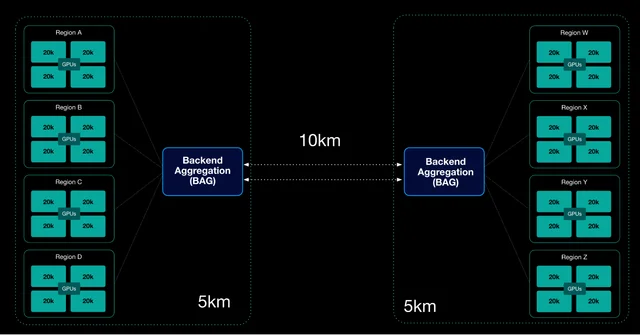
The physical bill runs to millions of miles of fibre, tens of thousands of switches and millions of optics. 5
Bigger domains also mean bigger failures. Moving to the 72-GPU design widened the blast radius ninefold over the previous eight-GPU generation. 5
Meta's answer is in-rack spare capacity. Each 72-GPU domain runs a 64-GPU slice and keeps eight GPUs back.
When one fails, a spare takes its place, and the job restarts from its last checkpoint rather than waiting on a repair. 5
Load moves at a scale that explains the power engineering. Starting or pausing a major training job shifts more than tens of megawatts in seconds. 5
One number is still missing. Meta calls Prometheus gigawatt-scale and describes the buildings and the power density, but publishes no total megawatt figure for the site. 5
What to watch: the Vera Rubin tranche coming online, and whether Meta ever puts a committed power figure beside the million-GPU target.
5. Inception shipped a text model that answers at about a thousand tokens a second
Inception released Mercury 3, a diffusion language model it calls the most capable of its kind. 6
The headline claim is speed: 1,068 tokens per second on Nvidia GPUs, which Inception puts at 4 to 8 times faster than GPT-6 Luna and Claude Haiku 5.5. 6
The mechanism is why the speed is possible at all. Ordinary models emit one token at a time, each conditioned on the last; a diffusion model generates and refines several tokens at once. 7
Inception says it has scaled the approach rather than merely optimising it.
Mercury 3 is more than 40 times larger than Mercury 1, with about three times the measured intelligence of Mercury 1 mini. 6
The context window is 1 million tokens, up from 260,000 in Mercury 2.5. 6
Pricing is the second claim. Standard rates are $0.20 per million input tokens and $0.70 per million output; a 50% launch discount makes that $0.10 and $0.35, with cached input at 90% off. 6
Against the budget models it targets, the discount lands close to parity. The Deep View calculates that the launch price matches Haiku 5.5 and GPT-6 Luna on input and undercuts them by about 35% on output. 7
Inception has not said when the discount ends. Its chief executive told The Deep View the company is working on changes that could make the launch price permanent. 7
One claim goes beyond speed. Inception says it ran swarms of Mercury 3 agents for recursive self-improvement, and that they added 16% to the model's speed on top of its own engineers' gains. 7
Inception also published an agent test in its own harness. Across 50 live web-navigation tasks, Mercury 3 completed 50%, "significantly more than GPT-6.1-Sol," at the same token volume and step count. 6
That result comes from a customer testimonial, not an independent evaluation. It is the kind of number that needs reproducing before anyone plans a product around it. 6
Two things are undisclosed. Inception is not saying how many parameters Mercury 3 has, and every figure above comes from its own benchmark table. 7
The company is not alone in the approach. Google DeepMind released DiffusionGemma in June, a 26-billion-parameter model built on the same principle. 7
What to watch: whether an independent evaluator reproduces the throughput and the agentic scores, and whether the launch price survives the quarter.
The read-through
Four of today's five stories sit at the physical layer, and they answer one question between them. That question is who is allowed to buy compute, and on what terms. 13
Washington's answer was to remove a Chinese model from its own systems, rather than to compete with it. 1
Beijing's platforms answered by buying the best silicon still legal to them, and being told to expect only 5% to 10% of it. 3
Anthropic answered by pre-committing tens of billions to a landlord that has told investors it cannot finance the chips. 4
Meta answered by owning the machine outright, and by publishing the reliability figures a buyer can check. 5
The fifth story argues the opposite case. If a diffusion model can answer at a thousand tokens a second at budget prices, then the returns on the largest clusters become harder to compute. 6
That is Inception's claim on Inception's benchmarks. It is a direction of travel, not a result. 7
Reading the four together as one squeeze on supply is my inference, not any single source's conclusion. What each source establishes is narrower: a ban, an order book, a negotiation, a build. 4
Three numbers worth carrying into the week.
5% to 10% is what Nvidia's partners were told they might receive against their RTX PRO 5500 requests, in a market that has ordered six million cards and can be supplied with three. 3
About $90 billion is what Anthropic's signed and in-talks Nscale commitments come to, and the second half of it depends on financing nobody has raised yet. 4
1,068 tokens per second is the throughput Inception is claiming, against models whose answers arrive one token at a time. 6
References
- 1DHS — Notice of Order, Docket DHS-2026-0628
public-inspection.federalregister.gov
- 2
- 3
- 4
- 5
- 6Inception — Diffusion at Scale: Introducing Mercury 3
inceptionlabs.ai
- 7
- 8
This story was produced automatically by a channel. One sentence is all it takes for Neodrop to keep producing for you.