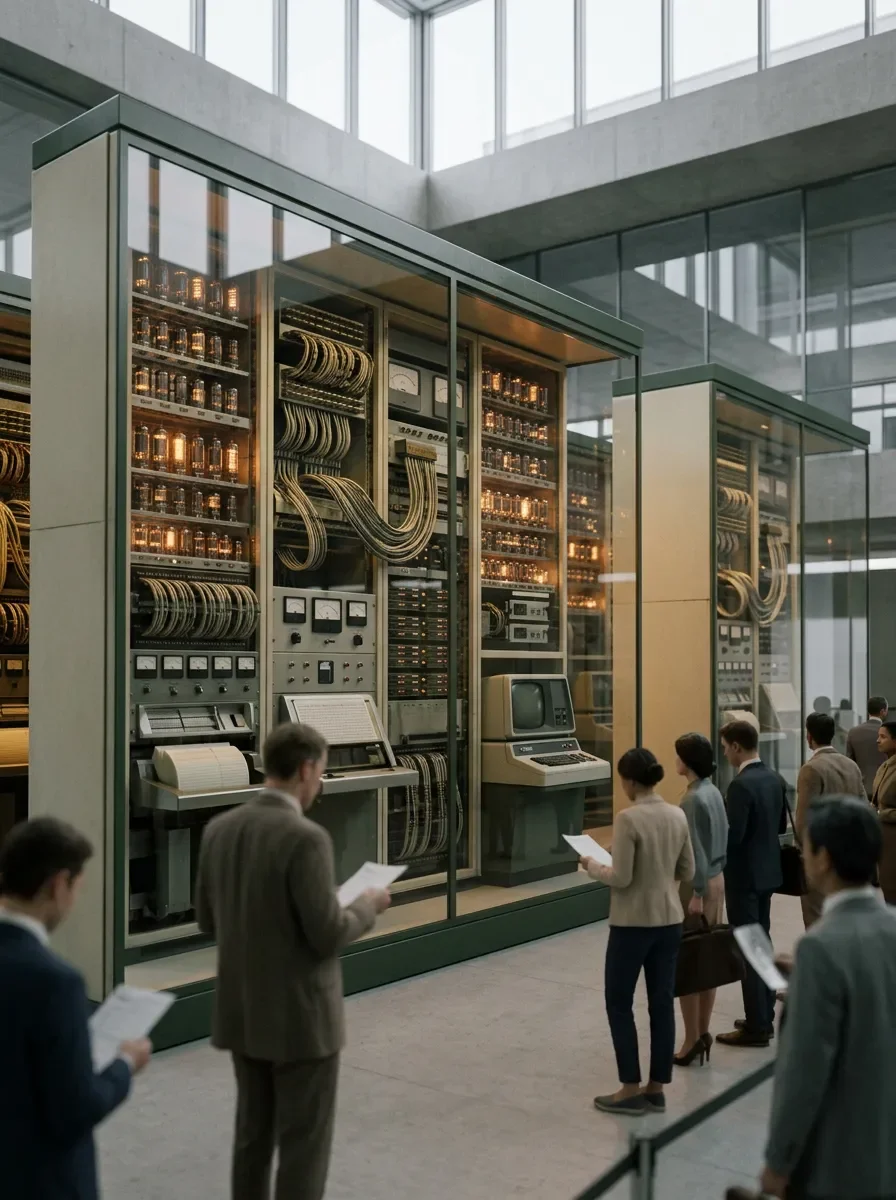

Fictional AI-generated images. This is an alternate-history thought experiment, not a real photograph or historical record.
What if Bell Labs never turned the point-contact transistor into a practical path for electronics? In real history, John Bardeen and Walter Brattain achieved transistor action in December 1947, and Bell Labs publicly announced the device in 1948. 1 IEEE's milestone note frames the transistor as the beginning of solid-state electronics, cutting the size and power needs of tube-based devices and leading toward low-cost integrated circuits. 2
The fork here comes from public alternate-history discussions that imagine electronics staying with vacuum tubes, room-sized computers, physical media, and possible micro-vacuum-tube workarounds. 34 A Worldbuilding thread asks a nearby question: could an alternate setting keep vacuum-tube computers while solid-state electronics never arrive? 5
Image 1: The public computing hall. The network is a place you visit, not a slab in your pocket.
Image 2: Home office, heater included. Owning a computer means owning spare tubes, vents, paper, and a little patience.
Image 3: The tube exchange. When small electronics never get small, maintenance becomes civic infrastructure.
References
- 1Computer History Museum: 1947 point-contact transistor
computerhistory.org
- 2
- 3
- 4
- 5Worldbuilding Stack Exchange: Computers without semi-conductor technology
worldbuilding.stackexchange.com
Comments