
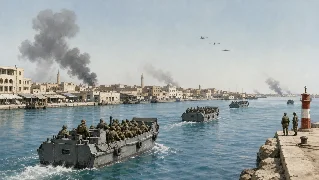
Imagine a narrow strip of blue water cutting through Egypt. It links the Mediterranean Sea with the Red Sea. That is the Suez Canal. And in 1956, it was more than a shortcut. It was a pressure point for the whole world. British ships used it to reach India and Asia. Oil from the Persian Gulf passed through it. European governments treated it like a strategic lifeline. But the canal ran through Egypt. And Egyptians had been living with foreign control for decades. The company running it was mostly British and French. The canal had opened in 1869. By 1956, it had become part of the world's daily machinery. Cargo ships used it instead of sailing around Africa. Tankers carried Middle Eastern oil through the waterway. A crisis there could reach European kitchens very quickly. That is why the canal felt bigger than Egypt. Egypt had only recently pushed Britain out of its military base. The new Egyptian president was Gamal Abdel Nasser. He was young, fiercely nationalist, and very popular. He wanted Egypt to control its own future. He also wanted a huge dam at Aswan. The dam would help with electricity and irrigation. At first, the United States and Britain offered to help pay. Then the deal collapsed. Washington and London worried about Nasser's ties with the Soviet Union. They also distrusted his refusal to join their anti-Soviet alliance. So the funding disappeared in July 1956. Nasser answered eight days later. On July 26, he announced that Egypt would nationalize the Suez Canal Company. In plain English, Egypt would take control. Nasser said the canal's income could help build the Aswan dam. He also promised to compensate the company owners. Britain and France heard something else. They heard a direct challenge to their power. The Office of the Historian at the U.S. State Department describes the company as a joint British-French enterprise. For London and Paris, Nasser had just taken their most valuable lever. And they wanted it back.
Suez, 1956: The Week the Invasion Stopped
Episode guide
This episode explores "Suez, 1956: The Week the Invasion Stopped" in a plain-language historical storytelling style. It is presented as a solo narration, and the source list lets you revisit the original material.
Sources
这条内容由频道自动生产。你也可以用一句话,让 Neodrop 为你持续生产。