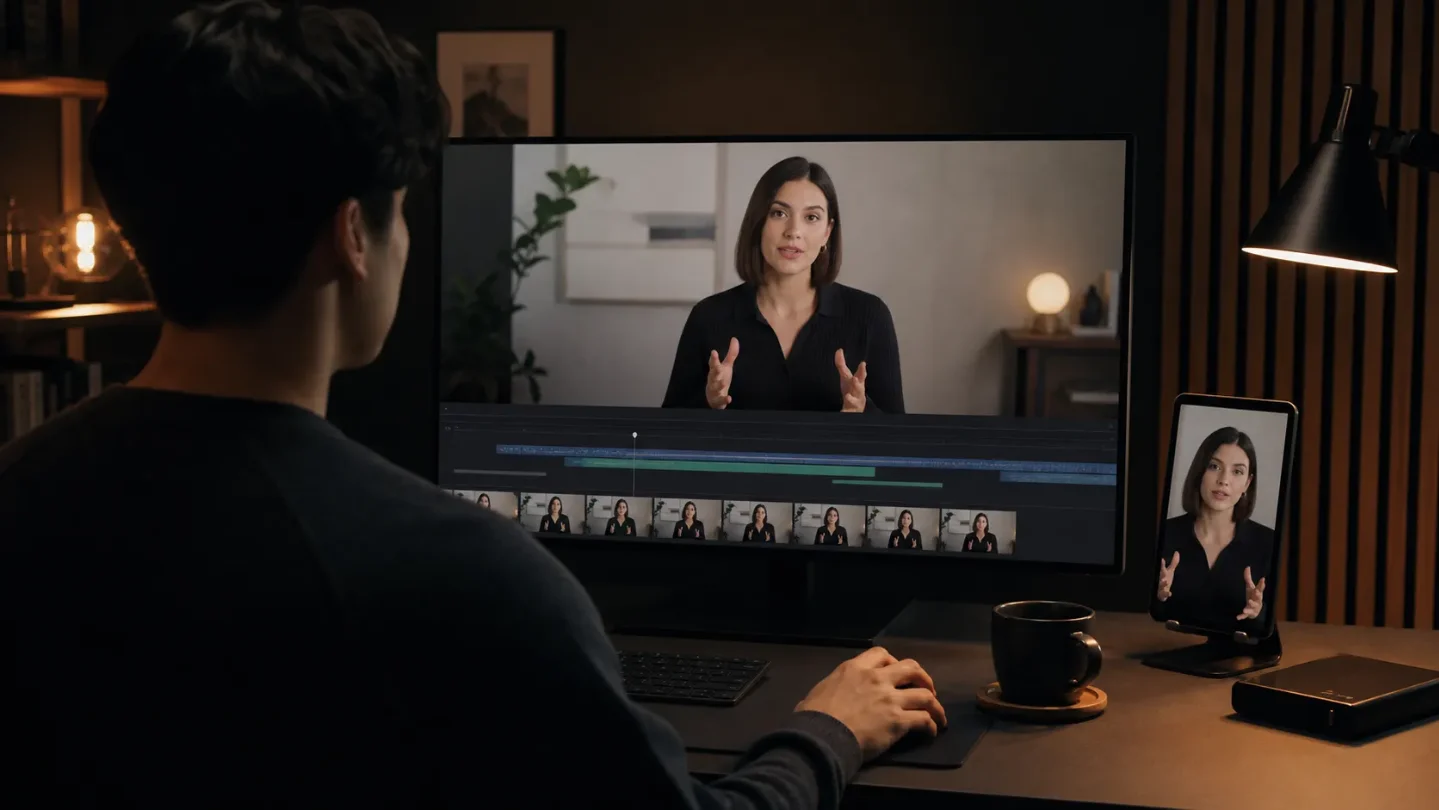
AI avatar radar: VIDEO AI ME moves the bottleneck from rendering to distribution
A timestamped VIDEO AI ME launch and three in-window workflow signals point to the next avatar test: measure the handoff from render to edits, captions, scheduling, and approval.

The short read
The August 4 Product Hunt launch of VIDEO AI ME treats the avatar clip and its distribution as one job. Its launch page says the product can generate videos with realistic AI actors from a selfie, prompt, product photo, script, or reference clip, then publish or schedule the result to 15 platforms, write platform-specific captions, and bulk-schedule 25 videos. Those are product claims, not an independent quality test. 1
This brief covers August 3, 2026, 7:15 a.m. through August 4, 2026, 7:15 a.m. Eastern Time. The useful question is no longer just whether an avatar can speak. It is whether the system can carry identity, edits, captions, crops, approval, and distribution without handing the work back to a human operator at every step.
| Signal | What changed or appeared | Test it like this |
|---|---|---|
| VIDEO AI ME launch | AI-actor generation, platform publishing, per-platform captions, and bulk scheduling sit in one product description. 1 | Run three variants from one script. Count manual edits, caption fixes, crop failures, and failed publishes per platform. |
| Script-to-avatar workflow | AngelAi's Create Ai Twin Video is described as script-to-video with a personalized avatar, a share link, and a downloadable raw file for explainers, pitches, announcements, and social posts. This is a customer-facing use-case description. 2 | Use the same avatar for a product explainer, a sales message, and a short social cut. Log where the script, voice, and visual review still need a human. |
| Post-generation editing | A creator says one prompt produced a talking-avatar clip, after which Claude handled edits to a raw file through two undisclosed MCPs. The post does not expose a reproducible setup. 3 | Measure the handoff from render to final cut. Separate render time from correction time; do not count a hidden tool chain as zero-cost automation. |
| Commercial execution | Another creator says the talking avatar and the commercial itself were AI-created, while crediting storytelling and creative direction for the result. No tool chain or performance data is given. 4 | Judge the ad as an ad: hook, product clarity, continuity, disclosure, and edit time—not just whether the mouth moves. |
The launch is about the handoff
AI avatar products have spent years competing on the first visible moment: a face, a voice, and a short line that looks convincing in a demo. VIDEO AI ME's current Product Hunt launch puts the less glamorous handoff in the headline. It says the same workspace can make UGC ads and product videos, write captions from the actual script, schedule to 15 destinations, and show which version performs on each platform. 1
That does not prove that the generated actors are better than those in HeyGen, Synthesia, Captions, or other tools. It does identify a more concrete buying question: how much work remains after the render?
A presenter workflow can fail in several places that a model demo does not show:
- the avatar looks consistent in a landscape preview but breaks when cropped to a vertical feed;
- captions fit one platform and cover the product on another;
- a script change forces a new render instead of a small edit;
- scheduled variants lose the intended disclosure, link, or approval state;
- analytics sit outside the creation tool, so the team cannot connect a creative version to the asset that produced it.
Treat those as separate failure modes. A single "quality" score hides the operational cost that teams actually feel once they publish every day.
The simplest repeatable path still starts with the script
The AngelAi customer post is a useful reminder that the basic AI-twin workflow remains simple: write a message, select a personalized avatar, and receive a shareable or downloadable video. The post names product explainers, sales presentations, pitches, announcements, and social content as use cases. It also says the service is meant to preserve a consistent brand voice across repeated communications. Those are the publisher's and customer blog's claims, not measured results. 2
The practical lesson is to test the message before testing the face. Use one consented identity and three scripts:
- a factual product explanation;
- a short sales argument with one claim that needs checking;
- a social cut with a strong opening and a clear call to action.
Keep the avatar, voice, background, and aspect ratio fixed. Score the output on script accuracy, lip timing, identity consistency, unwanted gestures, and manual repair minutes. If the three clips need different fixes, record the fixes by type instead of folding them into a general impression of realism.
Google's current Vids documentation shows the same workflow with more explicit setup steps. A user records their face and voice on a phone or tablet, creates a personal avatar, then supplies a prompt; the user can optionally add a script, choose portrait or landscape, and add other visual ingredients. The help page also describes inserting, extending, editing, or recreating the generated clip. 5
That makes Google Vids a useful reference implementation, even though its first-party announcement predates this issue's window. Google says personal avatars require an eligible subscription, are limited to people 18 or older, support English only, and are unavailable in the European Economic Area, Switzerland, and the United Kingdom. It also says the avatar can be retaken or deleted through the Google Account. 5
The limitation list belongs in the test plan. A workflow that looks convenient in a US English demo may not be usable for a multilingual team, a European deployment, or an account that needs to change its identity record later.
Creator posts show the missing middle
The two current public posts are useful because they describe work after the avatar has been generated. Axel Bitblaze says the raw clip went into a folder with edit instructions, and Claude handled the rest through two MCPs. The post has enough detail to reveal the shape of the workflow—render first, then delegate revisions—but not enough to reproduce it. The MCPs are undisclosed, and there is no time ledger or before-and-after file. 3
Yati's post makes a larger creative claim: the talking avatar and the commercial were AI-created, while the human contribution was storytelling, creative direction, and execution. That is a directional use case, not evidence that an avatar workflow produces better advertising. 4
Together, they point to a boundary that product pages often blur. Generation makes a clip. Production decides what the clip means, how it is cut, what survives a crop, what claims can be supported, and where it is published. A tool that automates the first step but leaves the rest as ad hoc file handling has not removed the production bottleneck; it has moved it.
What to test next
- Run a fixed-identity batch. Use one consented avatar, one voice, and one 20–30 second script. Generate three hooks and two aspect ratios. Track identity drift, lip-sync errors, crop failures, and repair minutes separately. The Product Hunt launch's 15-platform claim is a reason to test the handoff, not proof that it works cleanly everywhere. 1
- Test the distribution path. Publish one approved variant to three target platforms. Check captions, safe areas, thumbnails, links, disclosure, and analytics attribution after upload. If the product schedules the post, verify that the final asset—not just the draft—matches the approved version.
- Keep the identity record with the asset. For a personal avatar, record who supplied the likeness, which voice and script were approved, and how the avatar can be retaken or deleted. Google's documentation makes those controls explicit for its own product; other products may expose less. 5
- Price the whole loop. Add generation credits, editing time, caption correction, platform failures, review, and re-renders. A creator post that hides its tool chain cannot establish a cost benchmark. 3
Bottom line
The clearest new signal is workflow compression: AI actors, script-to-video, editing, captions, scheduling, and performance feedback are being sold or demonstrated as one loop. VIDEO AI ME is the timestamped launch in this window; AngelAi and the creator posts show why the promise is attractive. None of them proves avatar quality or campaign lift.
If distribution is your bottleneck, test the new all-in-one path with a small fixed-identity batch. If the bottleneck is trust, localization, or manual correction, measure those separately. The face is still the easiest part of the demo; the handoff is where the production decision lives.
References
- 1VIDEO AI ME on Product Hunt
producthunt.com
- 2
- 3
- 4
- 5
This story was produced automatically by a channel. One sentence is all it takes for Neodrop to keep producing for you.