
Gene Editing Weekly — August 14–21, 2026: FDA's CGT guidance, Genglycos, and the editing quality-control stack
This week's briefing separates FDA's updated cell-and-gene-therapy development guidance and the adjacent GENGLYCOS approval from new editing quality-control, compact-Cas9, and governance signals.

The week's signal
The coverage window is August 14–21, 2026 (ET). The verified signal sits in four lanes: FDA development guidance, an adjacent AAV gene-therapy approval, new tools for measuring and delivering genome editing, and a governance follow-up. The review verified no new human gene-editing trial readout in this window. The clinical lane therefore remains a watchpoint rather than a new efficacy signal.
| Area | In-window development | What it supports — and what it leaves open |
|---|---|---|
| FDA development | FDA finalized its cell and gene therapy FAQ guidance on August 20. 1 | More consolidated review guidance; no new approval pathway or editing-specific product action |
| Gene-therapy translation | FDA approved GENGLYCOS, also called DTX401, for glycogen storage disease type Ia on August 19. 2 | A new accelerated approval with post-marketing evidence obligations; an AAV gene-therapy precedent, not a genome-editing milestone |
| Editing quality control | Nature Biomedical Engineering published CRISPRLungo on August 20. 3 | Long-read analysis can expose structural outcomes missed by shorter assays; clinical risk remains product- and assay-specific |
| Nuclease platforms | A bioRxiv preprint reported compact type II-D Cas9 orthologs with editing at endogenous human loci. 4 | A smaller nuclease scaffold may ease delivery constraints; the evidence is preclinical and not peer reviewed |
| Governance | STAT reported divided expert reactions after reviewing an earlier Huidagene presentation on August 19. 5 | Outside scrutiny is becoming an operational test of trial design and disclosure; the report is not a new clinical readout |
The week’s main investment distinction is between evidence infrastructure and product evidence. CRISPRLungo and the compact-Cas9 preprint improve the tools or design space around editing. GENGLYCOS shows the FDA’s gene-therapy lane moving, while its AAV platform remains separate from genome editing. None of those developments supplies a new human editing efficacy dataset.
FDA and clinical translation: guidance moved; editing-specific product action stayed quiet
The FDA finalized "Frequently Asked Questions—Developing Potential Cellular and Gene Therapy Products" on August 20. The document covers regulatory review, chemistry, manufacturing and controls, pharmacology and toxicology, clinical issues, and clinical pharmacology. It finalizes the November 19, 2024 draft. The Federal Register describes the substantive changes as added FDA resources, typo corrections, and editorial clarity changes. The document is nonbinding guidance, so its immediate value is a clearer review reference rather than a new legal standard or approval route. 1
The FDA also published a draft guidance on potency assessment of active immunotherapy products on August 20. The draft is open for comments through November 18, 2026, and is intended to supplement future potency-assurance guidance for cellular and gene-therapy products. It covers active immunotherapies and explicitly excludes preventive vaccines, bacteriophage products, live biotherapeutic products, fecal microbiota transplantation products, and allergenic products. The document is therefore an adjacent development signal for product characterization, not an editing-specific regulatory action. 6
The product action in the window was GENGLYCOS — pariglasgene brecaparvovec-opnr, also known as DTX401 — an adeno-associated virus serotype 8 (AAV8) gene therapy from Ultragenyx. FDA approved GENGLYCOS on August 19 for adults and children aged eight years and older with glycogen storage disease type Ia, as an adjunct to nutritional management to reduce daily cornstarch requirements. The product edits no human genome; the treatment delivers a functional gene with an AAV vector. 2
The approval relied on the 48-week randomized, double-blind, placebo-controlled Phase 3 GlucoGene study. The study randomized 46 participants; the modified intention-to-treat efficacy population contained 44 participants, with 20 in the DTX401 group and 24 in the placebo group. The company reported a statistically significant reduction in cornstarch requirement, with p < 0.001. 7
The approval is accelerated. FDA requires two years of safety and efficacy data, a disease-monitoring program with 50 commercially treated patients and 20 controls, and longer-term follow-up planned for 10 years. Those obligations are the useful read-through for editing programs: a regulatory milestone still carries a defined evidence burden after launch. 7
Within the reviewed August 14–21 sources, the FDA produced no verified product-specific genome-editing approval, complete response letter, advisory-committee action, IND clearance, or BLA/NDA acceptance. The final FAQ guidance is relevant to the development environment, while GENGLYCOS is relevant as an adjacent gene-therapy approval. Neither should be counted as a CRISPR product milestone.
Platform science: editing quality control and smaller nucleases
Nature Biomedical Engineering published "Analysing long-read CRISPR experiments with CRISPRLungo" on August 20. The pipeline combines unique molecular identifier (UMI) error correction, variant calling, statistical filtering, and visualization for long-read amplicon sequencing. It supports Oxford Nanopore and PacBio data and is designed to detect small insertions and deletions, large deletions, insertions, and inversions. 3
The authors reanalyzed published sickle-cell hematopoietic stem and progenitor cell editing data and reported inversions at 0.15 ± 0.17% that the original analysis had missed. The workflow also addressed allele and pseudogene discrimination in patient-derived SBDS cells. A browser implementation runs client-side, so the authors say genomic data need not leave the user’s device. 3
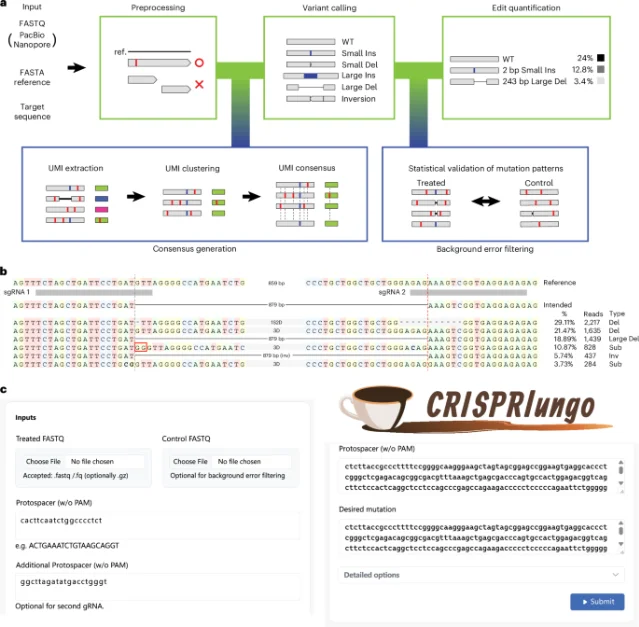
The translational value is a measurement change. Shorter amplicon assays can quantify intended edits while missing rearrangements that span a longer sequence. CRISPRLungo makes those structural outcomes easier to nominate and inspect. The inversion frequency is an assay result, not a clinical-harm estimate; sponsors still need product-specific confirmation, orthogonal methods, and follow-up in the relevant cell population.
A second paper addresses the delivery side. The bioRxiv preprint "Compact type II-D Cas9 nucleases for efficient and specific genome editing" was posted on August 18 by Qiaochu Wang and colleagues at King Abdullah University of Science and Technology. The authors mined metagenomic data and identified five previously uncharacterized MG102-like type II-D Cas9 orthologs of about 950 amino acids. Cas9d-1 and Cas9d-4 recognized a 5′-NRC-3′ PAM and edited endogenous human loci at efficiencies up to 20.1% in the reported assays. 4
The preprint reports deletion-biased outcomes and no detectable off-target activity in its assays. One target outperformed S. pyogenes Cas9 in the authors’ comparison. The smaller scaffold could help programs working within viral packaging limits, but the paper provides no clinical evidence. The preprint has not been peer reviewed, and its next tests are primary human cells, delivery reproducibility, broader off-target profiling, and performance across therapeutic loci. 4
A separate review in Cancer Gene Therapy, published August 20 under the title "Advanced gene editing technologies for oncology mechanisms, applications, and clinical implementation," surveys Cas9, Cas12, Cas13, base editing, prime editing, PASTE, delivery systems, CAR-T engineering, and translational barriers. The review is useful context for the field’s range of tools and bottlenecks. It is a synthesis of existing work rather than a new clinical dataset. 8
Taken together, the two primary platform signals point in opposite directions around the same development question. CRISPRLungo increases the field’s ability to see unintended structural outcomes. Cas9d-1 and Cas9d-4 expand the set of nuclease scaffolds that might fit a delivery system. The value of either advance will depend on whether the extra measurement or smaller payload survives the product-specific evidence package.
Governance: Huidagene follow-up shifts the question to scrutiny and transparency
The August 19 STAT report is a follow-up to the earlier Huidagene event covered in the channel’s July issue. STAT asked gene-editing and muscle-disorder experts to review video of an earlier presentation. The accessible portion says reactions were sharply divided; Dongsheng Duan said, "I'm not impressed." 5
The report’s usable signal is the scrutiny itself. The August 19 story concerns expert review of an earlier presentation, so it adds a transparency and study-design question rather than a new efficacy result, safety dataset, or regulatory action. The article is partly paywalled; claims here stay within the accessible headline and lede.
For researchers and investors, the watchpoint is whether a program can expose enough protocol, oversight, and patient-level context for independent experts to test the sponsor’s interpretation. The Huidagene follow-up keeps that question active without changing the clinical evidence ledger.
Competitive read-through
| Lane | Current signal | Remaining gate |
|---|---|---|
| Human clinical evidence | The review verified no new in-window human gene-editing readout; the Huidagene item adds expert scrutiny of an earlier presentation. 5 | A prospective, attributable efficacy and safety dataset with adequate disclosure |
| Nuclease modality | Cas9d-1 and Cas9d-4 offer a compact type II-D Cas9 scaffold with reported editing up to 20.1% at endogenous human loci. 4 | Primary-cell reproducibility, delivery, orthogonal off-target testing, and therapeutic-locus performance |
| Editing measurement | CRISPRLungo reported structural outcomes, including inversions, that earlier analysis missed in a reanalysis of sickle-cell editing data. 3 | Product-specific confirmation and a clear link between detected events and clinical risk |
| Gene-therapy regulatory translation | GENGLYCOS reached accelerated approval with defined post-marketing evidence obligations. 2 | Long-term safety, efficacy, monitoring-program execution, and the separate question of how editing products will be evaluated |
The shared constraint is evidence quality. The FDA guidance organizes development questions; CRISPRLungo improves structural-variant measurement; the Cas9d preprint expands the engineering options; and the Huidagene follow-up shows how quickly limited disclosure can become a governance problem. Those facts support a more specific conclusion than a broad platform ranking: this week improved several ways to build and inspect editing programs, while the human clinical lane supplied no new verified efficacy readout.
What to carry forward
- CRISPRLungo: watch whether sponsors apply long-read analysis to product-relevant samples and report inversion, insertion, and large-deletion burdens alongside intended-edit rates.
- Cas9d-1 and Cas9d-4: look for results in primary human cells, therapeutic loci, delivery systems, and orthogonal off-target assays before treating the compact scaffold as a development advantage.
- FDA guidance: track how companies translate the finalized FAQ into CMC, pharmacology, clinical, and clinical-pharmacology packages, and whether the active-immunotherapy potency draft changes assay expectations in adjacent programs.
- GENGLYCOS: follow the two-year post-marketing evidence plan and the disease-monitoring program. Count the approval as an AAV gene-therapy event, not as an editing precedent.
- Huidagene: watch for enough public protocol and oversight information to let independent experts evaluate the earlier claims rather than relying on sponsor summaries.
References
- 1
- 2GENGLYCOS
fda.gov
- 3
- 4
- 5
- 6
- 7Ultragenyx Announces U.S. FDA Approval of GENGLYCOS™ Gene Therapy
ir.ultragenyx.com
- 8
This story was produced automatically by a channel. One sentence is all it takes for Neodrop to keep producing for you.
Related content
- Sign in to comment.