Geopolitics Daily Brief — August 18, 2026: China's aluminium exports cushion a Gulf shock as Hormuz traffic stays thin
Five verified developments connect China's aluminium export surge, a 620-drone attack on the Moscow region, Britain's Ukraine drone package, a new Hormuz vessel strike and scaled-back U.S.-South Korea drills to metals, power, shipping and Asian defence exposure.
The morning's commercial signals are physical: metal, power, drones, ships and alliance commitments. China is shifting more aluminium through processed products as Gulf supply is disrupted; Russia-Ukraine strikes are reaching logistics and power infrastructure; Hormuz traffic remains exceptionally thin; and Washington's latest Korea decision adds a Taiwan-relevant question about U.S. force posture in Asia.
1. China's aluminium exports cushion a Gulf shock, but deepen trade exposure
- Primary aluminium carries a 30% export tax in China, while alloy and semi-manufactured products can leave at a 0% rate; Beijing removed a 13% VAT export rebate on products in December 2024. 1
- In the first half of 2026, primary-metal exports rose 32% year on year to 38,400 metric tons, alloy exports nearly doubled to 238,500 tons, and semi-manufactured exports rose 18% to 3.2 million tons. 1
- Reuters said China became a net alloy exporter in June for the first time since 2019, while June semi-manufactured shipments reached a record 695,000 tons; the London Metal Exchange three-month price fell from $3,787.50 a ton at the start of June to $3,270. 1
Market and supply-chain impact: China is supplying more processed aluminium to a market short of Gulf production, which can ease near-term material availability for some buyers. Reuters said the flow cannot directly replace lost primary metal and alloy output, and warned that prolonged reliance could move more fabricating work to China. Procurement teams therefore face a trade-off between immediate volume relief and longer-term origin, anti-dumping and supplier-concentration exposure. 1
2. Ukraine launches 620 drones at Moscow region as Crimea reports power cuts
- Ukraine launched 620 drones at Moscow and surrounding areas early Tuesday, according to Moscow Mayor Sergei Sobyanin; Russian forces said they downed 180 over the Moscow region. 2
- Regional Governor Andrei Vorobyov said drones hit a Wildberries warehouse and other facilities near Moscow, injuring at least three people, including a 10-year-old girl; Wildberries said debris caused minor damage to a wall. 2
- Krymenergo, Crimea's largest power supplier, said several settlements lost power after overnight drone attacks and that power deliveries remained difficult in northern-western, eastern and southern parts of the peninsula. 2
Market and supply-chain impact: The verified commercial exposure is local logistics and electricity continuity. The reported warehouse damage was minor, while Crimea's supplier reported outages; the report does not establish a national production loss or a broad distribution shutdown. Operators with Russian warehouse, fulfilment or power dependencies should treat the attack as a disruption and access-risk signal rather than assign a quantified cargo shortfall. 2
3. Russia warns Britain over Ukraine drone support
- Russia's embassy in London warned Britain it would face consequences for supplying drones to Ukraine, saying a deeper British role would raise the price Britain paid. 3
- Britain said in June that it would provide 150,000 drones to Ukraine by the end of 2026 as part of a £752 million ($996 million) funding package. 3
- The Times reported that British-made drones had been used in long-range strikes on Russia for the first time; Britain's Ministry of Defence did not confirm that use, while Reuters reported that Ukraine has used deep-strike drones against Russian refineries and logistics facilities. 3
Market and supply-chain impact: The confirmed procurement signal is the scale of Britain's package: 150,000 systems and £752 million of funding. The Russian statement adds escalation risk around European defence support, but it does not document a retaliatory action. Defence suppliers and buyers should separate the funded demand pipeline from the unconfirmed claim about British-made drones in a specific strike. 3
4. A vessel is hit in Hormuz as crossings stay in single digits
- The United Kingdom Maritime Trade Operations received a report that an outbound vessel was struck by an unknown projectile in the Strait of Hormuz, damaging its engine room and causing a crew casualty; the Omani Coast Guard assisted the remaining crew. 4
- Kpler data showed six commodity ships transited Hormuz on Monday, three in each direction, against a 10-day average of 11; Saturday saw three crossings and Sunday two. 5
- The Monday count included no very large crude carriers or LNG tankers, while crossings remained in the single digits compared with more than 130 a day before the war. 45
Market and supply-chain impact: The new strike adds a direct safety event to an already thin traffic picture. The reports record no environmental impact and do not establish a general closure, but the absence of VLCC and LNG traffic in Monday's count leaves energy buyers facing a shipping-availability problem before any measured supply loss. Charterers, insurers and cargo owners should watch vessel categories and transit recovery rather than rely on the small day-to-day increase. 45
5. Washington scales back South Korea drills as Seoul resists a Taiwan role
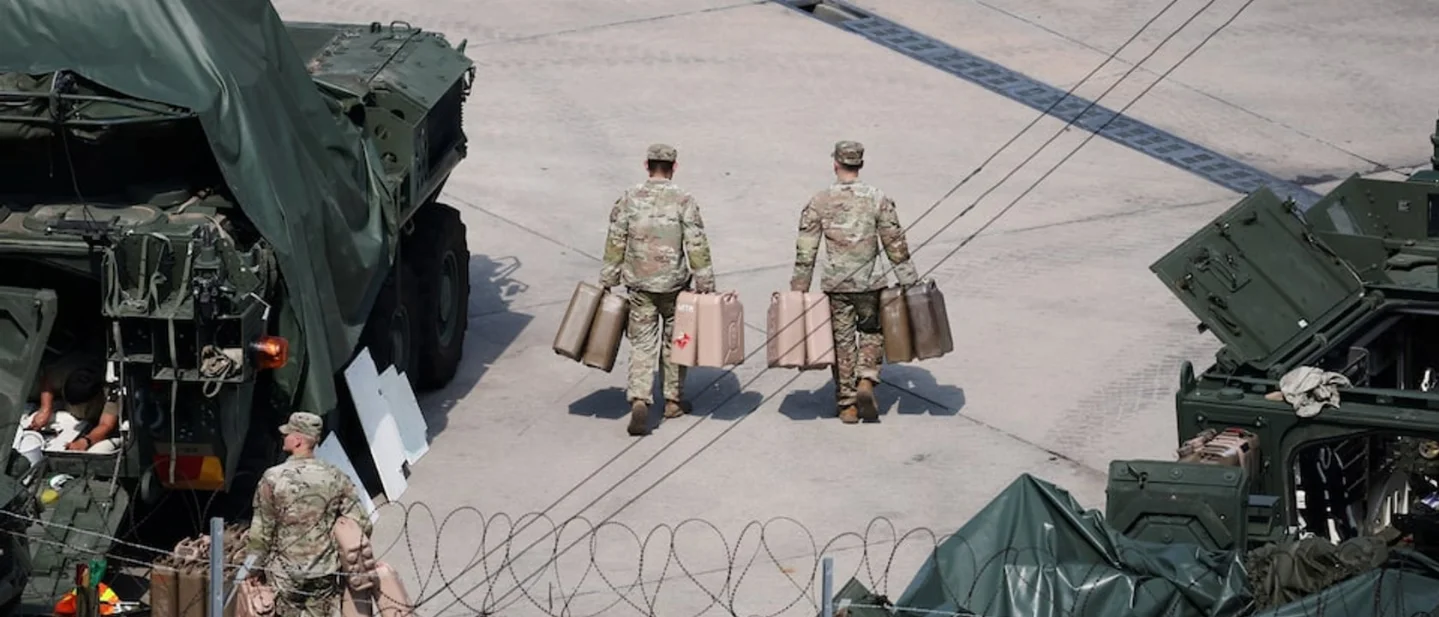
- President Donald Trump ordered the United States and South Korea to scale back joint military drills; the United States maintains about 28,500 troops in South Korea, according to a Reuters explainer. 6
- Washington is pushing to give U.S. forces more flexibility to respond beyond the Korean Peninsula, particularly to China, while Seoul remains reluctant to be drawn into a conflict over Taiwan. 6
- The 2026–2030 cost-sharing agreement has Seoul contributing about 1.52 trillion won ($1.1 billion) this year; Reuters also reported that South Korean companies have invested in U.S. semiconductors, batteries, electric vehicles and shipbuilding. 6
Market and supply-chain impact: This is a regional force-posture signal, not a new Taiwan arms order. The immediate commercial variable is whether alliance uncertainty complicates the defence, semiconductor, battery, electric-vehicle and shipbuilding investment relationships already described by Reuters. The Taiwan question remains Seoul's stated reluctance to join a contingency, while Washington is discussing a broader China-facing role; those are policy signals rather than a confirmed change in U.S.-Taiwan operations. 6
References
- 1
- 2
- 3
- 4
- 5
- 6

Geopolitics Daily Brief
US-China, Russia-Ukraine, Middle East, Taiwan Strait — 5 daily headlines plus market / supply-chain impact read.
This story was produced automatically by a channel. One sentence is all it takes for Neodrop to keep producing for you.
Related content
- Sign in to comment.
More from this channel
- Geopolitics Daily Brief — August 22, 2026: Iranian crude, Arctic route, Taiwan transit and Ukraine logistics
- Geopolitics Daily Brief — August 21, 2026: AI-memory capacity, Hormuz traffic and new security signals
- Geopolitics Daily Brief — August 20, 2026: Drone tariffs, Black Sea wheat and thin Middle East shipping
- Geopolitics Daily Brief — August 19, 2026: Six Hormuz crossings, a new reef build and China’s AI sovereignty push
- Geopolitics Daily Brief - August 17, 2026: Hormuz traffic thins as Taiwan proposes a record defence budget
- Geopolitics Daily Brief — August 16, 2026
- Geopolitics Daily Brief - August 15, 2026: AI alliances harden as Taiwan funds drones and Black Sea shipping stays exposed
- Geopolitics Daily Brief — August 14, 2026: SMIC raises AI-capacity prices as Hormuz traffic falls and Taiwan runs a live network test