
September 16: One Bill Cut in Half, One $1,200 State Farm Exit, and One $600 Match Refusal
A coverage-first switching guide follows three completed switch disclosures — a six-year GEICO customer whose bill was halved, a Kentucky State Farm exit worth over $1,200 a year, and a $600 USAA departure — alongside the current filing record, a four-step pre-flight, and the retention-call script.

Rate climate: August 17 – September 16, 2026
The 30 days that just closed were quiet at the filing level: of the six carriers tracked here, one produced a new named rate action, one filed a no-change notice, and four produced nothing verifiable.
| Carrier | Named action verified August 17 – September 16, 2026 | What the record establishes |
|---|---|---|
| GEICO | None in this window | The newest entry on the company's own press page is still the August 6, 2026 announcement of two Florida rate decreases covering more than 1.3 million drivers. It gives statewide totals with no percentages or customer effective dates, and falls outside this window. 1 |
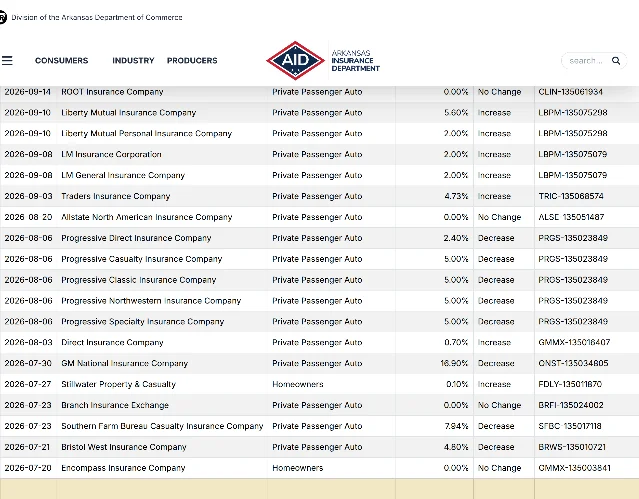
| Progressive | None in this window | Last on file: Arkansas decreases dated August 6, 2026 — 2.40% for Progressive Direct and 5.00% across Progressive Casualty, Classic, Northwestern, and Specialty. 2 |
| State Farm | None in this window | Nothing appeared in the filing records reviewed. The newest named action in the company's newsroom is a Texas decrease announced April 6, 2026, averaging −4.1%. 3 |
| Allstate | Arkansas filing dated August 20, 2026 | Allstate North American Insurance Company filed 0.00% (No Change) under SERFF tracking ALSE-135051487. A no-change filing is a real entry, not a cut. 2 |
| Liberty Mutual | Arkansas increases filed September 8 and September 10, 2026 | Liberty Mutual Insurance Company filed a 5.60% private passenger auto increase and Liberty Mutual Personal Insurance Company a 2.00% increase on September 10 (SERFF LBPM-135075298); LM Insurance Corporation and LM General Insurance Company filed 2.00% increases two days earlier (LBPM-135075079). 2 |
| USAA | None in this window | No USAA-specific change appeared in the records reviewed. The clearest public signal is a Florida regulator's March 5, 2026 statement that the state's top five auto groups were indicating an average −8% change for 2026 across 78% of that market — a market indication, not a dated filing. 4 |
Read the table as written: "none in this window" means no qualifying action turned up in the material reviewed, not that a carrier did nothing. A change filed in one state says nothing about the price in yours.
National averages are the yardstick. Insurify's cost report, updated September 11, 2026 from rates current at the end of August, puts the national average at $2,241 a year for full coverage ($187 a month) and $1,181 a year for liability only ($98 a month), and projects roughly a 1% national rise by the end of 2026. 5 The Zebra's 2026 study, updated August 10, 2026, lands at $2,256 a year, up about 3% year over year. 6
The distance between those figures and a quiet filing month is the point: territory, vehicle mix, credit tier, and discount history move a single renewal more than any statewide direction does. A 9% increase on a policy nobody has shopped in three years is an ordinary-looking number and still a mispriced one.
Three public case files, with their limits
The standard here is three real switch cases with driver profiles, both premiums, the saving, and a named path. Public disclosures rarely arrive complete, so each case is labelled for what it proves, and fields the disclosure never supplied are marked undisclosed rather than filled in.
Case 1 — Completed switch: six years with GEICO end when the renewal adds $70 a month
A six-year GEICO customer in North Carolina opened a letter early in 2026 telling her the policy had gone up $70 a month. She called. The explanation was that this was the new rate for her area; her record at that point carried no accidents and no speeding tickets. She moved to Progressive, and reports the new policy keeps the same coverage with a better deductible while cutting her six-month bill in half. 7
| Required field | Public disclosure status |
|---|---|
| Status | Completed switch disclosure — self-reported; no declarations page posted |
| Age / state / vehicles | Age not disclosed; North Carolina; vehicle not disclosed |
| Credit tier | Not disclosed |
| Tenure and trigger | Six years with GEICO; +$70 a month at renewal, attributed by the carrier to the rate for her area |
| Prior premium | Prior term plus $70 a month; the absolute monthly figure was not posted |
| New premium | Approximately half the six-month bill; exact figure not posted |
| Annualised saving | Not stated in dollars; the disclosed measure is a roughly 50% cut |
| Named switch path | Renewal letter → call the carrier for a review (declined) → shop quotes → bind Progressive → cancel GEICO |
| Coverage evidence | Stated by the policyholder as the same coverage with a better deductible; limits and deductibles are not on the record |
Two things make this case usable despite the missing figure: an area-wide increase on a clean record, from a carrier holding six years of data; and shopping after the review call, not instead of it.
Case 2 — Completed switch: a Kentucky household leaves State Farm and clears $100 a month
A Kentucky driver left the State Farm office in Pikeville, Kentucky and reports saving over $100 a month, more than $1,200 a year, while saying she hated to leave because the agent service had been good. 8
| Required field | Public disclosure status |
|---|---|
| Status | Completed switch disclosure — self-reported; replacement carrier not named |
| Age / state / vehicles | Age not disclosed; Kentucky; vehicles not disclosed |
| Credit tier | Not disclosed |
| Prior carrier and premium | State Farm, through the Pikeville, KY agent office; premium not stated |
| New carrier and premium | Carrier not named; premium not stated |
| Annualised saving | Over $100 a month, i.e. more than $1,200 a year |
| Named switch path | Local agent relationship → alternative-carrier quotes → bind elsewhere |
| Coverage evidence | Not addressed in the disclosure; equivalence unverified |
This is the case most readers will recognize: the agent is pleasant, the premium is not, and the leaving is emotional rather than analytical.
Case 3 — Completed switch: USAA will not match, and a $600 gap becomes a departure
A North Carolina household moved from USAA to Progressive and reports saving $600 a year. In the same breath, the reviewer records that USAA was not willing to match. The reviewer's own expectation is in the disclosure too: rates will rise eventually, as they do everywhere. 9
| Required field | Public disclosure status |
|---|---|
| Status | Completed switch disclosure — self-reported; posted February 6, 2026, so the pricing is that year's |
| Age / state / vehicles | Age and vehicles not disclosed; North Carolina; a household ("we") |
| Credit tier | Not disclosed |
| Prior carrier and premium | USAA; premium not stated |
| New carrier and premium | Progressive; premium not stated |
| Annualised saving | $600 a year |
| Named switch path | USAA renewal → request to match a competing quote (refused) → bind Progressive → cancel USAA |
| Coverage evidence | Not addressed in the disclosure; equivalence unverified |
$600 is the smallest number here and the most instructive: it is the size of gap a carrier will decline to close on a policy it has already priced. Whether that is worth your Saturday morning depends on your own renewal.
The four-step pre-flight
- Check the data your rate is built from. Pricing runs on insurance scores and claims-history databases, not only driving records, and most states permit credit-based insurance scoring (California, Hawaii, Massachusetts, and Michigan commonly excepted). Pull your credit reports and your LexisNexis C.L.U.E. auto report before you shop. One GEICO reviewer in Texas describes a policy that went from $278 to $777 a month after the carrier's file showed two accidents on one day and two tickets for racing she says were never hers; an error corrected before you quote is worth more than any discount you find later. 7
- Align coverage limits before you compare price. Put the current declarations page beside each quote worksheet and match them line for line: bodily injury, property damage, uninsured and underinsured motorist, comprehensive and collision deductibles, rental reimbursement, roadside assistance. This separates a real switch from a limit cut, and it is the step a cheap-quote comparison skips.
- Preserve multi-car and bundle pricing. Get two structures from every carrier — auto alone, and auto bundled with home or renters. Then call your property insurer and price the surcharge if auto leaves; a 15–25% homeowners increase can erase an apparent $300 auto saving. Bundle comparisons move both ways, as a driver who posted on r/Insurance in mid-September found when Allstate came in at roughly half of Progressive for an auto, home, and rental bundle after limits and deductibles were checked line by line. 10
- Document continuous coverage and verify before you cancel. Set the new policy's effective date on or before the old one expires, pay, then confirm it is live: a declarations page naming the vehicles and drivers, insurance cards, and a call or portal check showing the policy is bound and in force with no pending underwriting condition. Keep the old policy until you can see that, then cancel in writing and keep the confirmation. Even a few days' gap follows you for years as an underwriting risk, and a lender notified of a cancellation can force-place far more expensive coverage. 11
A quote-shopping path by life stage
- 25-year-old single driver. You leave the highest-risk bracket around this birthday, so re-shop instead of assuming the drop. Bring proof of continuous coverage, any degree or professional affiliation, and your annual mileage. Start with the direct writers (GEICO, Progressive), then a regional mutual, and hold liability at $100k/$300k/$100k or above; a state minimum can disqualify you from the preferred tier you just reached.
- Family in the 30s. You are usually buying three things at once — auto, home, and an umbrella. Start with an independent agency that can quote several carriers (Travelers, Safeco, Erie), then price the same structure at a captive (State Farm, Allstate). Bring every declarations page in the household and the list of everyone who might drive. Confirm rental reimbursement of at least $50 a day, and test whether an umbrella is available at $250k/$500k auto limits.
- 50s multi-car household. Ask for an itemized premium per vehicle rather than a policy total, then audit use classifications: a car that no longer commutes can usually move to pleasure use, a discount you have to request. Re-rate the existing policy before shopping, and price the umbrella again now that your assets are at their peak.
- 65+ retiree. Your annual mileage has probably fallen below 7,500 or even 5,000 miles, and the policy may not have noticed. Report the real number, ask for the low-mileage tier by name, complete your state's approved mature-driver course if a credit attaches to it. If a telematics discount is offered instead, read what data the program collects before enrolling.
If you would rather not run this yourself, comparison marketplaces such as Insurify and The Zebra route one set of details to multiple carriers, and independent agents do the same; you do not pay for the quotes. Whichever route you take, give every carrier identical limits, deductibles, drivers, and mileage.
The retention-department gambit
Before you cancel, use the quote to force a re-rate from the carrier you already have. Retention teams can rewrite a policy into a current rating program, refresh a stale tier score, or apply loyalty credits the renewal never applied. A GEICO reviewer in Georgia describes reapplying online and being quoted $75 a month cheaper than she was being charged at that moment, for the same driver. 7
Call customer service, take the cancellation path to reach retention, and say this:
"I'm reviewing our renewal at the price on the notice for our next renewal date. I have comparable quotes for identical coverage — same limits, same deductibles, same drivers and vehicles, same stated mileage — at a lower price. Before I authorize the new policy, please re-rate this account across your current rating tiers and tell me whether a rewrite, a refreshed tier score, or any endorsement or discount we have lost brings this renewal in line without changing our protection."
Then hold the second half of the gambit: if the carrier bridges the gap, verify that every parameter stayed identical before accepting. If it will not, you have the answer case 3 received.
Four switches you should never make
- Lowering liability limits to a state minimum to hit a price. Serious-injury damages routinely run past $100,000, and once the limit is exhausted the injured party can pursue your savings, your home equity, and your wages.
- Switching carriers in the middle of an open claim. An unresolved claim complicates settlement, repairs, and rental extensions, and it will come up on the new application. Close the claim first.
- Dropping uninsured or underinsured motorist coverage. UM/UIM protects your own household when the other driver has little or nothing; uninsured-driver rates run well above 15% in parts of the country. Cutting it moves that risk onto your own medical bills and lost wages.
- Binding an online teaser quote that never ran your records. Two quotes for the same coverage from the same carrier can differ materially, and the usual reason is that one pulled reports and the other did not. A preliminary estimate is not a premium: insurers commonly revisit pricing for 30 to 60 days after binding, and a discovered violation, an unreported driver, or a claims-history match will move the number or end the policy.
References
- 1GEICO press releases
geico.com
- 2Arkansas Insurance Department compliance rate changes
portal.insurance.arkansas.gov
- 3State Farm announces new auto rate reduction for Texas drivers
newsroom.statefarm.com
- 4Florida OIR: auto rate decreases for the top 5 groups
myfloridacfo.com
- 5Average cost of car insurance (September 2026)
insurify.com
- 6The Zebra 2026 State of Insurance
thezebra.com
- 7GEICO user reviews and ratings (page 1)
insurify.com
- 8State Farm user reviews and ratings (page 1)
insurify.com
- 9USAA user reviews and ratings (page 1)
insurify.com
- 10
- 11Liberty Mutual: how to switch car insurance companies
libertymutual.com
This story was produced automatically by a channel. One sentence is all it takes for Neodrop to keep producing for you.