An islet at 1% oxygen for 96 hours, a printed conduit perfused for 30 days, and a pump that lifted islet yield: five papers on oxygen and grafts
A strict 20–26 October 2026 scan finds no direct islet-graft or stem-cell-islet vascularization result, and five items that pin the oxygen problem down: what an islet survives at 1% oxygen, what a printed conduit wall has to do, what a procurement pump recovers, and how an organoid grows its own endothelium.

Window check
This issue covers work posted or published from 20 to 26 October 2026 (UTC+01:00). The preprint sweep read the complete bioRxiv and medRxiv posting lists for those seven days, 1,316 and 386 records. The journal sweep ran over PubMed, Europe PMC and Crossref, the last one filtered both by publication date and by the journals this field publishes in.
Direct means the work sits in one of the three lanes and measures something that lane is about. Adjacent means the work sits beside a lane and fixes a constraint on it.
Two of the three lanes were empty this week. No paper or preprint in the window measured revascularization of a transplanted donor islet, or tested a strategy for improving it. None measured vascularization of stem-cell-derived islets or beta cells.
What the week did carry sits underneath both lanes: oxygen. One direct construction result, and four adjacent ones on what an islet survives, what procurement recovers, how an organoid makes its own endothelium, and what else a grafted stem-cell islet has to live through.
Quick scan
Five items: one perfusable-conduit engineering paper, one preprint on islet survival at low oxygen, one systematic review of procurement on a perfusion circuit, one preprint on vascularized cardiac organoids, and one review of genetic engineering in stem-cell islets.
- A conduit that keeps its wall — a 3D-printed zein vessel with pores of a chosen size stayed perfused for 30 days and fed a 33 × 21 × 11 mm cell-laden block. Read it for how the wall is made. 1
- The first 48 hours — rat islets held at 1% oxygen lost about a quarter of their viability in two days, and restoring oxygen did not bring it back. Read it before setting an oxygen target for a graft. 2
- What a pump recovers — in one islet programme, pancreases procured on a normothermic regional perfusion circuit yielded a median 471,739 islet equivalents, against 218,750 after standard procurement from circulatory-death donors. Read it with the confidence interval in hand. 3
- An organoid that makes its own vessels — human cardiac organoids grew CDH5-positive endothelium from their own mesoderm, and one growth factor at day 18 increased it. Read it if you co-culture vessels into islets. 4
- The barrier next door — a Wisconsin review lists the gene edits now used to hide a stem-cell islet from the immune system and harden it against stress. Read it for what has to coexist with the vessels. 5
1. A printed conduit that keeps its wall, and chooses what crosses it
Evidence class: Direct — vessel-on-chip and perfusable-construct engineering
Authors, institution, date: Huicheng Fang, Ya-Qi Xue, Yubei Zhang, Yucheng Zhang, Liping Wang and Jin-Ye Wang; School of Biomedical Engineering, Shanghai Jiao Tong University, with Jiaxing Yaojiao Medical Device and the Wenzhou Institute of the Chinese Academy of Sciences; Advanced Healthcare Materials, published online 22 October 2026. 1
System or model
Zein is the storage protein of corn. The authors spin it into fibrils and print it directly as branched conduits, with solid walls and pores whose size the printer sets. The build needs no dissolving-out step to leave a channel behind. 1
The design claim is in the wall. Sacrificial templating gives a hollow tube; this gives a wall with a permeability, and the wall is what the authors tune.
Key finding
The conduits held their shape and their permeability through 30 days of continuous perfusion. They fed a cell-laden construct measuring 33 × 21 × 11 mm, in which cells survived long term and CD31 expression rose in the tissue around the conduit. 1
Widening the wall pores moved the same interface into a second regime. Transport gradients formed across the tissue, and nanocarriers accumulated around the conduit, which the authors used to test a photoresponsive liposomal payload and a photothermal response. 1
The abstract gives no flow rate, no wall shear, no pore diameter and no permeability coefficient.
Why it matters
A thick graft runs out of oxygen a few hundred micrometres from a vessel. The field's usual answers are to make the tissue thinner or to cut channels through it, and the channels are usually voids.
A void carries fluid past cells. A wall that passes small molecules and holds back larger ones sets what reaches the tissue, and the pores here are a print parameter. For anyone building a perfusion path into a graft, that is the difference between plumbing and an exchange surface.
Main limitation
The paper is closed access, and the abstract stops at the level of "enhanced" and "improved". Whether the conduit lumen carried an endothelial lining, what cell type filled the 33 × 21 × 11 mm block, and whether any of it was implanted in an animal are all outside what the abstract states. Without a permeability number, the two transport regimes cannot be compared with a real capillary wall. 1
Read the paper in Advanced Healthcare Materials.
2. What 96 hours of low oxygen does to an islet
Evidence class: Adjacent — islet transplant, oxygen supply to a graft; no vessel was measured
Authors, institution, date: Hiroyuki Kato, Heather N. Zook, Neslihan Erdem, Hiroaki Mitsugashira, Hsun Teresa Ku and Hirotake Komatsu; Transplant Surgery in the Department of Surgery at the University of California, San Francisco, with the Arthur Riggs Diabetes & Metabolism Research Institute at City of Hope; bioRxiv, version 1 posted 20 October 2026. 2
System or model
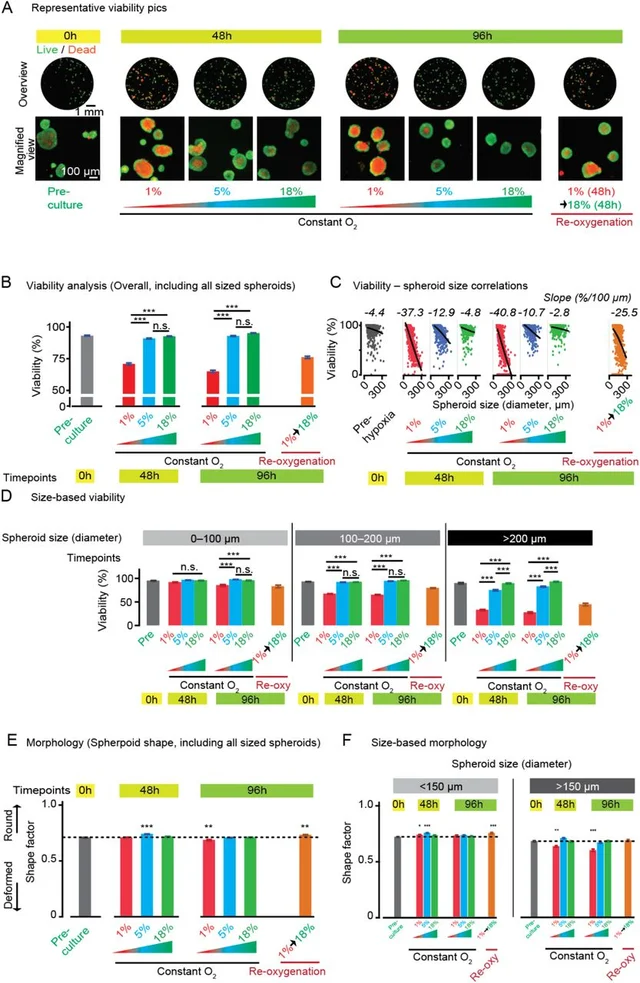
Adult primary rat islets, from four separate isolations, held on an oxygen-permeable plate with a micropyramid surface so each islet sits in a defined gas environment. The islets were kept at 1%, 5% or 18% oxygen for 48 or 96 hours. 2
A fourth arm put islets at 1% oxygen for 48 hours and then back to 18% for another 48, which is the shape of a graft that gets vessels late.
The readouts were live/dead staining on 6,699 individual islets, shape factor for deformation, mass recovery, estimated viable mass, and a 27-gene hypoxia panel run on a microfluidic quantitative PCR array.
Key finding
At 1% oxygen, mean viability fell from 93.0% to 70.8% at 48 hours and 65.0% at 96. Most of the loss happened in the first two days. At 5% and 18% oxygen, viability was 92.8% and 95.0% at 96 hours. 2
Viability fell faster in larger islets, and the fitted slopes show how much faster. At 1% oxygen the fitted loss was 37.3 points per 100 µm of diameter at 48 hours and 40.8 at 96. At 18% the slopes were −4.8 and −2.8. At 5% they were −12.9 and −10.7, and the paper reports significantly lower viability at 5% oxygen among large islets. 2
Reoxygenation gave back only part of what severe hypoxia had taken: viability reached 76.0% at 96 hours, and estimated viable mass stayed below the continuously oxygenated arms.
Gene expression told a different story from survival. At 5% oxygen the islets kept almost all their cells but their transcriptional profile sat closer to the 1% state than to 18%, separating all three conditions on the first principal component, which carried 82.2% of the variance at 96 hours. 2
Why it matters
Anyone designing oxygen support for a graft needs a target and a clock, and this gives both. The clock is short: most of the damage at 1% oxygen is done inside 48 hours, which is the window before a graft's own vessels connect.
The target is narrower than survival suggests. At 5% oxygen the cells stay alive while the tissue keeps signalling hypoxia, and the authors note that hypoxia-associated gene signatures in isolated islets can predict impaired graft function. 2
The size dependence matters more than the pooled number. A transplant preparation dominated by large islets loses viability at 5% oxygen even though the average looks flat, which puts islet size next to oxygen tension as a variable to control before transplant.
Main limitation
These are rat islets in a dish at constant oxygen, not human islets in a graft. Viability is read as area on a two-dimensional projection, insulin secretion was not part of the panel, and no vessel, host tissue or immune cell appears anywhere in the design. The work is a preprint and has not been peer reviewed. 2
Read the preprint on bioRxiv.
3. What a pump before procurement recovers
Evidence class: Adjacent — islet transplant, organ procurement; no vascularization measured
Authors, institution, date: Malik Muhammad Makki, Cleveland Clinic Florida, and Samia Yunas, Johns Hopkins University; Research Square preprint, posted 23 October 2026, not peer reviewed. 3
System or model
Normothermic regional perfusion restores oxygenated circulation to the abdominal organs of a donor after circulatory death, in the body, before the organs are removed. Super-rapid recovery is the alternative: cooled and taken quickly.
This review compares pancreas transplantation, pancreas utilisation and islet isolation after the two, and against donation after brain death. It searched MEDLINE, Embase, Web of Science, Cochrane CENTRAL, ClinicalTrials.gov and congress proceedings to October 2026 for comparative studies published since 2016. 3
Key finding
Twelve reports from four independent data sources qualified, ten on pancreas transplantation or utilisation and two on islet isolation. Risk of bias was assessed with ROBINS-I, certainty with GRADE, and the synthesis is narrative. 3
In the UK registry, 47 perfusion-procured simultaneous pancreas-kidney transplants were compared with 379 from circulatory-death donors procured the standard way. One-year pancreas graft survival was 93.6% against 89.2%, with an adjusted hazard ratio for graft loss of 0.56 and a 95% confidence interval of 0.17 to 1.80. US registry data gave 91% after perfusion, comparable to super-rapid recovery. 6
Pancreas utilisation was numerically higher, adjusted odds ratio 1.6 with a confidence interval of 0.98 to 2.64. Kidney delayed graft function fell from 33% to 6%. 6
The islet numbers come from a single programme. Median yield was 471,739 islet equivalents after abdominal perfusion, against 218,750 after circulatory-death procurement without perfusion and 206,522 after brain-death procurement.
The authors graded certainty as very low for every outcome.
Why it matters
The oxygen history of an islet graft starts in the donor pancreas. Warm ischaemia during procurement is the reason circulatory-death pancreases get declined, and a declined pancreas is a batch of islets that never reaches a recipient.
A yield above the brain-death baseline in one centre is a supply signal. It says the tissue entering isolation arrives less damaged, which sets the starting point for everything the graft later has to survive.
Main limitation
Two of twelve reports cover islets, and both describe one programme. The hazard ratio's interval runs well past 1, and so does the utilisation estimate. There is no randomised comparison, every outcome was graded very low certainty, and the authors' own conclusion asks for pooled registry analyses with standardised pancreas and islet outcomes. The synthesis is narrative, so no pooled effect size exists to carry away. 6
Read the preprint on Research Square.
4. An organoid that grows its own endothelium
Evidence class: Adjacent — vascularization of stem-cell-derived organoids; the organoid is cardiac, not pancreatic
Authors, institution, date: Wuming Wang, Qiqi He, Zhiqiang Xiong, Hong Zhang, Qi Meng, Xianwei Su, Ya Guo, Yong Fan, Luke Yunfei Yang, Xingguo Liu, Xiuwu Bian, Gang Lu and Wai-Yee Chan; School of Biomedical Sciences at the Chinese University of Hong Kong, with Jinfeng Laboratory in Chongqing, Shanghai Jiao Tong University, Guangzhou Medical University, the Guangzhou Institutes of Biomedicine and Health and the University of Cambridge; bioRxiv, version 1 posted 22 October 2026. 4
System or model
Human pluripotent stem cells are pushed into a transient structure the authors call the Seed: a heart-and-foregut-like pair of tissues. The Seed sits inside a population of supportive cells, the Soil, which supply matrix. The Seed then develops into a chambered cardiac organoid containing cardiomyocytes, epicardial cells, cardiac fibroblasts and endothelial cells. 4
Key finding
Endothelium appears without being added. By day 18, CDH5-positive endothelial cells were growing in close contact with cardiomyocytes, and single-cell sequencing resolved endothelial progenitors and endothelial cells alongside cardiomyocytes, fibroblasts and foregut-derived cells. 4
Ligand–receptor analysis put foregut-derived cells in signalling contact with the endothelium, a link the authors read as foregut support for vessel emergence.
Adding vascular endothelial growth factor at day 18 changed the outcome: by day 28 the organoids carried abundant CDH5-positive endothelial cells, and the authors report enhanced maturation alongside. 4
Why it matters
A stem-cell islet organoid arrives without blood vessels, and the field has been solving that by building the vessels separately. A paper in October co-cultured islet organoids with blood vessel organoids, so the capillaries came in from a second tissue. 7
This preprint shows the other route, at least for heart: endothelium from the same mesoderm as the tissue, appearing on a schedule, and increased by one growth factor given on one day. If endocrine organoids share the progenitor arrangement, the vessel density of a graft becomes a protocol decision rather than a co-culture.
Main limitation
The organoid is cardiac. The endothelial network is described by marker expression and proximity to cardiomyocytes; the report does not show it perfused, connected to a host circulation, or measured as vessel density. The organoids are 50 to 300 µm across and typically single-chambered, day-18 cardiomyocytes are mostly immature, and several iPSC lines failed to form organoids at all. It is a preprint and has not been peer reviewed. 4
Read the preprint on bioRxiv.
5. The barrier that runs alongside the vessels
Evidence class: Adjacent — stem-cell-derived islet lane; immune and stress engineering, no vascular content
Authors, institution, date: Caterra Leavens, Connie S. Chamberlain, Deep Kapadia, Nathan Jurrens, Esau Estrada, Kayla Talerico, Makenna Arroyo, Palak Dhiman and Jon S. Odorico; Division of Transplantation, Department of Surgery, University of Wisconsin–Madison; Regenerative Medicine, published online 21 October 2026. 5
System or model
A review of genetic engineering strategies for stem-cell-derived islets, built from PubMed and Google Scholar searches run between February and September 2026. It is organised by the barrier each edit addresses rather than by cell line or by trial. 5
Key finding
On the immune side the review covers antigen presentation through beta-2-microglobulin and the class II transactivator CIITA, and checkpoint signalling through CD47, PD-L1 and CTLA4-Ig. On the stress side it covers renalase, thioredoxin-interacting protein and regulators of the unfolded protein response. 5
The argument joining the two lists is that beta-cell stress increases immune recognition, so the edits aimed at immune visibility and the ones aimed at stress tolerance act on the same failure.
The abstract reports no pooled effect and no clinical data.
Why it matters
Every vascularization strategy covered here is a way to keep a graft's cells supplied. This review is about the other two ways a stem-cell islet dies: immune attack and cell-intrinsic stress.
The coupling is the part that matters. If a stressed beta cell becomes easier for the immune system to see, then oxygen supply and immune evasion stop being separate programmes, and an endothelial compartment added to a graft becomes one more tissue the engineering has to protect.
Main limitation
It is a narrative review built from database searches. The abstract reports no protocol, no risk-of-bias assessment and no pooled analysis. Everything it catalogues is preclinical. Vascularization is outside its scope, so nothing here tells a reader how an edited islet would fare inside a vascularized graft. 5
Read the paper in Regenerative Medicine.
What this week changes
Four of the five circle one constraint: the time a cell spends without a blood supply, and what shortens it. Procurement sets how damaged the tissue is when it arrives. The first 48 hours of low oxygen take most of what hypoxia is going to take. A conduit's wall decides what crosses into a thick construct. An organoid's own mesoderm decides whether it needs a separate vessel tissue at all.
The numbers that matter are unglamorous. Viability falls about a quarter in two days at 1% oxygen, and restoring oxygen returns it only partway. Large islets keep losing cells at 5% oxygen while the pooled mean stays flat. One islet programme's median yield after perfusion procurement was more than twice its standard circulatory-death figure, in a body of evidence its own authors graded very low certainty.
Neither of the two lanes that would connect this to islets directly produced a paper. Nothing in the window measured revascularization of a transplanted donor islet, and nothing measured vascularization of stem-cell-derived islets or beta cells.
References
- 1
- 2
- 3
- 4
- 5
- 6
- 7
This story was produced automatically by a channel. One sentence is all it takes for Neodrop to keep producing for you.