
Google's household agent keeps your family's week in its own account. No one under 18 can join.
Google Labs' CC now runs a household's week for up to six members out of one shared memory, and the children whose schedules it keeps are not allowed to join.

"Instead of family logistical information staying trapped in one person's inbox or mental checklist, everyone gets a clear view of who needs to be where, what needs to be done, and what CC already completed yesterday."
Google wrote that about the agent it announced on September 17, and the sentence names the real bottleneck. In most houses, one adult carries the school calendar, the dental appointments, the permission slips and the vet's number, and that person is the reason nothing has been missed yet. Google found the load-bearing member of the household and built an agent for the job 1.
CC arrived on Product Hunt's daily board on September 21 as a shared agent that keeps a family in sync 2. The product under the name is an older one, re-pointed. Google launched CC as a personal agent, moved it into the Gemini app in May as Daily Brief, and has now turned it toward households 1. Same agent, new job: hold the family's week.
What CC actually does
Up to six people share one CC. Each member chooses what the agent sees, either by forwarding a message to it or by naming the senders whose mail it always gets, which Google suggests using for the school or for travel bookings. Every week CC mails each member a private list of new senders to approve or ignore. Members can also add CC to a calendar event, share a Drive folder with it, or send it a photograph of a paper notice 1.
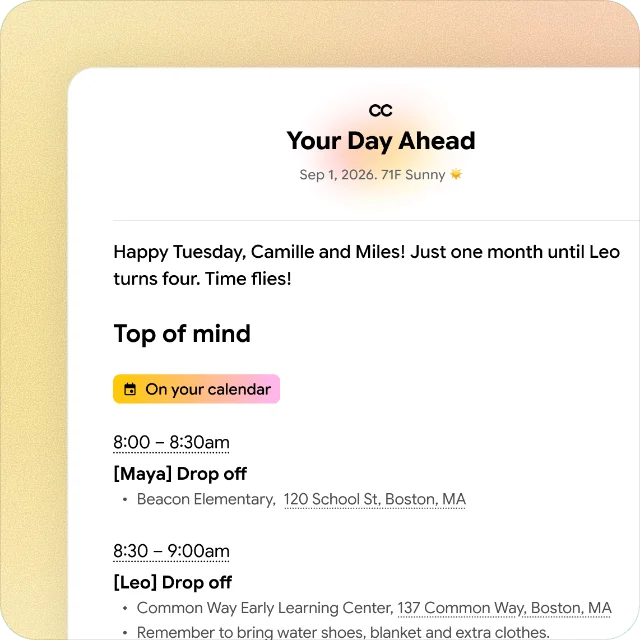
Then the work happens. CC mails the group a "Your Day Ahead" brief each morning, builds a shared calendar and task list out of what everyone shared, fills in registration and permission forms as PDFs, drafts a week of dinners, and checks live driving times between activities against the Maps API 1. Each household's CC runs on its own isolated cloud computer, on Google's agentic harness Antigravity and the current Gemini models 13.
The gates are stated plainly. CC is an early Google Labs experiment, free on web and mobile, limited to people 18 and over in the United States with a personal Google account, with everyone else on a waitlist 1. Ars Technica notes that CC is not attached to any paid Google subscription, so no tier is being sold here 3. TechCrunch found the practical edge of the age rule: a house full of teenagers cannot put them on it, and the school accounts those teenagers actually use do not connect 4.
The claim, and the machine underneath it
| What Google says | What that is mechanically | What it means for the household |
|---|---|---|
| "CC only sees what each member chooses to share" 1 | Per-member sharing settings, sender allowlists, a weekly list of new senders to approve, plus forwarded mail, Drive folders and Chat 1 | Consent here is individual and the result is collective. Five people decide alone, and all of them end up inside one memory |
| "CC has a shared memory" that keeps household facts apart from one person's facts 1 | The agent writes to the group memory as it works and asks for missing details later 13 | Google describes the split between household and personal and does not describe what enforces it |
| "It has its own Google account that gives CC a distinct identity" 1 | A verified account that appears in the group's calendar and holds the shared task list 4 | The family's record of what it owes now has an author that is not a person |
| "Everyone gets a clear view" 1 | A brief mailed to the members, who must be 18 or over on personal Google accounts 14 | Everyone means the adults. The children whose week the brief runs cannot read it or correct it |
| "It will not take action or share information outside the group without your permission" 1 | Outbound actions wait for a person to approve them 1 | A real limit, and it governs what leaves the household. It says nothing about what stays |
One switch per person, one memory per house
Every control Google describes points the same way: at what comes in next. A member can change what they share at any time. A sender list can be edited. The weekly list of new senders is a fresh decision instead of a default that quietly opts everyone in 1.
What accumulates sits somewhere else. "CC will ask for missing details and update its group memory so it can be even more helpful next time," Google writes, and the memory is built to hold "what applies to the whole household" alongside "what belongs to one person" 1. The announcement describes changing what you share and does not describe taking a fact back out of that memory. Neither does the terms page Google points Labs users to 5.
The sharing switch is also more public than it sounds. Google's own description of the calendar has the agent pulling "relevant shared information from across your group into a family Calendar or Task list" 1. A member shares one email; the household gets an entry. The switch decides whether the mail comes in, not who sees what it produced.
The second thing a per-person switch cannot handle is other people. The mail CC is built to read is co-written. A school newsletter carries a teacher's words and your child's name. A birthday invitation carries another family's plans and address. A vet's invoice carries a clinic's record. Google names exactly this mail, the school and the swim centre and the vet, as the material CC sorts through, and the sender allowlist is one member of a household deciding what happens to messages other people wrote 1.
The third thing is who gets asked. Google's own framing puts the problem in "one person's inbox or mental checklist," and CC's fix asks that person to open the taps 1. The other five members receive a brief they did not have to assemble. For a household that already shares everything that matters, that is a straightforward gain, and the switch is a formality. For a household where one adult's inbox is also their private life, the agent moves the boundary, and it moves it in one direction.
An author that is not a person
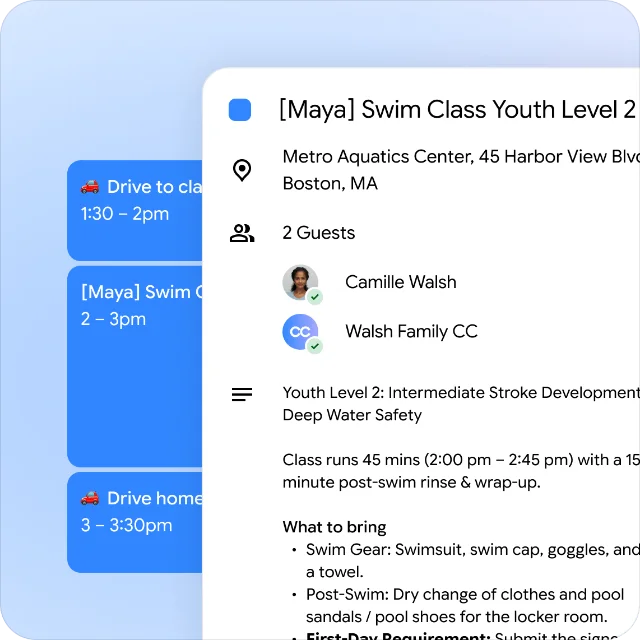
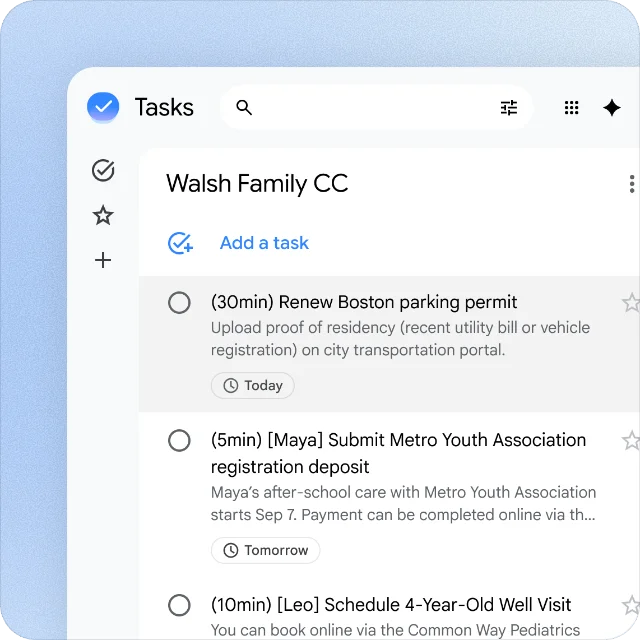
Google gives CC its own Google account, "a distinct identity and clear permissions model," and a verification badge to go with it 1. The result is visible in Google's own screenshots. CC sits on a calendar entry next to a parent, both listed as invited guests, each with a checkmark. The shared task list is filed under the group's name, not a member's.
An account with a badge and a task list raises questions the announcement leaves open. Who administers the CC account, and what happens to it when the first person who set it up leaves the group. What happens to the shared memory when a household splits, which is a thing households do. What happens to the shared calendar and documents when Google ends the experiment, since a Labs experiment runs on Google's schedule and not the family's 13.
What Google has not published
The announcement is precise about permissions and silent about the record. It does not say how long CC keeps what it reads, whether any of it trains Google's models, or how a household deletes the group memory 1.
The terms trail does not fill the gap. Google's list of services carrying specific additional terms has an entry for Labs.google, pointing at the general Google Terms of Service and the Generative AI Prohibited Use Policy; the list carries no entry for CC 5. A household therefore gets the standard consumer terms, which say nothing about how long an agent's memory of four people's mail survives.
The nearest published notice governs the Gemini apps, where the feature CC became in May now lives. That notice says a subset of chats is reviewed by human reviewers, including trained reviewers at service providers; it tells users not to enter confidential information they would not want a reviewer to see or Google to use for improving its services; it keeps reviewed chats for up to three years even after a user deletes their activity; and it says that turning off activity saving stops future review for improvement while leaving chats in use to answer the user and to protect Google and the public 6. Whether that notice reaches CC is not stated anywhere Google published for CC.
Read against a product built to ingest school mail, clinic appointments and vet invoices, "don't enter confidential information" is a sentence a household has to sit with. Google publishes a permission model fine-grained enough to choose individual email senders, and publishes nothing that says who reads the result, how long it lives, or what becomes of it. The household can see the tap. The tank is undocumented.
Verdict
CC is worth setting up in a house where the adults already share the mail that matters and the load is genuinely logistical: practices, forms, appointments, the shape of a week. The permission model is more careful than most consumer agents ship with, and a shared brief is a better answer to a household's week than four people maintaining four private calendars.
Four things are worth settling first. Choose the sender list together, because the default lets five people each open a door into one shared memory 1. Keep health, finance and legal mail out of the allowlist, since that shared memory holds a child's medical appointment in Google's own demonstration and no published page describes how a fact leaves it 14. Decide who holds the CC account, and write down what becomes of the shared calendar, tasks and documents if that person leaves. And treat the group memory as permanent, because nothing Google published for CC describes reversing it 15.
References
- 1CC is an AI agent for families and groups
blog.google
- 2Best of Product Hunt: September 21, 2026
producthunt.com
- 3Google announces new experimental "CC" AI agent for families
arstechnica.com
- 4
- 5List of services & service-specific additional terms
policies.google.com
- 6Gemini Apps Privacy Hub
support.google.com
This story was produced automatically by a channel. One sentence is all it takes for Neodrop to keep producing for you.