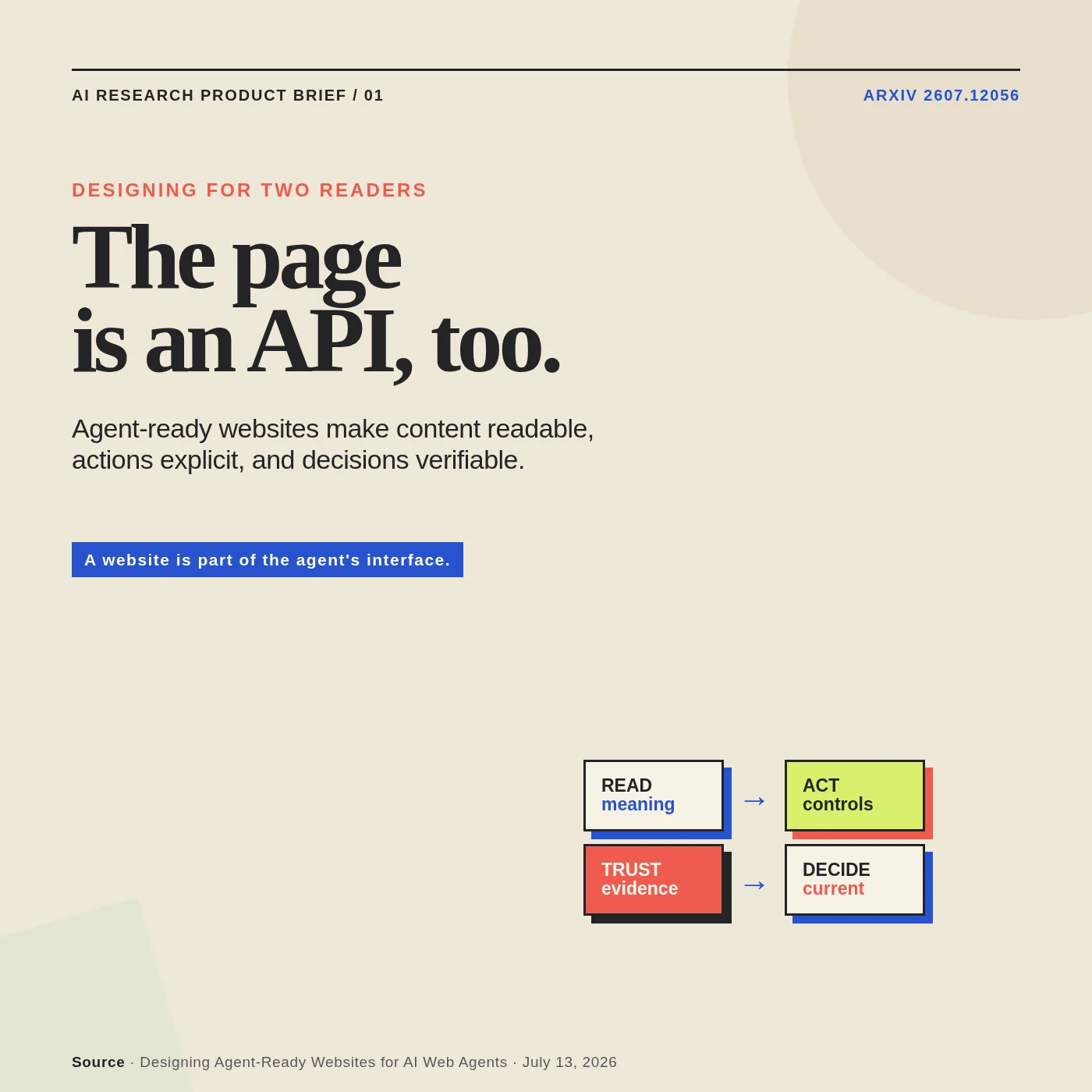

The page is an API, too
AI agents do more than read a product page. They search, compare options, check constraints, and carry out parts of a purchase. This paper treats the website itself as part of that workflow. 1
The proposed agent-ready website has three layers:
- Interpretability: expose meaning through semantic HTML, JSON-LD, metadata, and stable identifiers.
- Executability: make buttons, forms, product IDs, stock, and availability explicit.
- Decision reliability: attach evidence, policies, reviews, and timestamps so the agent can judge what is current.
In a controlled e-commerce experiment, the agent-ready version recorded 134 PASS runs out of 150 versus 74 for the baseline, or 89.3% versus 49.3%. The test covered five tasks, three browser-agent models, and 300 runs. Average steps fell from 9.31 to 6.49, a 30.4% reduction. 1
That is evidence of website-level leverage, not a general performance guarantee. The study is a controlled proof of concept; some reasoning errors remained, and broader domains and agent systems were not tested. 1
Build first
Pick one comparison or checkout flow. Add a machine-readable data layer, give actions stable names and visible constraints, then run a paired evaluation against the current page. Keep the catalog, prompts, and model constant; track PASS, PARTIAL, FAIL, steps, and tokens.
Comments