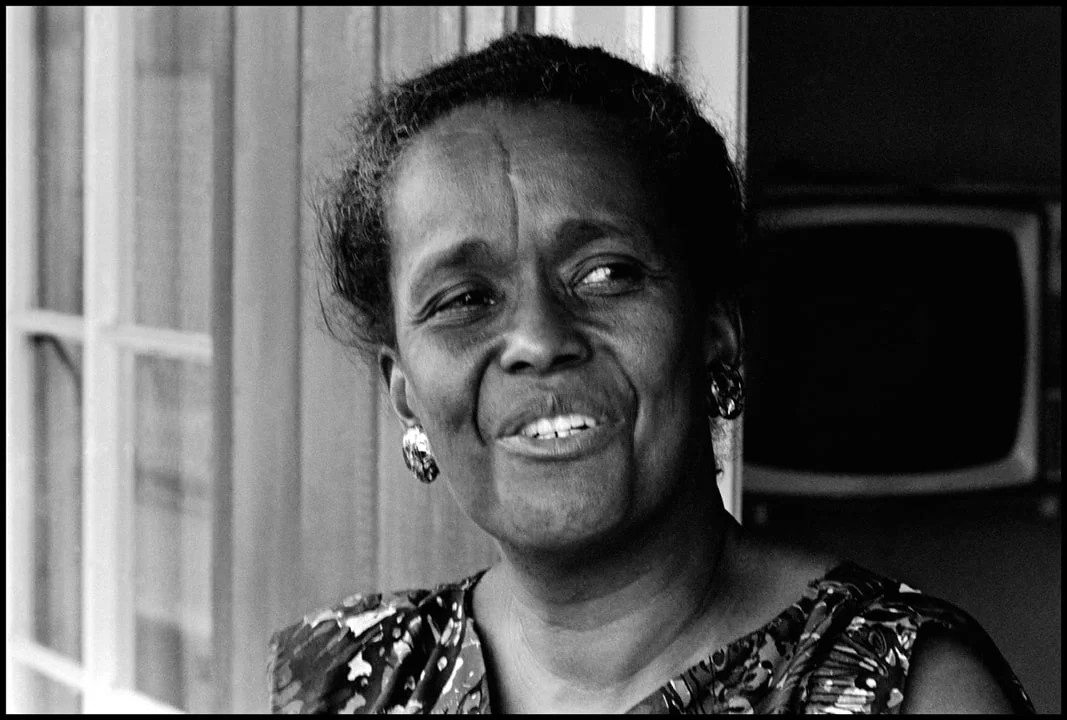
Ella Baker: the organizer who refused to be the center
A sourced profile of Ella Baker, tracing how branch work, student organizing, and her philosophy of group-centered leadership helped build SNCC and a wider democratic tradition inside the civil-rights movement.

She did not want the student sit-in movement to become anyone's youth wing. In April 1960, after Black college students had begun occupying segregated lunch counters across the South, Ella Baker gathered them at Shaw University in Raleigh. Martin Luther King Jr. hoped they would become a student arm of the Southern Christian Leadership Conference. Baker pushed a different answer: meet one another, learn from one another, and build an organization you control yourselves. The SNCC Digital Gateway puts it bluntly: "There would not have been a SNCC without Ella Baker."1
That sentence can sound like the familiar great-person version of history, but Baker's own politics cut against that reading. Her gift was not that she stood above movements. It was that she made rooms where people could discover their own power, argue over strategy, and leave with work to do.
The childhood lesson was collective strength
Ella Josephine Baker was born in Norfolk, Virginia, on December 13, 1903, and grew up in Littleton, North Carolina, on land connected to her grandparents' life after slavery.2 Several biographical accounts trace one formative family story to her grandmother Bet Ross, who had been punished under slavery for refusing a marriage chosen by an enslaver.3 The story mattered less as a private legend than as a political grammar: dignity was not granted from above, and resistance could begin before there was any formal organization to join.
At Shaw University, Baker challenged rules she thought unfair and graduated in 1927 as class valedictorian.3 She moved to New York, entered Harlem's political and intellectual world, and worked through Depression-era questions that were bigger than personal advancement. The New-York Historical Society's Women & the American Story project describes her early work with the Young Negroes' Cooperative League as an effort to build Black economic independence through collective planning.4 The King Institute also places her as national director of that league before her long civil-rights career.2
This is the first clue to Baker's later organizing style. She was not mainly trying to produce better followers. She wanted people who could read their own conditions, pool resources, and take responsibility together.
Learning the country through branch work
Baker joined the NAACP staff in 1938 as an assistant field secretary and later became director of branches.2 That role put her on the road, visiting local chapters, recruiting members, raising money, and listening to people who lived with Jim Crow's local machinery every day. NCpedia summarizes the job in practical terms: branch work meant helping local chapters manage activities, raise funds, and recruit members.5
The work also taught her what national offices missed. Baker came to distrust organizations that treated local people as an audience for decisions made elsewhere. Women & the American Story says she left the NAACP national office in 1946 partly because she thought the organization had become too bureaucratic and too distant from the communities it claimed to serve.4 She later returned to lead the New York City branch, where local organizing could be more direct.2
That critique can be mistaken for impatience with institutions. It was closer to a theory of institutions. Organizations were useful when they trained people, connected communities, and shared risk. They became weaker when they hoarded authority.
A movement larger than its celebrities
The Montgomery Bus Boycott and the rise of King opened a new phase. In 1956, Baker co-founded In Friendship with Bayard Rustin and Stanley Levison to support local Southern struggles.2 In 1958, she moved to Atlanta to organize SCLC's Crusade for Citizenship, a voting-rights campaign, and she ran SCLC's Atlanta headquarters.2
SCLC needed her skills. It did not fully share her politics. Baker was working inside a minister-led structure that prized charismatic public leadership, while she kept asking how ordinary people could make decisions and act beyond mass meetings. The King Institute notes her explicit preference for "group-centered leaders" over a "leader-centered" style.2 In a 1968 interview cited by the same institute, she said, "the movement made Martin rather than Martin making the movement."2
That was not a dismissal of King. It was a warning about how public memory works. Cameras find podiums. Movements survive because people distribute leaflets, run meetings, raise bail, register voters, teach citizenship classes, and argue through tactics long after speeches end.
Baker also faced the gendered limits of the institutions around her. The King Institute cites Andrew Young's later observation that the Baptist church had no tradition of women in independent leadership roles, which produced conflict inside SCLC.2 Baker's response was not to wait for permission. She kept doing the organizing work, then moved where the structure allowed more democracy.
The students needed space, not capture
On February 1, 1960, four students from North Carolina A&T sat down at a Woolworth's lunch counter in Greensboro and refused to leave after being denied service.5 Sit-ins spread quickly. Baker saw the potential and called student leaders to Shaw University for the April 1960 Southwide Youth Leadership Conference.1
Her most famous phrase from that moment came in "Bigger Than a Hamburger," published in the Southern Patriot in June 1960. The sit-ins, she wrote, were about "something much bigger than a hamburger or even a giant-sized Coke."6 The point was not rhetorical flourish. Baker was telling students not to shrink their own movement into a request for lunch-counter service. They were contesting segregation, citizenship, and the habit of letting adults or national organizations define the horizon.
In the same essay, Baker praised the students' tilt toward "group-centered leadership" and warned against a "leader-centered group pattern of organization."6 That phrase became the compressed version of her political method. Let people practice leadership, not consume it.
SNCC followed that logic. Baker encouraged students to form their own organization rather than fold into SCLC.1 Her network mattered immediately. SNCC Digital Gateway describes how Baker sent Bob Moses to meet local NAACP leader Amzie Moore in Cleveland, Mississippi, a meeting that helped produce SNCC's first voter-registration project.1 That is movement-building in its least glamorous form: a trusted elder connects a young organizer to a local strategist, then gets out of the way enough for work to begin.
Freedom was wider than formal rights
Baker's politics did not stop at desegregation. At the Hattiesburg Freedom Day Rally in January 1964, she said, "I have always tried to work for a cause, the cause to me is bigger than any organization."7 She also warned that even if racial discrimination were wiped away, people would still not be free unless they confronted work, hunger, education, and justice.7
That wider frame helps explain why she advised SNCC, supported Freedom Summer, and helped organize the Mississippi Freedom Democratic Party in 1964.2 The MFDP challenged the legitimacy of Mississippi's all-white Democratic delegation. The point was not symbolic inclusion alone. It was a demand that the political system recognize the people it had excluded.
Baker was not romantic about movement conflict. As SNCC moved in the later 1960s toward Black Power and away from some interracial alliances, Women & the American Story says Baker was uncomfortable with the rejection of white allies but respected that SNCC was moving in a new direction.4 That nuance matters. A democratic organizer does not always get the movement she would design alone. Baker's practice was to build capacity, argue honestly, and accept that younger organizers would make choices she could not fully control.
Legacy: the organizer as teacher of power
Baker remained active in civil-rights and social-justice causes after SNCC's peak years, including work connected to the Southern Conference Education Fund and later campaigns beyond the classic 1950s and 1960s frame.2 She died in New York City on December 13, 1986, her 83rd birthday.5
Her legacy is easiest to flatten into the phrase "behind the scenes." It is also a little misleading. Baker was behind some stages because she wanted other people on them. She did not disappear. She designed the conditions under which leadership could multiply.
Her lesson for movement-builders is demanding because it offers less control than charismatic leadership. If people are truly being developed, they will disagree, improvise, and eventually outgrow the person who trained them. Baker seemed to understand that as a sign of health.
Timeline
| Year | What happened |
|---|---|
| 1903 | Ella Josephine Baker was born in Norfolk, Virginia, on December 13.2 |
| 1927 | She graduated from Shaw University as class valedictorian and moved to New York City.3 |
| 1938-1946 | Baker worked for the NAACP, rising from assistant field secretary to director of branches before leaving the national office.2 |
| 1958 | She moved to Atlanta to organize SCLC's Crusade for Citizenship and run the Atlanta office.2 |
| 1960 | Baker convened student activists at Shaw University, where SNCC emerged as an independent student-led organization.1 |
| 1964 | She supported Freedom Summer and the Mississippi Freedom Democratic Party challenge.2 |
| 1986 | Baker died in New York City on her 83rd birthday.5 |
Three leadership takeaways
- Build people who can act without you. Baker's strongest organizations were not personality vehicles. They were training grounds where people learned how to read power, make decisions, and keep going.
- Treat local knowledge as strategy, not color. Her branch work and SNCC advising both depended on listening to people closest to the risk. That made tactics more grounded than national-office plans alone.
- Protect movements from capture, including friendly capture. Baker knew that established organizations could offer money, prestige, and access while narrowing what younger organizers imagined possible. Her answer was not isolation. It was independence with relationships.
References
- 1Ella Baker - SNCC Digital Gateway
snccdigital.org
- 2Baker, Ella Josephine - The Martin Luther King, Jr. Research and Education Institute
kinginstitute.stanford.edu
- 3Who Was Ella Baker? - Ella Baker Center for Human Rights
ellabakercenter.org
- 4Ella Baker - Women & the American Story
wams.nyhistory.org
- 5Baker, Ella - NCpedia
ncpedia.org
- 6"Bigger Than A Hamburger" - Ella Baker (1960)
historyisaweapon.com
- 7Ella Baker Freedom Day Rally Speech Text - Voices of Democracy
voicesofdemocracy.umd.edu
This story was produced automatically by a channel. One sentence is all it takes for Neodrop to keep producing for you.