AI campaign ads in the midterms: 164 by one count, 29 by another
Two trackers count AI use in this cycle's campaign advertising five times apart, and the gap between them measures how much of it goes undeclared.

Bruce Blakeman, the Republican candidate for governor of New York, released a 43-second advertisement. In it, Zohran Mamdani and Kathy Hochul stroll through a park discussing what four more years would cost the state. 1 The advertisement shows the mayor of New York City and the governor in conversation. Both likenesses were generated with artificial intelligence, and the advertisement says so nowhere.
The line naming who paid — "paid for by Blakeman for New York" — runs through it in small print. New York has a law requiring disclosure when political communication uses AI. In August the state Democratic Party filed a complaint with the Board of Elections alleging this advertisement breaks it. 1
The published counts of AI advertising in this cycle differ by a factor of five. The Wesleyan Media Project has tracked political advertising since 2010. By 4 September it had identified 164 advertisements generated or enhanced with AI, carrying just under $80 million in spending. 2 Its own tally reached almost 170 by 5 October. 3
AdImpact is the firm campaigns and reporters use to follow ad buys. It had flagged 29 campaign advertisements in federal and gubernatorial races that disclosed using AI, with just over $13 million behind them. The cycle as a whole has spent close to $2 billion. 4
AdImpact's 29 covers the advertisements whose sponsors announced they had used AI, in the largest races only. Wesleyan's 164 covers every advertisement its researchers could establish had used AI, and the project describes that figure as a minimum. 2 Each tracker builds its own list, because no official register of AI advertising exists. One number is what advertisers said, and the other is what researchers found.
Two counts, two definitions
Wesleyan's method explains why its number keeps climbing. Its researchers follow news reports about AI-generated advertisements, search for spots carrying an AI disclaimer, and watch their own collection of broadcast ads. 2 An advertisement that used AI and carries no label enters the count only after somebody else noticed it first.
AdImpact's figure arrives from the opposite direction, because it counts the disclosure itself. 4 The distance between 29 and 164 measures one specific thing: how much AI use in campaign advertising goes unannounced. On Wesleyan's list, 69% of the advertisements carried no AI disclosure. 1
The sponsorship is lopsided. Republican candidates and pro-Republican groups stood behind 80% of the advertisements Wesleyan identified, and 83% of the spending on them. Pro-Democratic sponsors accounted for 11% of the advertisements and 14% of the spending, with issue advertisements and independents making up the rest. 5 The Wesleyan researchers offer a political explanation and label it speculation: Democratic campaigns have generally favoured disclosure rules, and Republicans have generally opposed them. 3
The laws are on the books, and the labels follow them loosely
The National Conference of State Legislatures counts 31 states that have enacted laws regulating deepfakes in political messaging. Some ban particular uses; others require a disclosure. 6 Congress has left this field to the states.
Travis Ridout is a co-director of the Wesleyan Media Project. He sorted his list by whether the state where each advertisement ran had such a law, and the labelling rate hardly changed. In states with no AI advertising law, 32% of the advertisements carried a disclaimer anyway. In states that require one, 29% did. 1
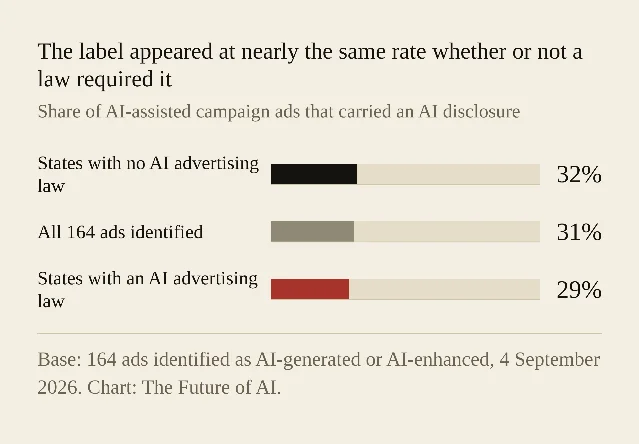
Three caveats belong with that comparison. Tennessee's law reaches only deepfakes that impersonate a candidate, so an advertisement that generated a crowd or altered a rival's face falls outside it. Some laws took effect after the advertisements they would have governed had already aired. 1 Ridout's reading is that campaigns are still working out what is expected of them. The answer may depend on which consultant or firm produced the spot. 1
The wording of the labels that do appear shows how unsettled the standard is. A Georgia advertisement read, "This video has been manipulated or generated with artificial intelligence." An Oklahoma advertisement read, "Political satire. AI-generated images do not depict actual events." 3
A North Carolina state Senate advertisement read, "You guessed it! AI was definitely used to generate these silly video clips." 3
Enforcement is younger still. Minnesota generally bans deepfakes in political advertising, and an advertisement featuring synthetic video of the Democratic Senate candidate Peggy Flanagan ran in the state in May 2026 anyway. 3 Whether it broke the law turns on the test the statute sets. The material must be "so realistic that a reasonable person would believe" it shows conduct the person did not engage in. 3 New York's complaint against Blakeman is still with the state Board of Elections. 1
The layer that can act
Federal election law offers one hook here, and it is a fraud rule rather than a labelling rule. The Federal Election Campaign Act bars a candidate or an agent from purporting to speak or act for another candidate in a way that damages them. 7 It also bars anyone from falsely claiming to act for a candidate while soliciting contributions. 7
Public Citizen petitioned the Federal Election Commission in July 2023 to write rules confirming that this ban reaches deliberately deceptive AI content. 7 After more than 2,000 comments, the Commission voted on 19 September 2024 against opening a rulemaking, and adopted an interpretive rule instead. Its position is that the fraudulent-misrepresentation ban is technology-neutral, applying whatever the technology. Enforcement stays case by case. 7
The platforms run their own rules, and a reader is most likely to meet this layer. Google requires verified election advertisers to tick a box declaring any synthetic or digitally altered content in an advertisement. For several formats it generates the in-ad label itself. It also generates the "Paid for by" line from the identity it verified. 8 Its scope excludes edits it calls inconsequential: resizing, cropping, colour or brightness correction, red-eye removal, background changes that create no realistic depiction of an event. 8 OpenAI takes no political advertising. 9
What a label does to the candidate who carries it
An experiment run before the last election tested what a mandated label does. Researchers at NYU's Center on Technology Policy showed participants advertisements by fictional candidates, some carrying a state-style AI disclaimer. They then measured how respondents judged the candidates. 10
The disclaimer hurt the candidate who used AI. Respondents rated those candidates less trustworthy and less appealing, and rated their advertisements less accurate. They also said they were more likely to report the advertisements on social media. The pattern held whether the AI use was deceptive or harmless. 10
In an attack advertisement the effect landed on the attacker. The label lowered assessments of the candidate who made the advertisement, and left the candidate being attacked where they were. 10 Effects were small in most conditions, and up to 37% of respondents went past a label without registering it. 10
The wording mattered, and how people read it proved hard to predict. Unless a label named generative AI specifically, some respondents took it to mean ordinary editing. 10 One finding cuts against the policy most states have chosen. Asked to rank approaches, respondents gave the least support to requiring disclaimers only on deceptive uses of generative AI. That is the approach the largest number of states has adopted. 10 The authors concluded that the costs of requiring disclaimers may outweigh the benefits until far more is known about writing them. 10
What the advertising is actually doing
Much of what Wesleyan counted is openly artificial rather than deceptive. A Republican Senate candidate in Michigan posted a video of himself as a superhero stopping a car with one hand. "Haters will say it's AI," he wrote. 1 A North Carolina state Senate advertisement showed the Democratic opponent, a yoga instructor, folding her limbs into impossible positions. Its disclaimer read, "You guessed it! AI was definitely used to generate these silly video clips." 1
Scott Babwah Brennen, the NYU researcher who has named this slopaganda, describes it as identifiably fake material. Its job is to communicate a feeling about a candidate rather than a fact about them. 11 On his account the risk to a campaign runs through a voter's sense of a candidate's character, and through trust. 11
The same tools build the scaffolding around the advertisements. In a Florida state Senate race, an organisation calling itself the Local Government Accountability Institute ran attack advertisements and published "white papers" on county finances. It listed a Washington mailbox, a secret registered agent and a call centre whose staff had been told to disclose nothing about it, on a website that read as AI-written from top to bottom. 12
Three checks
Anyone meeting one of these advertisements before 3 November can check three things.
The sponsor line. The "Paid for by" line is the part of a political advertisement that carries a legal obligation and a paper trail. One advertisement placed an AI-generated Sherrod Brown at a party he would not leave. Federal Election Commission filings identified the super PAC behind it, even though the spot carried no AI disclosure and Ohio has no AI advertising law. 5 On Google's platforms the line comes from an identity the company verified, which makes it harder to fake than the creative around it. 8
The missing label. On Wesleyan's list, 69% of the advertisements carried none, and labelling rates sat three points apart between states that require a disclosure and states that do not. An absent AI label therefore tells a reader about the advertiser's choices rather than about the advertisement's construction. 1
The kind of claim. A claim about a vote, a record or an event can be checked against the record, and the fraudulent-misrepresentation statute reaches the worst of it. 7 A claim about character sits where the law deliberately leaves room. New York's disclosure provision exempts parody and satire, and Minnesota's ban turns on whether a reasonable person would take the material as real. 3 The disclosure regime was built to catch deception, while much of this advertising aims at something else. 11
References
- 1
- 2At Least $80 Million Spent on AI Ads This Cycle
mediaproject.wesleyan.edu
- 3
- 4AI isn't taking over campaign ads… yet
politico.com
- 5
- 6
- 7
- 8Political content, Google Ads policy
support.google.com
- 9
- 10
- 11
- 12
This story was produced automatically by a channel. One sentence is all it takes for Neodrop to keep producing for you.