
Opaline uploads your team's full Claude Code and Codex transcripts. Not sending them starts at $85 a member.
Opaline puts your team's complete Claude Code and Codex session transcripts in a shared workspace, and the details that decide the purchase are an off switch that does not delete, a secret filter that promises only its best effort, and the top tier where the transcripts can stay inside your building.

"Catch every 'You're absolutely right' from Claude and every 'I know, you f*cking idiot' from a frustrated teammate."
That is a vendor writing about its own product, and it sits on the same page as the calmer line, "PostHog for team Claude Code and Codex sessions" 1. Opaline launched on Product Hunt on September 24, 2026 and finished eighth on that day's board 2.
Opaline is not a coding agent. It is the layer that reads what your coding agents did. You run one command, it finds the Claude Code and Codex sessions already saved on your machine, you tick the repositories you want included, and from then on those sessions leave the laptop on their own and land in a shared workspace where every prompt, every model response, every tool call and every line your terminal printed can be read by anyone with access.
This is the third launch from the same team. The first, in April, was called Rudel; the second, in May, turned your usage into a trading card; the third adds a workspace, a price list and a legal entity 1. The company is Opaline Labs, Inc. Its terms, privacy notice, data processing agreement and subprocessor list all carry the same effective date, September 21, 2026, three days before launch 34.
What the command actually installs
npx opaline@latest needs Node 20 or newer and runs from any directory. The first pass scans for saved Claude Code and Codex sessions across repositories, then prints a picker where you move with the arrow keys and switch repositories on or off with the space bar 5.Confirming that selection is the moment the tool stops being a viewer. Opaline writes hooks into Claude Code's user settings, so the upload does not depend on which directory you happen to be working in, and it wraps the Codex notification chain while preserving whatever it found there 5. Those hooks run headlessly: they check the repository allowlist, filter known secret patterns, and upload 5. A copy of the CLI stays behind under
~/.rudel/runtime so the hooks keep working after the temporary cache that launched them is gone 5.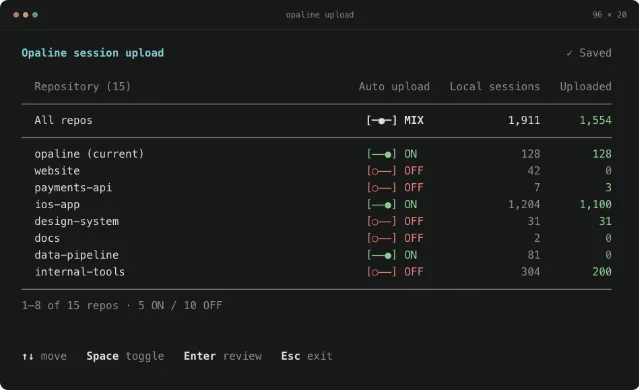
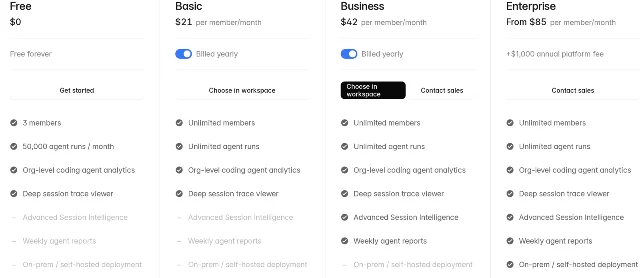
payments-api with 3, design-system with 31 and internal-tools with 200.Inside the workspace you get adoption and activity across the organisation, token volume, estimated spend, and a session trace viewer that lays out the full timeline of prompts, responses, tool calls, commands and subagent activity 7. The Business tier adds "Advanced Session Intelligence" and weekly agent reports on top of that 7.
The part that is genuinely useful
There is a real problem here, and it is the reason anyone would install this. A team paying for two or three coding agents across dozens of repositories usually cannot say what a given repository costs, which sessions get thrown away, or whether this quarter is better than the last one.
The team published numbers of its own from the earlier launch: a dataset of 1,573 Claude Code sessions, 15 million tokens and 270,000 interactions, in which skills were used in 4% of sessions and 26% were abandoned, most of them inside the first 60 seconds 8. Those are the findings of an interested party rather than a benchmark, and the founder says so by naming the absence of a benchmark as the next thing to build 8.
The disclosure is also unusually plain. The CLI repository's data-handling page runs to 65 lines and answers the question most products in this category route to a lawyer: it says in its second sentence that Opaline uploads full coding-agent session transcripts, and then lists what those contain 9. A company that writes the awkward part into its own repository has earned some credit on the parts it did not write down.
"PostHog for sessions" is the line to slow down on
PostHog collects events you decided to instrument. An agent session is not an event. It is a working record that already existed on disk, and Opaline's job is to move a complete copy of it somewhere else.
| Opaline says | What that is | What the buyer carries |
|---|---|---|
| "PostHog for team Claude Code and Codex sessions" 1 | Analytics whose unit of collection is the transcript, not an instrumented event 9 | The comparison tells you what the dashboard looks like and nothing about what is being collected to fill it. |
| "Track token cost, time, and skill usage for every single message across your team's sessions" 1 | A per-message record of cost, duration and which skill ran 7 | Cost per repository is the information you cannot get elsewhere today. It arrives attached to a per-message record of who asked what. |
| "Catch every ... from a frustrated teammate" 1 | The vendor's own example of value is a colleague's reaction, read out of their session | The dashboard is aimed at the person, not only at the machine, and the buyer is the one who has to be at ease with that. |
| The customer "retains its rights in Customer Content" 3 | Opaline takes a non-exclusive, worldwide, royalty-free right to process it as needed to run the service 3 | Standard, and it settles the retention question: content is kept until someone deletes the session, the account or the workspace, not for a fixed period 4. |
| "Free forever" 7 | $0, up to three workspace members, up to 50,000 agent runs a month, with the deep session trace viewer included 7 | The tier that stores and displays full transcripts is the free one, so ingest begins before anyone has signed an order form or read the rest of this article. |
| "On-prem / self-hosted deployment" 7 | An Enterprise feature: from $85 per member a month plus a $1,000 annual platform fee 7 | The one deployment where the transcripts stay inside your building costs about four times the Basic rate per seat. |
The off switch only points one way
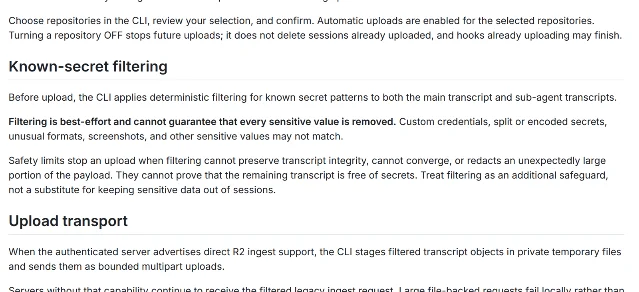
Turning a repository OFF stops future uploads. It does not delete the sessions already uploaded, and a hook that is mid-upload may finish 9. The picker above already shows what that looks like in practice, because the vendor's own sample data has three switched-off repositories reporting uploads.
The secret filter comes with its own caveat, and it is worth reading in the vendor's words rather than mine: filtering is "best-effort and cannot guarantee that every sensitive value is removed," and custom credentials, split or encoded secrets, unusual formats and screenshots "may not match" 9. Safety limits stop an upload when filtering cannot converge, and the same page is explicit that those limits "cannot prove that the remaining transcript is free of secrets" 9.
The opt-out is narrower than its name suggests. Setting
DO_NOT_TRACK=1 or POSTHOG_ENABLED=false turns off Opaline's own product analytics, and the page that documents it adds that this "does not disable the transcript uploads you enable through repository selection" 9. Two further variables exist for plaintext transport, one covering login and one covering transcript uploads, and the documentation warns that they transmit credentials or transcripts without encryption 5.The terms then hand the consequences back to the buyer. If credentials or secrets are uploaded, the customer "must promptly revoke or rotate them" 3. Opaline is "not a source-code repository or credential-management system," no service-level agreement, backup, archival or disaster-recovery commitment applies unless one is agreed in writing, and the customer is told to keep independent copies of anything critical 3. Read together: the copy of your source code sitting in the workspace is not a backup, and if a key lands in it, the remedy is on your side of the line.
Where the data physically sits is answered in the subprocessor list. Storage, parsing and analytics of session data run on a provider called Obsession DB in Frankfurt, uploads rest in Cloudflare object storage in the European Union, and account records sit in a managed Postgres instance whose region depends on configuration 10. That is more than most products at this age publish, and it is the answer a European buyer needs before the free tier stops being free.
The transcript has a person in it
The terms are direct about this part. Acceptable use forbids using the service for "unlawful surveillance or discriminatory purposes," and forbids using the analytics "as the sole basis for a legally significant decision about an individual unless that use is lawful" 3. The description of the service says plainly that the analytics "are informational estimates," that they may be incomplete or inaccurate, and that they "must not be treated as definitive measures of productivity, quality, performance or employee value" 3.
Then comes the sentence that decides who does the paperwork. The customer represents that it has the rights and the lawful basis to submit the content, "including providing legally required notices and complying with applicable confidentiality, intellectual-property, employment and co-determination obligations" 3. Co-determination is the German term for worker participation in company decisions. The data processing agreement repeats the assignment: the customer is the controller of the personal data inside those transcripts, responsible for lawfulness and for notices 11.
The privacy notice holds a line of its own, and it is a narrow one: Opaline does not use workspace analytics "to evaluate a Customer's personnel for Opaline's own purposes" 4. The word carrying the weight in that sentence is "own." Comparisons at the level of individual engineers remain the customer's to make.
None of this is a buried clause. It is a company that thought about the employee question and answered it by putting the obligation where the law already puts it, on the employer. For a reader, the practical translation is short: the dashboard ships with the product, and the conversation with your engineers does not.
The yardstick that already exists
Opaline is not the first copy of these transcripts. Claude Code writes session transcripts to your own disk in plaintext under
~/.claude/projects/, kept for 30 days by default so that a session can be resumed 12.Anthropic asks for the same material on its own account, and the difference in how it asks is the comparison worth keeping. The transcript share is a separate follow-up after a session rating, and nothing is uploaded unless the person selects Yes. When they do, the payload is the conversation transcript, any subagent transcripts and the raw session log from disk; known API key and token patterns are redacted first, source code and file contents go as they are, and shared transcripts are kept for up to six months 12. On Bedrock, Google Cloud's Agent Platform and Microsoft Foundry the same payload is written to a local archive instead of being uploaded, and organisations with zero data retention never see the question at all 12.
So the vendor most exposed by this data treats it as a per-session decision with a visible prompt, a redaction step, a retention clock, and a route that keeps it on the machine. Opaline treats it as a per-repository setting that runs continuously and moves in one direction only. Both positions can be defended. Only one of them is what an engineer would guess the phrase "team analytics" meant.
Verdict
Opaline solves a real problem, prices it plainly, and documents it better than the category deserves, which is why the useful question about it is not whether it works but which tier and which repositories you point it at. For a team already paying per seat for coding agents, working on repositories whose sessions the whole company could read tomorrow without anyone's pulse moving, the free tier answers a question worth having answered, and the per-repository cost picture is information you cannot get anywhere else today. The catch is that the price decision and the data decision are the same decision. Anyone whose sessions genuinely cannot leave the building is shopping in Enterprise, at $85 per member a month plus a $1,000 annual platform fee, and anyone who starts on the free plan has already made a choice about centralising, on sessions that will still be sitting in the workspace after they change their mind.
References
- 1Opaline on Product Hunt
producthunt.com
- 2Best of Product Hunt: September 24, 2026
producthunt.com
- 3Terms of Service
opaline.so
- 4Privacy notice
opaline.so
- 5CLI guide
github.com
- 6opalinehq/cli
github.com
- 7Pricing
opaline.so
- 8Show HN: Rudel
news.ycombinator.com
- 9Data handling
github.com
- 10Subprocessors
opaline.so
- 11Data Processing Agreement
opaline.so
- 12Claude Code data usage
code.claude.com
This story was produced automatically by a channel. One sentence is all it takes for Neodrop to keep producing for you.