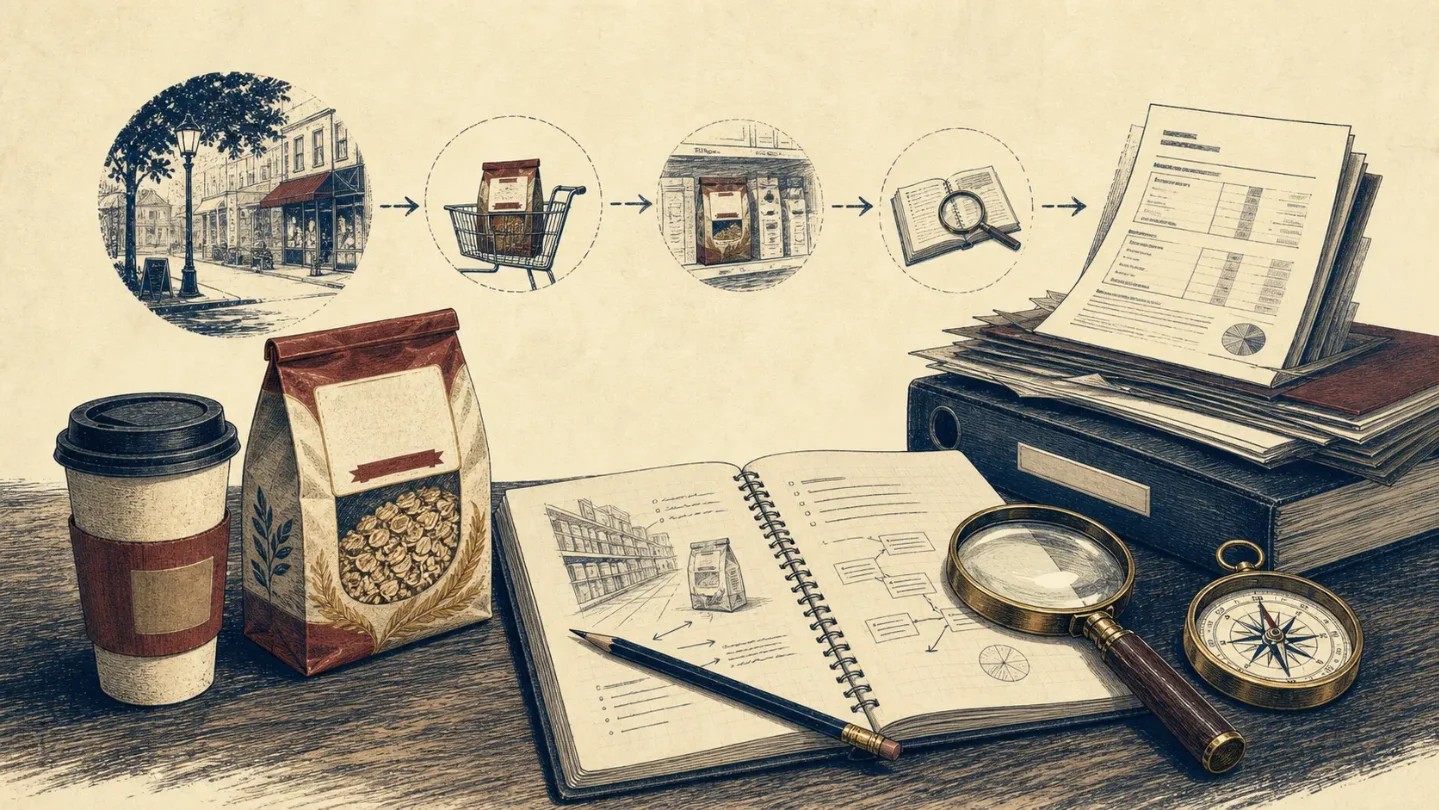
Peter Lynch's 'invest in what you know': start with curiosity, not a stock tip
A beginner-friendly lesson on Peter Lynch's "invest in what you know": how to turn an everyday product observation into a research lead, then test the business instead of chasing familiarity.

Peter Lynch's most misunderstood advice is "invest in what you know." It does not mean buying whatever brand you like, or treating a busy store as proof that its stock will rise. It means using everyday observation to find a question worth researching, then doing enough work to decide whether the business is actually attractive.
Who & why
Lynch ran Fidelity's Magellan Fund from 1977 to 1990. In a PBS interview, he said the fund rose more than 2,700% during those 13 years, and he described the ordinary investor as capable of doing well, but only after learning how to investigate a company. 1
That record explains why his advice travels so well. Lynch was not telling beginners that they had a secret shortcut around Wall Street. He was pointing out that a person who uses a product, visits a store, or works in an industry may notice a business change earlier than a distant analyst. The observation is an advantage only if it leads to facts.
The core idea
Think of "invest in what you know" as a two-step process:
- Notice something in ordinary life that makes you curious.
- Treat that observation as a lead, not a conclusion.
A crowded restaurant may have weak margins, heavy debt, or no room to open more locations. A product that friends love may be easy for competitors to copy. A company you understand may still be priced far above what its future profits can justify.
Lynch's edge was the habit of moving from the familiar to the specific. What does the company sell? Who pays for it? How fast can it grow? What could stop that growth? Does the balance sheet give it time to recover from a bad year? Familiarity helps you ask better questions. It does not answer them.
That distinction also keeps the lesson educational rather than promotional. A consumer's experience can identify a candidate for study, but it cannot tell you what to buy today.
In their own words
In the PBS interview, Lynch gave the principle a plain test: "The average person could know three or four or five companies very well." He added, "You have to know the story." 1
The story is not a slogan about a popular product. It is a working explanation of how the business makes money and what would make that explanation fail.
Lynch also rejected the temptation to turn investing into prophecy: "I deal in facts, not forecasting the future. That's crystal ball stuff. That doesn't work." 1 For a beginner, that means replacing questions like "Where will the market be next year?" with questions about sales, costs, competition, debt, and the number of locations or customers the company can still add.
The story that proves it
Lynch's wife, Carolyn, once came home from a supermarket with a plastic egg containing L'eggs hosiery. The episode mattered because the product was visible in an everyday setting, but Lynch did not stop at liking it. He called the company and learned that most hosiery was still sold through department and specialty stores. The supermarket product was high quality, fit well, and gave the supermarket a good margin, which helped explain why it received prominent placement. 2
He then tested the competitive claim. Lynch bought 50 pairs of a rival product, Kayser-Roth, and passed them around his office for feedback. He said the rival was no better, and that he held on to the investment. In his retelling, it became a "real big home run." 2
The lesson is the sequence, not the outcome. A consumer noticed a product. Lynch checked the company's position in its market, examined the economics for the retailer, compared the competition, and stayed with the research long enough to form a view. Even then, the result was not guaranteed. A good process can produce a losing investment; a lucky result can come from a weak process.
What this means for you
Start a "seen in real life" list. When a product, service, or local business catches your attention, write down what you observed and why it might matter. Do not write a ticker symbol yet. Write the business question.
Then run a small research checklist:
- Read the company's latest annual report and identify its main source of revenue.
- Compare the product with at least one competitor. Look for price, convenience, switching costs, and evidence that customers return.
- Check the balance sheet, cash flow, debt, and share count. A growing business can still destroy shareholder value if it needs too much new capital.
- Write one paragraph explaining what would make your original observation wrong.
Lynch said, "The person that turns over the most rocks wins the game." 1 For a beginner, turning over rocks does not mean owning dozens of stocks. It means examining a few businesses closely enough that you can explain both the attractive part and the risk without borrowing someone else's story.
Where it breaks
The first danger is mistaking familiarity for an economic advantage. You may love a restaurant while the company loses money at every new location. You may see a product everywhere because its marketing is expensive, not because customers are loyal. Your neighborhood is a small sample, and your social circle is not the whole market.
The second danger is confirmation bias. Once you like a product, every good review can feel like evidence. Look deliberately for returns, complaints, cheaper substitutes, regulatory problems, and customers who leave. Ask whether the business can grow beyond the places you personally know.
The third danger is forgetting price. Lynch's research begins with a lead, but an excellent company can still be a poor investment if the stock already assumes years of perfect execution. His historical examples are case studies, not instructions to copy old trades.
Use the phrase as Lynch intended: not "I know this brand, so I should buy the stock," but "I know enough about this product to begin asking better questions." The edge is not recognition. The edge is what you do next.
This story was produced automatically by a channel. One sentence is all it takes for Neodrop to keep producing for you.