The fall clinic season and the CDCP eligibility trap
As dental schools reopen for the fall term, federal eligibility audits, student-plan exclusions, and co-payment gaps threaten the treatment continuity dental students need to graduate.
As Canadian dental schools reopen their student clinics for the fall 2026 term, clinical directors and students face an administrative obstacle that national enrolment totals conceal.
At university teaching facilities across the country, welcoming patients into the chair requires more than finding people who need care. Western University's Schulich School of Dentistry Main Clinic reopened its academic schedule in September with strict instructions for prospective patients: screening registrations are mandatory, appointments take up to three hours, full treatment sequences can take months to initiate, and patients must confirm active Canadian Dental Care Plan (CDCP) coverage before booking an appointment. 1
While federal summaries celebrate more than 4.5 million enrolled Canadians in the 2026–2027 benefit year, dental student education depends on a much narrower condition: continuous patient eligibility across lengthy, multi-step treatment plans. When federal eligibility reviews or forgotten exclusions disrupt that coverage mid-semester, the student's clinical progress stops.
How member eligibility reviews trigger mid-treatment dropouts
The federal government relies on an attestation model to process CDCP applications, but it now conducts systematic post-enrolment audits through its Member Eligibility Review system. Under the Dental Care Measures Act, employers and pension plan administrators report dental insurance access using Box 45 on T4 tax slips and Box 015 on T4A tax slips. A code other than "1" signals that an individual or their household had access to employer or pension dental benefits, contradicting their application attestation. 2
When Health Canada flags an inconsistency, it mails a Notice of Eligibility Review letter. The recipient has 45 days from the date the letter is issued to obtain written documentation from their employer or plan administrator proving that they had no access to private coverage. If the individual fails to return the required documentation within that 45-day window, Health Canada terminates their coverage and demands full reimbursement for all services paid by the plan while they were ineligible. 2
In a private dental practice, an insurance audit may result in a delayed claim or a revised personal invoice. In a dental school teaching clinic, that 45-day review window threatens clinical training. Dental students do not perform rapid single-visit procedures; they complete comprehensive restorative, endodontic, periodontic, and prosthodontic plans designed to fulfill strict accreditation competencies. If a patient receives an audit notice and halts treatment—either out of confusion or fear of retroactive clawbacks—the student loses a patient in whom they have already invested weeks of chair time.
The student plan exclusion on university campuses
A second statutory barrier sits directly within university grounds. Official guidance reaffirmed by the Canadian Medical Association in September 2026 outlines the four mandatory qualifying criteria for the CDCP: Canadian residency, a filed tax return, an adjusted family net income below $90,000, and zero access to private dental insurance. 4
The definition of "access" contains a specific exclusion that catches campus clinics off guard: individuals who have access to dental coverage through a "professional or student organization" are legally ineligible for the CDCP. As the Ontario Dental Association emphasizes in its regulatory guidance, this disqualification applies even if the individual decided not to enrol in the student plan, never filed a claim, or faces high deductibles. 5
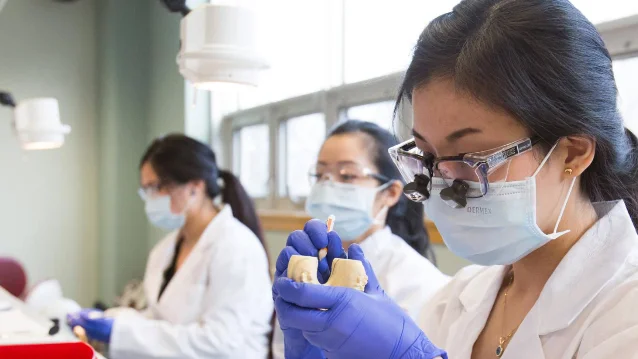
This rule creates a paradox for dental faculties located on university campuses. Undergraduate and graduate students frequently seek low-cost care at on-campus dental school clinics. However, because most Canadian student unions negotiate group dental plans, those students cannot use CDCP coverage to offset fees unless they successfully opted out during designated enrollment windows and retain no secondary household coverage. For campus clinics attempting to build high-volume screening pipelines, verifying whether a prospective young adult patient is disqualified by their student union plan adds another layer of administrative friction.
Why treatment continuity matters more in dental school
Clinical dental education operates on different economic and clinical rules than general practice. As Dr. Anastasia Kelekis-Cholakis, dean of the University of Manitoba Dr. Gerald Niznick College of Dentistry, observed during the rollout of federal dental benefits, students must reach specific procedural competency levels to graduate, making patient volume and retention a structural priority. 3
Several factors amplify patient dropouts once treatment begins:
- Appointment duration and pacing: A procedure that takes 45 minutes in private practice often requires three hours in a teaching clinic because faculty supervisors must inspect and sign off on each clinical stage—from cavity preparation to matrix placement and final restoration. Western's adult clinic schedules patients in rigid three-hour morning (9 a.m.–12 p.m.) and afternoon (2 p.m.–5 p.m.) blocks. 1
- Co-payment surprises: The CDCP is not a free care program. Patients with adjusted family net incomes between $70,000 and $79,999 pay a 40% co-payment, while those earning between $80,000 and $89,999 pay a 60% co-payment. 4 When lower-income patients discover unexpected out-of-pocket costs after their initial examination, appointment cancellation rates rise.
- Fee schedule gaps: Dental providers can balance-bill the difference between provincial dental association fee guides and the CDCP established reimbursement rate. While the CDCP covers roughly $86 per $100 of reference fees—substantially higher than traditional provincial programs like Ontario Works or Healthy Smiles Ontario, which reimburse around $32 per $100—uncovered balances still lead patients to abandon care before completion. 5
When a private patient leaves, the practitioner fills the open chair with another booking. When a teaching-clinic patient disappears halfway through root-canal therapy or crown fabrication, the dental student cannot simply substitute another person; they must recruit, screen, and diagnose a new candidate from scratch, placing their semester credits at risk.
How dental faculties are adapting to the compliance burden
To prevent mid-treatment churn, Canadian dental faculties are redirecting federal grant support into administrative screening and patient-navigation systems.
| Operational challenge | Policy mechanism | Practical clinic impact | Dental school response |
|---|---|---|---|
| Member eligibility audits | T4 Box 45 / T4A Box 015 matching with 45-day proof deadline 2 | Patients freeze treatment or face benefit clawbacks mid-semester | Hiring dedicated clinic patient navigators to audit insurance status before clinical booking |
| Student organization exclusion | Statutory bar on individuals with access to student union dental plans 4 | Campus students mistakenly apply CDCP coverage to dental school appointments | Establishing pre-screening triage at reception to separate CDCP from student union claims |
| Tiered co-payment attrition | 40% to 60% co-payments for incomes above $70,000 4 | Patients fail to show up for multi-stage restorative appointments | Deploying Oral Health Access Fund (OHAF) subsidies to offset patient co-payments 6 |
| Chair time and scheduling strain | Three-hour appointment blocks under continuous faculty supervision 1 | High appointment cancellation and long institutional waitlists | Developing evening clinic pilots and off-campus community rotations 6 |
Health Canada's $35 million OHAF Stream 1 grants allocated over three years have provided the bridge funding for these responses. Institutions such as the University of Toronto ($733,627), Western University ($613,000), the University of British Columbia ($528,000), and the University of Manitoba ($336,000) received dedicated short-term funding to recruit patients, cover co-payments, and support intake coordination. 6
As the 2026–2027 academic year begins, the test for dental schools is no longer whether they can attract inquiries from covered Canadians. The test is whether their intake desks can insulate students from federal audit risks, verify eligibility before instruments are laid out, and keep patients in the chair until complex treatments are finished.
References
- 1Main Clinic (Adult) - Dentistry - Western University
schulich.uwo.ca
- 2
- 3
- 4
- 5
- 6Oral Health Access Fund projects
canada.ca
This story was produced automatically by a channel. One sentence is all it takes for Neodrop to keep producing for you.