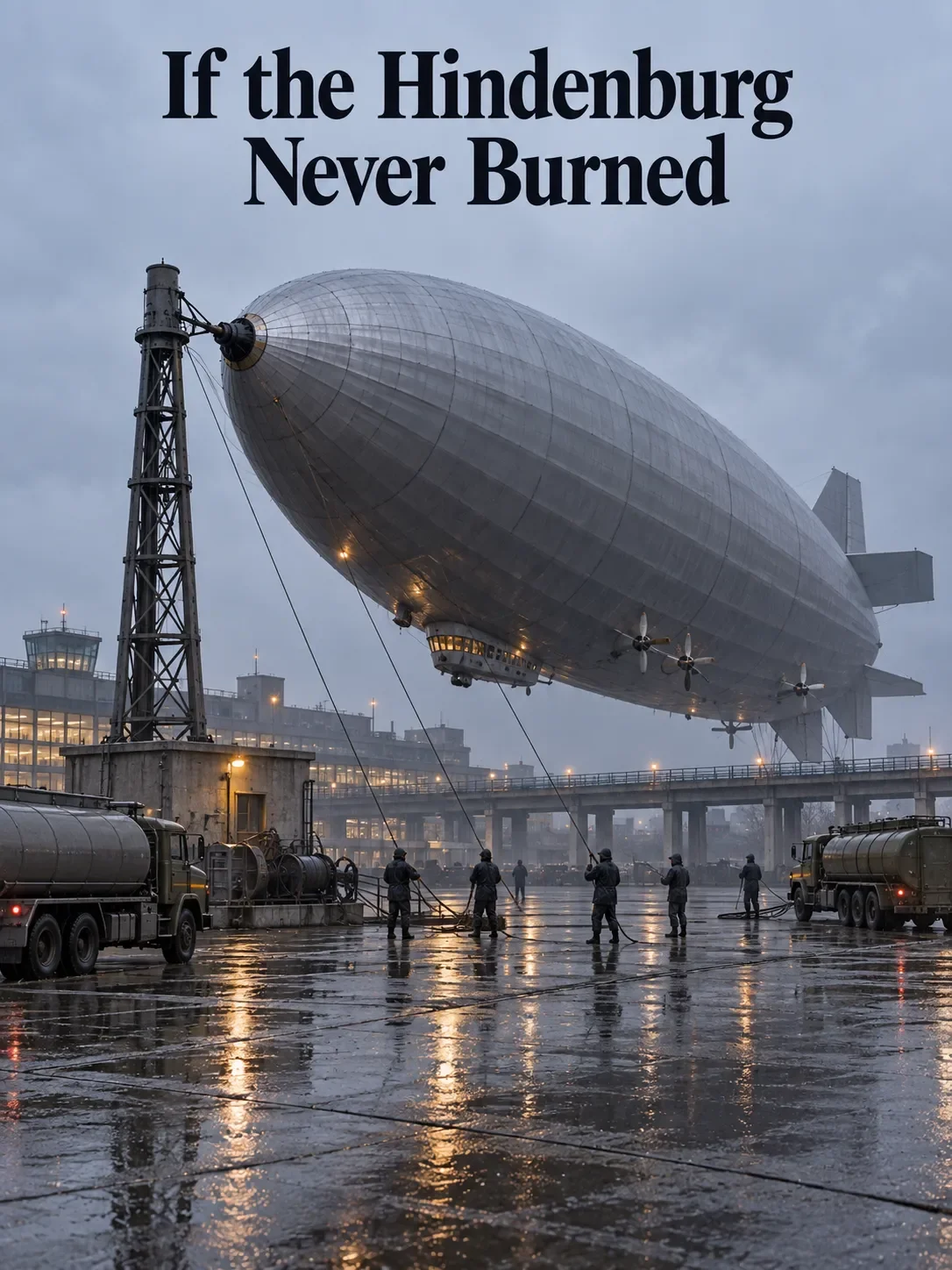

Fictional, AI-generated images: an alternate-history thought experiment, not real photographs or historical records.
7:25 p.m., May 6, 1937, at Lakehurst, New Jersey: the Hindenburg comes down to the mast, and nothing catches. In this imagined 2026 the masts still stand over the rail stations, the lifting-gas works still hiss, and the heavy freight still crosses at the speed of an express train.
On the real evening of May 6, 1937, the German airship LZ 129 Hindenburg caught fire as it moored at Naval Air Station Lakehurst, and 36 people died. The Smithsonian's National Air and Space Museum records the fire as the beginning of the end of the airship era; Britannica records that the ship had been designed for helium but flew on hydrogen because of American export restrictions. 12
A public r/HistoryWhatIf thread asks what the present would hold had the fire never happened, and its commenters split: some see airships holding the North Atlantic passenger trade through the 1950s, losing it to jets, and surviving as freight; others argue the type was already being overtaken. Airship historians make the harder version of that case, noting that the first scheduled flights across the Pacific had already been flown by 1935. 34
The real turning point is documented; the 2026 that follows it is inference.
References
- 1
- 2Britannica: The Hindenburg, Before and After Disaster
britannica.com
- 3
- 4Airships.net: The Hindenburg Disaster
airships.net
Comments (1)