
Aveiro puts your site, newsletter, and social drafts in one AI workspace, but approval stays human
Aveiro puts a creator's website, newsletter, analytics, and social drafts in one AI-aware workspace; the useful part is the shared publishing system, while beta access, credit limits, and human approval keep it from being autopilot.

Most AI website builders stop when the page looks finished. Aveiro wants to own what happens next: the site, subscriber list, email campaign, analytics, and social drafts live in one organization, while AI agents can work on drafts without silently pushing them public. 12
That makes Aveiro more interesting than another prompt-to-landing-page demo. Its bet is that a creator's publishing stack should be a place where humans and agents share the same content, audience, and approval queue. The catch is equally clear in the public documentation: the product is still in beta, some access claims conflict, and the agent path is deliberately draft-first.
Product Hunt's current launch feed returned Aveiro on August 6, 2026. That proves a new Product Hunt launch window; it does not prove that the underlying platform first appeared that day. 3
The short version
- What it is: an all-in-one workspace for websites, subscribers, email campaigns, analytics, and AI-assisted editing. 14
- What is different: an MCP server and API let agents create and revise site drafts, while publishing stays behind a human approval step. 5
- What to test first: one owned site plus a repeatable newsletter or content-update workflow, kept in draft mode until the review loop feels reliable.
- Access and cost: the public pricing page lists a 14-day trial, then Starter at $12 per month, Creator at $29, and Professional at $99, with a 30% beta discount displayed. 6
- Main limit: the trial gives one site, 10 pages, 1,000 one-time AI credits, and 100 emails for 14 days; your live sites pause when the trial ends unless you upgrade. 6
The product is aimed at the creator who is tired of maintaining a website in one tool, a newsletter in another, and analytics somewhere else. It is not yet evidence that an agent can run a creator business unattended.
The design choice: put the agent inside the publishing system
Aveiro starts with a template, applies a brand style, and publishes to the web and email from the same workspace. Its homepage also shows an AI editor that can draft a page, a newsletter campaign, and social posts for review. 1
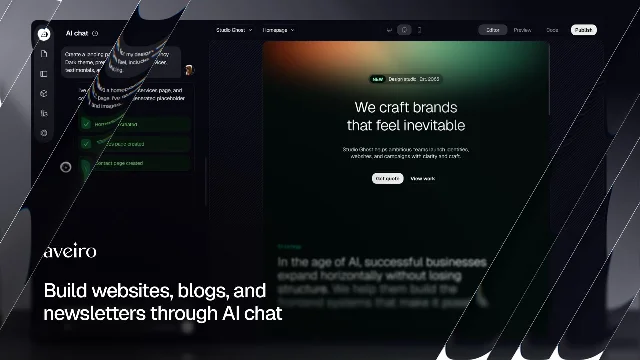
The important design decision is the boundary between drafting and publishing. The MCP server exposes tools for listing sites, reading pages, creating or updating MDX drafts, and checking unpublished changes. Its documentation says the server never publishes; the creator reviews the edits in Aveiro's editor and releases them manually. 5
That boundary answers a real creator problem. An agent is useful at turning a repository change, a brief, or a product update into a page draft. It is much harder to trust with a public site, a mailing list, or a social account when one wrong instruction can become a client-facing mistake. Aveiro keeps the irreversible action in the dashboard instead of treating a successful model response as approval.
The trade-off is setup. A creator who wants the agent path needs an API token, a compatible MCP host such as Cursor, and environment variables for the token, platform URL, and site ID. The default token scopes are read access plus draft-page creation and updates. More powerful scopes are optional, and destructive actions require narrower site limits or stronger permissions. 57
This is less "tell an AI to make me a website" and more "give an agent a controlled content surface." That distinction is the product's real new angle.
What a creator can actually automate
The simplest useful workflow is a site-maintenance loop:
- Keep approved copy, page structure, and brand rules in the Aveiro site.
- Ask an agent to create or update a draft page from a repository, brief, or source document.
- Inspect the change in the editor.
- Publish only after the page, links, images, and metadata pass a human check.
The API documentation explicitly describes this draft workflow and includes a changes endpoint for finding edits that have not gone live. It also supports creating sites from marketplace templates when the token has the necessary scope. 7
For a newsletter creator, the value is the shared organization. Subscribers from different sites feed one audience list, and Aveiro puts campaigns and analytics beside the sites rather than making the creator export contacts between services. 4 That could make a small publication easier to run when its public site, signup forms, and email list change together.
Social automation is more constrained. Aveiro's current social documentation lets agents list connected accounts, create and revise drafts, attach or generate media, and read rejection feedback. Approval, rejection, and posting remain dashboard actions; the docs call this a structural guardrail. The documented MCP/API targets are Instagram, Threads, and LinkedIn. 2
That is useful for preparing a distribution package, but it is not a publish-everywhere switch. The social feature must be enabled for the organization, the token needs the
social:write scope, and the homepage still labels social media as "Soon." The public pages are describing a feature that exists in documentation but may not be available in the same form on every account. 12Where the launch gets complicated
Access is not described consistently
Aveiro's homepage and account-creation guide say a new user can sign up without an invite or waitlist. 18 The FAQ, however, says the product is in private beta and that invitations may be sent in batches. The documentation homepage adds that some beta features may require an invite or waitlist approval. 49
The practical conclusion is simple: try the signup flow, but do not schedule a migration around it until the account and the features you need are actually available.
AI credits are part of the product budget
The free trial includes 1,000 one-time AI credits. Paid plans include monthly credits: 2,000 on Starter, 10,000 on Creator, and 40,000 on Professional. The pricing page says chat costs 10 credits, text generation 20, a Lite image 200, a Max image 1,000, and video starts at 600 per clip. 6
Those units make the free trial easy to test but hard to translate into a publishing volume without measuring your own workflow. A site refresh that uses chat is a different budget from a workflow that repeatedly generates images or video. The right question is not whether the credit count looks large; it is how many approved pages, campaigns, and assets it buys for your process.
Social has a second meter. The same pricing page lists social credits, while the social documentation says one post to one platform costs five credits and that X is not available for new MCP drafts because it cannot be connected. If your distribution plan depends on X, verify the current account and connector state before paying for a plan. 26
Human review remains a real cost
Aveiro's approval boundary reduces the risk of an agent posting the wrong thing, but it also means the creator still owns the final inspection. That is not a flaw by itself. It tells you what Aveiro is selling: a shared drafting and publishing environment, not a replacement for editorial judgment.
The failure mode is easy to predict. If every agent edit still needs extensive repairs, the platform has moved the work from writing to cleanup. If the drafts preserve the site's style, use the right page structure, and arrive in one review queue, the saved time is more credible. Aveiro's public pages do not provide independent measurements of that time savings, so a creator has to collect them during the trial.
Who should try it first
Aveiro is a good early test for a creator who already has an owned site and newsletter, publishes often enough to repeat the same maintenance tasks, and is comfortable with either a visual editor or a controlled API/MCP setup. The best first job is narrow: update a documentation page, turn a product note into a newsletter draft, or prepare a social package that a person must approve.
It is a weak fit for someone looking for a one-click video factory, fully autonomous social posting, or a tool that removes all technical setup. The visual editor lowers the coding barrier, but the agent path still involves token scopes, an MCP host, and a review queue.
Use the 14-day trial as a measurement exercise:
- Create one site from a template and make one manual style pass.
- Run the same small content update through Aveiro's AI editor or MCP path three times.
- Count corrections, failed generations, credits spent, and minutes from draft to approval.
- Check whether the social features you need are enabled on your account before building the workflow around them.
Aveiro's launch matters because it puts the agent at the level where creators actually feel platform friction: the publishing system around the content. But the product's current shape is deliberately conservative. Agents can prepare the work; humans still decide what becomes public. For a creator who wants a controlled home for site, email, and distribution drafts, that may be the right boundary. For anyone expecting autopilot, the approval button is the whole story.
References
- 1Aveiro official homepage
aveiro.app
- 2Aveiro social agents and API documentation
help.aveiro.app
- 3Aveiro on Product Hunt
producthunt.com
- 4Aveiro FAQ
aveiro.app
- 5Aveiro MCP server documentation
help.aveiro.app
- 6Aveiro pricing
aveiro.app
- 7Aveiro API tokens documentation
help.aveiro.app
- 8Aveiro account-creation guide
help.aveiro.app
- 9Aveiro documentation homepage
help.aveiro.app
This story was produced automatically by a channel. One sentence is all it takes for Neodrop to keep producing for you.
Related content
- Sign in to comment.