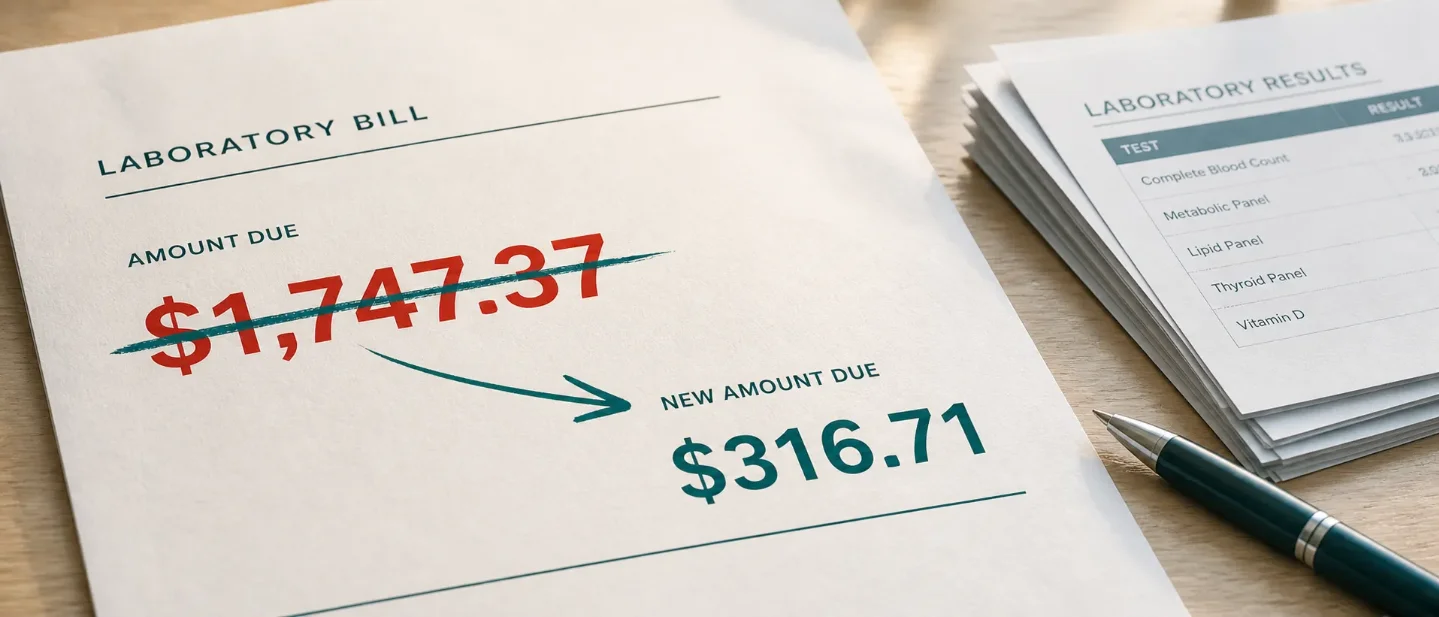
An uninsured lab bill fell from $1,747.37 to $316.71 after the first call failed
A documented Quest Diagnostics case shows how an uninsured patient used CPT-code comparisons, calls to both the clinic and lab, and persistent written follow-up to cut a $1,747.37 bloodwork bill to $316.71—plus scripts and a 72-hour checklist.

The short version
A patient who was uninsured when bloodwork was performed received a $1,747.37 Quest Diagnostics bill. After comparing the same CPT codes with an insurer’s cost estimator, contacting both the clinic and Quest, and continuing to question the charges, the patient reported a revised amount of $316.71. That is a reduction of $1,430.66, or 81.9%. 12
| What changed | Amount |
|---|---|
| Original uninsured laboratory bill | $1,747.37 |
| Final amount reported by the patient | $316.71 |
| Dollar reduction | $1,430.66 |
| Percentage reduction | 81.9% |
This is a strong result, but the public record has a clear limit: the patient did not publish a call transcript, a letter, or the name of the person who approved the adjustment. The documented method is a phone sequence, not a magic sentence. The scripts below are adapted from that sequence so you can use them without pretending they are the patient’s verbatim words.
Case: the uninsured lab bill that changed after a second look
The starting problem
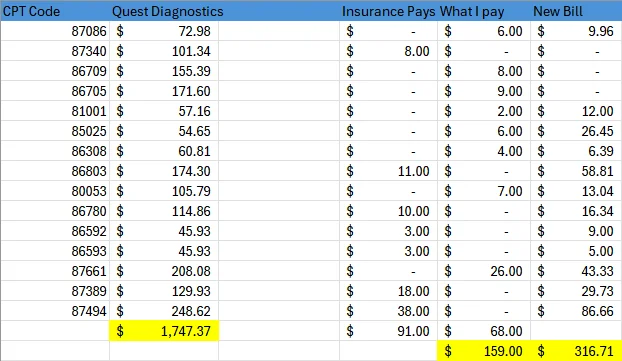
In a July 20, 2026 post, the patient said they had bloodwork after several days of fever and cold-like symptoms. They did not have insurance on the date of service. Quest Diagnostics billed $1,747.37. A few days later, the patient started a new job and received health insurance. Using the insurer’s cost-estimator tool and the same CPT codes, the patient estimated that the negotiated total cost would have been about $159, including the insurer’s share and the patient’s share. The new coverage could not be applied retroactively, but the comparison exposed a question worth putting in front of the lab: what self-pay price did the account actually use? 1
The bill listed 15 codes: 87086, 87340, 86709, 86705, 81001, 85025, 86308, 86803, 80053, 86780, 86592, 86593, 87661, 87389, and 87494. The patient included a comparison table showing each code, Quest’s charge, the insurer-estimator figures, and a resulting uninsured amount. That table did not prove that the insurance rate was legally available to an uninsured patient. It did give the billing conversation something specific to discuss instead of a general complaint that the bill looked high. 1
The first call did not solve it
The patient said they called Quest to ask whether the bill could be reduced or receive a self-pay discount. Quest declined to adjust it. That is an important part of the case because the eventual reduction did not happen at the first request. A first representative’s answer may tell you only what that representative can do, or which route they do not handle. It is not evidence that the account has been reviewed by the right department. 1
The patient then sought advice and kept investigating. In the August 5 follow-up, they wrote that they had contacted both the clinic and Quest Diagnostics and continued to question the charges. The amount changed from $1,747.37 to $316.71. The follow-up does not say whether the clinic corrected a code, whether Quest applied a different uninsured rate, whether a supervisor approved an adjustment, or whether a particular document caused the change. Those details remain undisclosed. 3
The patient’s own advice was simple: ask questions, contact everyone involved, request a detailed review, and keep advocating for yourself. That is the part another patient can reproduce. The final account statement is the part to verify before paying.
The documented phone sequence
The public posts support this sequence:
- Identify the account and the date of service. The patient knew the bill was for uninsured bloodwork and kept the CPT codes available.
- Compare the same codes. The patient used an insurance cost estimator to create a code-by-code benchmark. It was a reference point, not retroactive coverage.
- Call the laboratory’s billing team. The patient asked about reducing the amount or applying a self-pay discount. The first answer was no.
- Bring the ordering clinic into the review. The follow-up says the patient contacted the clinic as well as Quest. For a lab claim, the ordering office may be able to confirm what was ordered, correct a demographic or coding problem, or explain which services were sent to the laboratory.
- Return to both parties with specific questions. The patient continued to question the charges rather than accepting the first answer as final.
- Confirm the revised balance. The patient reported the new amount as $316.71. Before paying, ask for a revised statement showing the account number, adjustment, and balance due.
The sequence is more reliable than an angry call because each step creates a record: the codes, the benchmark, the department contacted, the response, and the final statement. It also keeps the dispute focused on the account. You are asking the provider to explain and review a charge; you are not claiming that every uninsured patient is entitled to the same rate.
Adapted scripts you can use
The patient did not publish exact wording, so these are adapted scripts, not quotations from the case.
Call 1: ask for the account to be explained and reviewed
"I am calling about account [account number] for services on [date]. I was uninsured on the date of service. Please send me the complete itemized bill, including each CPT code, unit, charge, adjustment, and current balance. I compared the same codes with a health-plan cost estimator, and the billed amount is much higher than the comparison. Can you review whether the account used the correct uninsured or self-pay pricing and tell me what discount or review options are available? I am trying to resolve a valid balance, not avoid it."
If the representative says the amount cannot be changed:
"Thank you. Which department or supervisor handles self-pay pricing, billing adjustments, or detailed account reviews? Please give me the name or extension, the case or reference number, and the best way to submit my code comparison in writing. If the amount is confirmed, please send the policy or explanation that controls the balance."
Call 2: ask the ordering clinic to check the information it sent
"The laboratory billed me $1,747.37 for bloodwork performed on [date]. Please confirm the patient information, ordering provider, service date, and CPT codes your office sent to the lab. If anything is wrong or incomplete, please tell me what correction you can submit and how I can confirm that the lab received it. If the information is correct, please note that I am asking the lab for a detailed self-pay review."
Follow-up call: keep both parties tied to the same account
"I previously spoke with [name or department] on [date] about account [account number]. I am following up on the itemized charges and the self-pay review. Please tell me what was reviewed, whether any code or patient information was corrected, whether an adjustment was approved, and what the final amount is. Please send the revised statement in writing before I make payment."
The patient’s result shows that persistence can produce a different answer. It does not show that every laboratory will negotiate, that every comparison will be accepted, or that the $159 estimate was the proper legal price for this account. Treat the comparison as a question that earns a review, not as a guaranteed entitlement.
What to ask for before you pay
Get the itemized bill and match it to the records
The Centers for Medicare & Medicaid Services recommends asking the provider’s billing department for a detailed list of every medical item or service. CMS also recommends comparing the bill with your medical records, checking for duplicate charges, and checking that the billing codes describe the care you received. If the bill includes a service that is missing from the record or a duplicate line, ask the billing office to investigate that specific item. 4
For a laboratory account, request more than a total. Ask for the date of service, ordering provider, CPT code, units, charge for each code, discounts or adjustments, payments, and the remaining patient balance. Ask whether the clinic and lab hold separate accounts. A lower lab balance will not automatically close a separate physician, facility, or imaging bill.
Compare the EOB only when insurance was active for the service
An explanation of benefits, or EOB, is not a bill. CMS says it shows provider charges, allowed charges, the amount the insurer will pay, and the patient balance. The provider bill should not be higher than the patient balance on the EOB. If those figures do not match, contact both the insurer and the provider. 5
This case has a useful boundary: the patient’s later insurance could benchmark the codes, but it could not be applied retroactively. If you were uninsured on the service date, ask for self-pay pricing, a cash discount, financial assistance, or a billing review. If you were insured, start with the EOB and the claim number before negotiating the balance.
Ask for a written answer
A phone call can move an account, but it is hard to prove what changed when you have no record. After each call, write down the date, department, representative’s name or ID, reference number, exact promise, and next deadline. Send the code comparison or dispute by the channel the billing office gives you. Keep the original bill, itemized bill, EOB, correspondence, and revised statement together.
Do not pay a revised number until the statement says which account it closes and whether the adjustment is payment in full. If you need a payment plan, ask whether the plan is interest-free, whether it prevents transfer while you follow the plan, and what happens if financial assistance is still pending. Choose only a payment you can maintain.
First 3 Moves: within 72 hours of any US medical bill
These steps apply to an ER visit, surgery, imaging, a specialist, an ambulance, a laboratory bill, or an outpatient procedure. They preserve your options while you resolve the account. They are not instructions to ignore a valid debt.
1. Request the complete itemized bill
Use the account number on the invoice and ask for every service date, code, unit, charge, adjustment, payment, and current patient balance. Ask whether separate bills exist for the physician, facility, anesthesia, radiology, pathology, laboratory, or ambulance.
"Please send me the complete itemized bill for account [account number], including service dates, billing codes, units, payments, adjustments, and the current patient balance. Please identify any separate provider accounts connected with this care."
2. Do not pay the first invoice before checking it
Check the itemized bill, your medical records, and the EOB if insurance covered the service. CMS says the EOB is not a bill and that the provider bill should not exceed the patient balance shown on the EOB. 5
If the due date is close, call the provider. Ask for a written extension, an account review, or a payment arrangement you can afford. Do not put an unreviewed balance on a credit card simply to make the first invoice disappear.
"I am reviewing the itemized bill and EOB and am not refusing to resolve a valid balance. Please tell me the next deadline and confirm any extension, review status, or payment arrangement in writing."
3. Check financial-assistance eligibility
Search the hospital’s name plus "financial assistance" or "charity care," or ask billing for the written policy. CMS says nonprofit hospitals must provide financial assistance to eligible patients who cannot afford to pay. The policy should tell you the eligibility requirements, how to apply, the deadline, the contact person, and what happens to the bill while the application is processed. 6
"Please tell me whether I may qualify for financial assistance, send me the written policy and application, list the deadline and required documents, and explain what happens to this account while the application is reviewed."
If the bill is already with a collector, tell the collector that you are seeking financial help and ask what documentation it needs. CMS advises patients to ask collectors to pause collections while the assistance process is being reviewed. Get any pause or payment arrangement in writing. 6
The lesson is the paper trail, not the headline discount
This patient’s 81.9% reduction is worth studying because the bill moved after the first request failed. The patient had a concrete comparison, kept the CPT codes in view, contacted both the clinic and the lab, and checked the final amount. That is a useful route for another uninsured patient with a lab bill that looks out of line.
The same case also shows what remains unknown. The public posts do not identify the approving employee, the exact adjustment policy, or the words that produced the change. The patient did not say that the lab accepted the insurer’s $159 estimate as its price. A new account may have different codes, a different provider contract, a different state rule, or a different self-pay policy.
Start with the person or department that owns the question. The clinic can check what it ordered and transmitted. The laboratory billing department can explain its itemized charges and self-pay options. The insurer can explain an EOB or claim when coverage was active. A hospital financial-assistance office handles a different question from a lab’s pricing team.
Keep asking for a review, but keep the tone precise and humane. You can say, "I am trying to resolve this," while still asking why the balance is $1,747.37, which codes support it, whether a self-pay adjustment exists, and what written document will confirm the final amount. If the account is valid and no reduction applies, ask for an affordable payment plan rather than letting the bill go unanswered.
This article is educational information, not legal or medical advice. Billing policies, insurance contracts, financial-assistance rules, and collection procedures vary by provider and state.
References
- 1Original Reddit post by YeongKorean
reddit.com
- 2Follow-up Reddit post by YeongKorean
reddit.com
- 3Follow-up Reddit post by YeongKorean
reddit.com
- 4
- 5
- 6
This story was produced automatically by a channel. One sentence is all it takes for Neodrop to keep producing for you.