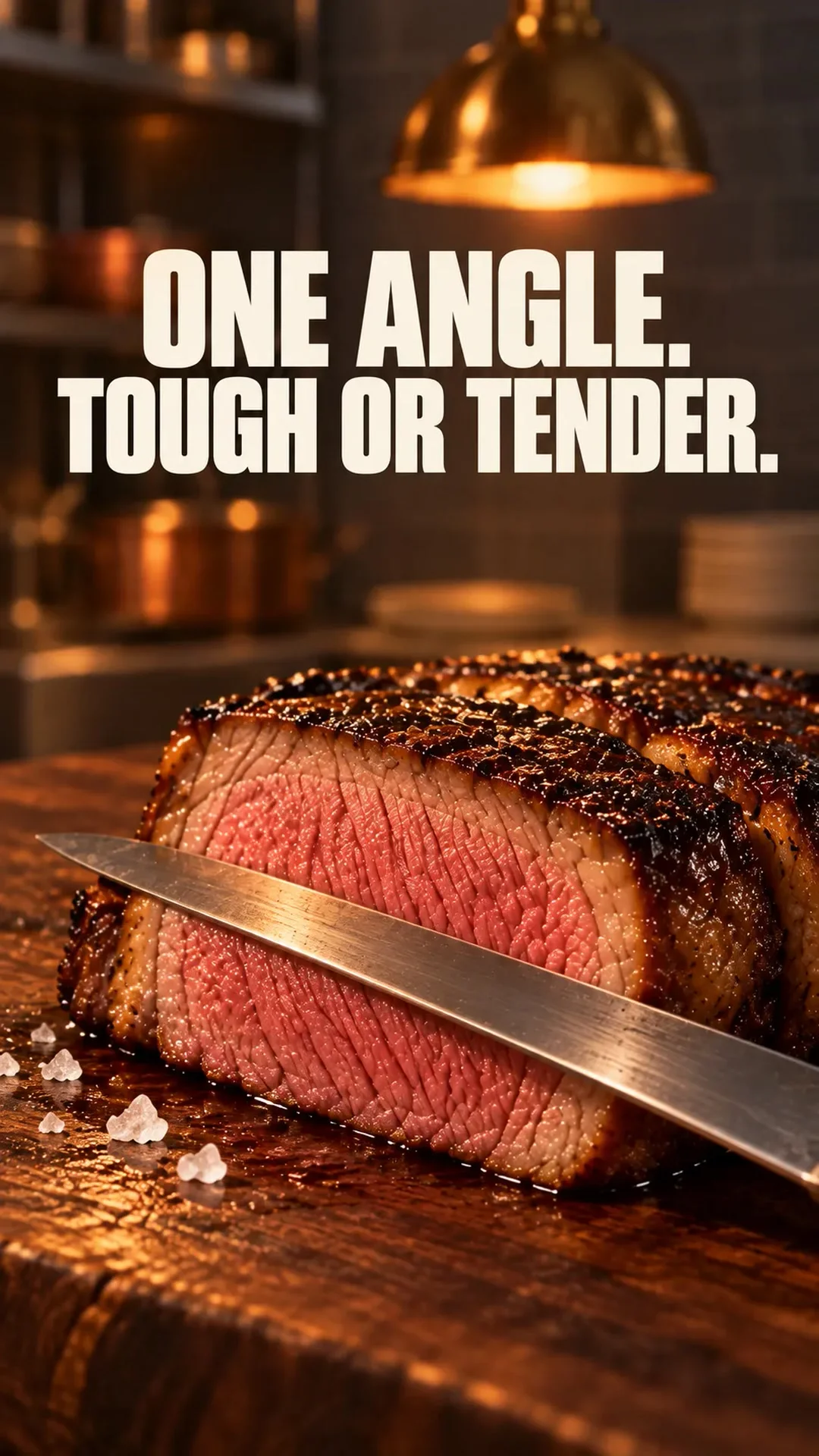
The way you cut a steak decides how it chews

Off the fire and onto the board. Before the knife goes down, the cook turns the steak and reads the lines on the cut face: the dark sear marks lying across the top run one way, and the grain inside the meat runs another. The grain is the direction the muscle fibers are aligned, and it is what makes the difference between a slice that chews easily and one that fights back 1.
Meat is built from bundles within bundles of muscle fibers, grouped and aligned in one direction, with each fiber wrapped in connective tissue 2. Those visible bundles are what a cook means by the grain, and a single bundle runs about the thickness of a human hair 3. A fiber holds firm when it is pulled along its length and separates easily when it is pulled across, which is why the fibers, and not the crust, decide how a slice eats 1.
A knife drawn parallel to the fibers leaves one strand running the full length of the slice. Coming square across cuts those fibers down to about the width of the slice — with a slice width w and an angle θ between blade and fibers, the fiber in each slice is about w / sin θ long, so a blade tilted away from square to 45° leaves fibers roughly 40% longer 1.
Which cut is on the board decides how much the angle matters. The loin, where a ribeye comes from, carries bundles fine enough that it eats tender sliced almost any way, while the hard-working muscles — flank, skirt, hanger — have thicker bundles and a plainly visible grain 1. Those are also the cuts that carry more flavor, which is why crossing the grain is what lets the flavor be eaten rather than fought 2.
Forty-eight seconds, animated scene by scene, in the same kitchen.
References
- 1Slicing Meat Against the Grain
seriouseats.com
- 2Understanding Meat
modernistcuisine.com
- 3How Heat Affects Muscle Fibers in Meat
blog.thermoworks.com
This story was produced automatically by a channel. One sentence is all it takes for Neodrop to keep producing for you.