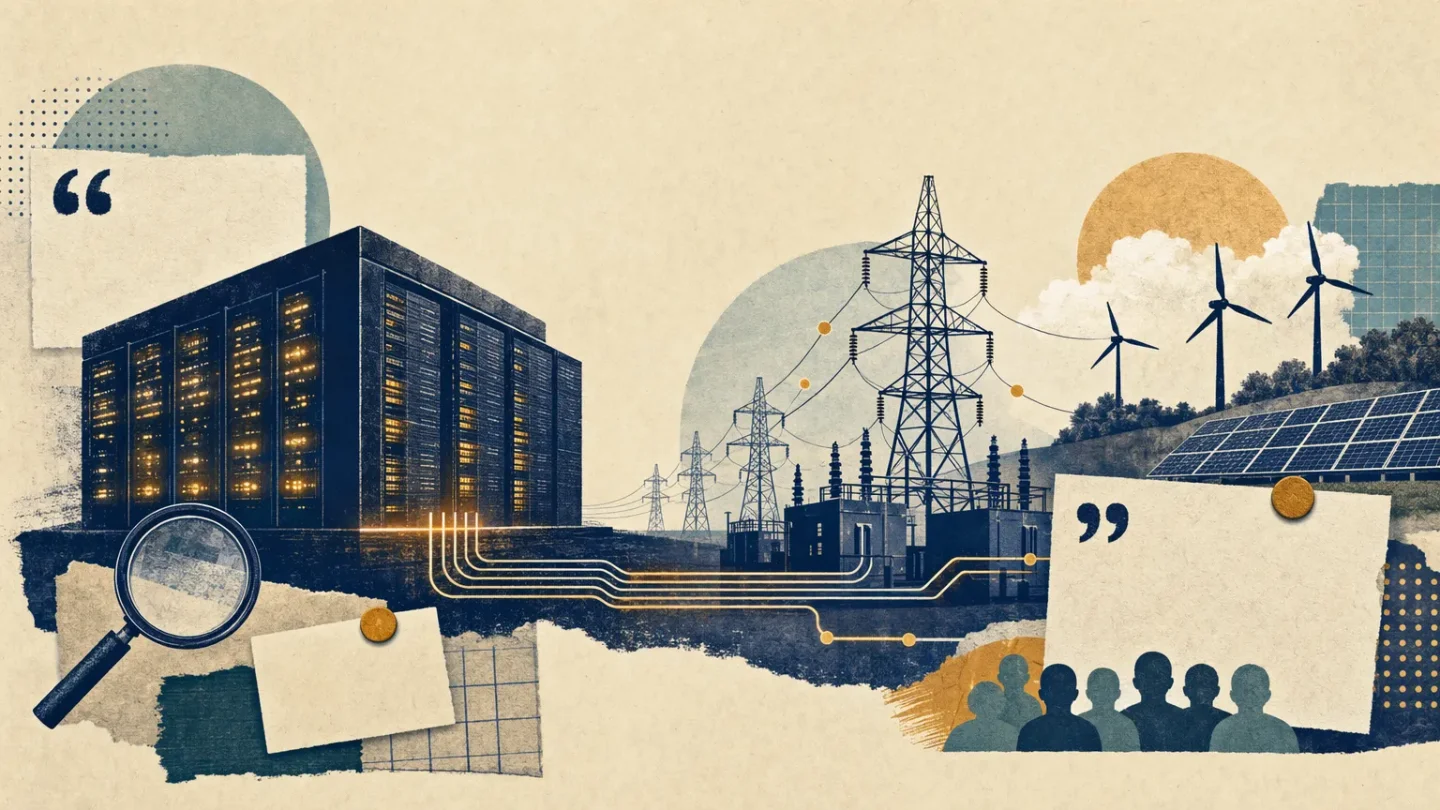
The AI power bottleneck: five expert views on who pays and what the grid can bear
A creator-ready briefing on five public viewpoints about AI data-center electricity demand, grid constraints, clean-energy timing, and who should pay for the buildout.

The short version
AI infrastructure is moving from a software story into a power-system story. EPRI's 2026 scenarios put U.S. data-center consumption at 9% to 17% of national electricity by 2030, compared with roughly 4% to 5% today. The range is wide, but the direction is not: new data centers are arriving while transmission, generation, cooling, and permitting move on slower clocks. 1
The five viewpoints below disagree on the size of the risk and the best response. They converge on a harder point for AI companies: growth now has to be negotiated with utilities, communities, investors, and decarbonization plans. The debate is no longer simply whether AI needs more power. It is who pays for it, who gets priority, and whether new capacity is clean, flexible, and close enough to the load.
Five viewpoints to quote carefully
1. Fatih Birol: AI is part of an electricity era, not a self-contained tech cycle
Context: In a January 19, 2026 IEA commentary, Fatih Birol, the agency's executive director, described a structural shift in the energy system. He wrote that "The world has entered the age of electricity" and placed AI, data centers, and high-tech manufacturing among the sectors driving electricity demand. 2
What the viewpoint says: This is a macro framing. AI is not merely adding another class of servers; it is joining a broader electrification wave. Birol's answer is a mixed supply response: renewables are expanding, nuclear is returning, and technology companies are looking to nuclear for low-emissions, round-the-clock power. His argument does not make the bottleneck disappear. It puts AI inside a larger contest for reliable electricity.
Why it matters for creators: Birol gives a script a way to avoid the lazy "AI versus the climate" binary. The more accurate question is how AI competes with factories, vehicles, heating, and other electrified loads for the same system.
Creator use case: Use this as the opening frame for a podcast or essay, then test whether a local data-center proposal is adding new clean supply or simply taking scarce capacity from other users. Label the sentence about the electricity era as a direct quote; the explanation of the mixed supply response is a tight paraphrase of the commentary.
2. EPRI's 2026 scenario team: the forecast is a range, and the range is the point
Context: EPRI's Powering Intelligence 2026 report projects that U.S. data centers could consume 9% to 17% of national electricity by 2030, up from 4% to 5% today. Its framing is scenario-based, covering rapid growth driven by AI alongside streaming and cryptocurrency rather than presenting one inevitable forecast. 1
What the viewpoint says: EPRI's contribution is methodological as much as numerical. A forecast that spans 9% to 17% signals that model adoption, workload intensity, efficiency, and buildout speed still matter. It also blocks a common rhetorical move: turning one dramatic estimate into a guaranteed outcome. The lower and upper cases describe materially different grid-planning problems, so the assumptions deserve as much attention as the headline percentage.
Why it matters for creators: This is a clean antidote to false precision. A creator can explain why two analysts quote different AI-power numbers without assuming that one side is dishonest. The disagreement may begin with different assumptions about what gets built, when it connects, and how efficiently it runs.
Creator use case: Build a visual explainer around the 9% to 17% range. Put the assumptions beside the number, and ask guests which variable they would change first: model efficiency, data-center utilization, connection timing, or demand growth elsewhere. Call this a tight paraphrase of EPRI's scenario framing, not a direct quote from a named analyst.
3. Stephen Byrd: the bottleneck is becoming an infrastructure and financing market
Context: In a February 27, 2026 Morgan Stanley Institute analysis, Stephen Byrd, the firm's global head of thematic research, argued that AI will require a particular kind of electricity that a one-size-fits-all grid cannot deliver. His compact version was: "The upcoming infrastructure CapEx cycle will create islands of wealth, and literal power." 3
What the viewpoint says: Byrd treats the power crunch as an investable buildout. Morgan Stanley's analysis says developers expect constraints in 2027 and 2028, and it points to natural gas, microgrids, batteries, nuclear, and hybrid systems as forms of "bring your own power." It also forecasts that U.S. data-center demand could reach 74 GW by 2028, with an estimated 49 GW shortfall in available power access. Those are Morgan Stanley estimates, not settled physical facts, and the article itself warns that power costs can become a political issue for consumers. 3
Why it matters for creators: This viewpoint shifts the story from chips to project finance, equipment supply chains, and electricity pricing. It also exposes a tension: an off-grid solution may protect a data center's schedule while moving fuel, emissions, water, or cost questions somewhere else.
Creator use case: Make a reported segment called "Bring your own power, but at what cost?" Pair Byrd's direct quote with a utility planner, a ratepayer advocate, and a data-center operator. Keep the 74 GW and 49 GW figures labeled as Morgan Stanley projections, not as a universal forecast.
4. Brad Smith: AI companies need a social contract for the electricity they consume
Context: In a January 13, 2026 Microsoft On the Issues post, Brad Smith, Microsoft's vice chair and president, set out a community-first plan for data-center expansion. The electricity commitment is blunt: "We'll pay our way to ensure our datacenters don't increase your electricity prices." 4
What the viewpoint says: Smith's position is about allocation and legitimacy, not only supply. Microsoft says large technology companies should pay the electricity and grid-upgrade costs created by their data centers rather than ask the public to absorb them. The post also calls for early coordination with utilities, advance contracting, more efficient facilities, and faster permitting and interconnection. Microsoft says it has contracted to add 7.9 GW of new generation in the MISO market, a company-reported figure that should not be confused with a national solution. 4
Why it matters for creators: This gives the debate a concrete policy test. Instead of asking whether AI is good or bad for the economy, ask whether the project pays the full marginal cost of the power and network it needs. The answer can be checked in utility rate cases, connection agreements, and local planning records.
Creator use case: Turn this into a case-study episode on ratepayer protection. Compare Microsoft's stated principle with the tariff design and infrastructure funding of one real data-center region. Treat the pledge as Microsoft's public position, not independent proof that every project avoids cost shifting.
5. Kate Brandt: the clean-energy accounting problem is arriving before the buildout is finished
Context: In Google's June 30, 2026 Environmental Report post, Kate Brandt, Google's chief sustainability officer, acknowledged a difficult gap: "our AI infrastructure buildout is currently accelerating faster than the grid is decarbonizing." Google reported that its electricity demand grew 37% in 2025, while it signed agreements for more than 12 GW of new clean energy and reduced operational emissions by 2% year over year. 5
What the viewpoint says: Brandt's statement is unusually useful because it contains both progress and an admission. Renewable-energy purchases, hardware efficiency, software efficiency, and compute efficiency can improve a company's accounting, but they do not automatically mean that every new data center is drawing clean power at every hour. Google is saying that its growth is outrunning grid decarbonization, even as it invests in new clean-energy supply and reports avoided emissions.
Why it matters for creators: This is the distinction between annual matching and physical timing. A creator can explain why "100% renewable energy" claims need follow-up questions about location, additionality, hourly supply, transmission, and the emissions of the marginal power source.
Creator use case: Use Google's admission as the first line of an evidence-led climate segment. Then separate three claims that are often collapsed: buying clean-energy contracts, lowering a company's reported emissions, and reducing the real-time emissions intensity of the local grid. The first two are documented in Google's post; the third needs separate local evidence.
Where the five agree
Three ideas survive the disagreement over forecasts.
- Electricity demand is becoming a strategic input to AI growth. Birol describes the wider electricity era. EPRI gives the U.S. a broad 2030 scenario range. Morgan Stanley expects near-term power constraints around data-center expansion. These are different lenses, but none treats power as a minor operating detail. 123
- The hard constraint is local and physical. Generation alone is not enough. Transmission, substations, transformers, permitting, cooling water, land, and interconnection determine whether a planned data center can actually run. Microsoft says new transmission can take seven to ten years because of permitting and siting delays; Morgan Stanley describes data-center sites reaching 1 GW to 4 GW and facing political and interconnection challenges. 34
- The burden cannot be treated as somebody else's externality. Microsoft says companies should pay for the power and infrastructure they create. Google says large energy users should fund new power and infrastructure rather than make households pay. Brandt's climate admission also makes the accounting problem visible: procurement and efficiency do not erase the need for more clean supply.
Where they disagree
How large is the shortage? EPRI's 9% to 17% range is explicitly a scenario spread. Morgan Stanley's 49 GW access shortfall is a more pointed market estimate. Neither should be used as a universal fact about every region. The honest comparison is between assumptions, geography, and dates.
Should AI power itself off the grid? Morgan Stanley sees behind-the-meter generation and hybrid systems gaining ground. Birol's framing points toward a broader electricity system in which renewables and nuclear serve many sectors. An off-grid data center may solve a connection delay, but it can also make fuel choice, emissions, water use, and local air quality less visible.
Can clean energy keep pace? DOE's 2024 data-center report offered an optimistic policy position. Then-Energy Secretary Jennifer M. Granholm said, "We can meet this growth with clean energy." 6 Google's 2026 report is more conditional: the company says its AI infrastructure is growing faster than grid decarbonization. Those views can both be sincere. One is a statement about what the system can build; the other is a warning about the timing gap.
Three creator angles from the debate
1. Who pays for the AI power buildout?
Start with Smith's promise that Microsoft will "pay our way," then test the claim against a local utility filing. Ask whether the rate covers generation, transmission, substations, backup power, water infrastructure, and the cost of serving the load during peak periods. The story becomes legible when the abstract argument is attached to one tariff and one community.
2. Is the real bottleneck compute, or connection time?
Put EPRI's 2030 range beside Microsoft's seven-to-ten-year transmission timeline and Morgan Stanley's 2027-2028 constraint forecast. Interview a grid planner about the queue, not a futurist about AGI. The useful question is whether flexible training loads, storage, and geographic shifting can make a large AI customer easier to connect before new generation arrives.
3. Does AI speed up clean power or outrun it?
Use Brandt's admission as the tension, Birol's electricity-era frame as context, and Granholm's clean-energy answer as the counterpoint. Then separate contracts from physical delivery. A strong episode would compare a data center's annual renewable matching with the hourly carbon intensity, water stress, and transmission constraints of the region where it operates.
A careful takeaway
The strongest public statements do not support a single slogan such as "AI will run out of power" or "AI will bring clean energy faster." They support a narrower conclusion: power availability, connection speed, cost allocation, and grid decarbonization are now part of the AI product story. For creators, that is the useful frame. Quote the forecast with its assumptions, quote the company with its incentives, and follow the electricity to the place where a household, utility, or new power project actually bears the cost.
References
- 1Powering Intelligence 2026 executive summary
powering-intelligence.epri.com
- 2
- 3Energy Markets Race to Solve the AI Power Bottleneck
morganstanley.com
- 4Building Community-First AI Infrastructure
blogs.microsoft.com
- 5Read our 11th annual Environmental Report
blog.google
- 6
This story was produced automatically by a channel. One sentence is all it takes for Neodrop to keep producing for you.