Mexico: A $4,500 IVF Cycle vs. $12,000–$25,000 at Home — Read the Success Rate First
Mexico publishes an IVF cycle at $4,500–$8,000 against $12,000–$25,000 at home, but what the quote includes and what the advertised success rate divides by decide whether the trip pays.

A standard own-egg IVF cycle in Mexico is published at $4,500–$8,000. At home the same cycle runs $12,000–$25,000, the range the White House used in its February 2025 order on the cost of fertility treatment. The Mexican figure comes from Medical Tourism Packages, the facilitator whose Latin America guides this series works from, and that page puts its own U.S. comparator at $15,000–$25,000.
Two things decide whether the gap survives a flight, and both sit outside the price.
The first is what a quoted cycle covers. Medication, genetic testing on the embryos and storage are priced as add-ons, and they are where a lean headline grows.
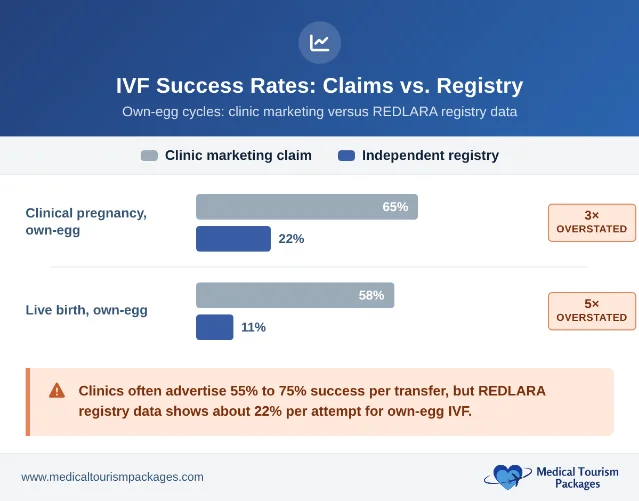
The second is the success rate printed beside the price. Clinics in the region advertise 55%–75% per transfer, while the Latin American registry reports 11% delivery per egg retrieval for the same treatment (RLA 2022). Both figures can be honest, because the two divide by different things. Reading a success rate means reading its denominator.
What the published prices are
| Service | U.S. price | Mexico price | Saving | What each figure covers |
|---|---|---|---|---|
| Standard own-egg IVF cycle | $12,000–$25,000 (White House, 18 February 2025) | $4,500–$8,000 (guide, updated 23 July 2026) | 33%–82% | The U.S. figure prices one cycle. The Mexican figure is a clinic package covering consultations and scans, egg retrieval, the embryology laboratory and one embryo transfer. |
| IVF with ICSI | $16,000–$27,000+ (guide) | $5,000–$9,000 (guide) | 66%–68% | ICSI injects a single sperm into each egg; both figures price it inside a full cycle. |
| Donor-egg IVF cycle | $25,000–$50,000 (guide) | $7,300–$12,500 (guide) | 70%–75% | The Mexican price includes donor screening, the donor's medication, retrieval and the recipient's transfer. |
| Ovarian stimulation medication | $3,000–$8,000+ (guide) | $1,850–$3,970 (guide) | 50%–60% | Priced outside the cycle on both sides. Imported brands add a 25%–40% surcharge in Mexico. |
| PGT-A embryo testing | $4,000–$10,000 (guide) | $2,000–$5,000 (guide) | 50%–60% | Genetic testing on the embryos, priced per cycle rather than per embryo. |
| Intrauterine insemination | $2,500–$4,000 (guide) | $500–$1,500 (guide) | 62%–80% | A first-line treatment that stops short of IVF and is often tried before it. |
The same page also breaks the cycle into parts: consultations and scans at $300–$600, egg retrieval at $1,200–$2,000, anesthesia at $400–$800, the embryology laboratory at $1,500–$2,500 and the transfer at $800–$1,500. Those parts add to $4,200–$7,400, which brackets the $4,500–$8,000 package range, so the guide at least agrees with itself about what is inside.
Rows two through six set a Mexican price against the same publisher's figure for the American market, so those savings are one company's view of U.S. prices. The first row is the one with a government figure behind it, and it is the row to budget from.
Where the price stops being like-for-like
Mexico City and Guadalajara carry an urban premium of 20%–30% over the border and smaller-city clinics, and imported brands of stimulation medication add 25%–40%. The guide's own summary quotes a $4,000 starting figure while its table starts at $4,500, so budget from the number you were quoted.
A quote buys one cycle, and a cycle that ends without a transfer has still consumed the medication, the retrieval and the laboratory work. Of 34,213 fresh own-egg cycles started across Latin America in 2022, 11,495 reached an embryo transfer, and 12,697 of the rest were freeze-all cycles, where every embryo was banked for a later transfer (RLA 2022). Ask any clinic what proportion of its own started cycles reach a transfer.
Then the trip arrives as a fixed cost. A full cycle means two to three weeks in Mexico; the hybrid version, with monitoring done at home and travel only for the retrieval and the transfer, about a week. One Mexican cycle at $4,500–$8,000 leaves $4,000–$20,500 of the U.S. range for flights and lodging, and the saving per cycle is large enough that a second cycle still lands below the bottom of that range.
What a success rate divides by
CDC counted 435,426 assisted-reproduction cycles performed on 251,542 patients in 2022, and reports that 37.5% of them resulted in a live-birth delivery, with the average patient aged 36.3 years (CDC national summary).
The Latin American registry counts per egg retrieval and per embryo transfer instead. For fresh own-egg cycles in 2022 it reports 14.8% clinical pregnancy and 11% delivery per retrieval, and 25.3% delivery per fresh transfer rising to 30.1% after a frozen-embryo transfer (RLA 2022). Two hundred and four centers in 16 countries reported 123,265 cycles that produced 19,663 deliveries, and Mexico contributed 17.1% of them, second only to Brazil.
A clinic quoting per transfer and a registry counting per retrieval therefore describe the same outcomes with figures three times apart. Which one you were shown is worth a question in writing: ask what the denominator is, and what the numerator is.
Which transfer you get matters as much. Delivery came to 30.6% after an elective single-embryo transfer, against 14.2% when the single embryo transferred was the only one the cycle produced (RLA 2022).
Two CDC lookups let a reader arrive at a consultation with a number of their own. ART Success Rates carries clinic-level and national figures for every reporting clinic in the United States, and the IVF Success Estimator returns a cumulative live-birth chance for ages 20 to 50. Both are built from the same surveillance data the national summary draws on, and they give you a number of your own to compare a clinic's claim with.
Ask the Mexican clinic for its delivery rate per egg retrieval and its delivery rate per embryo transfer, for your own age band, with the number of cycles behind each figure. A clinic that reports to the registry above already has those answers.
Verify the doctor, the subspecialty and the laboratory
Mexico keeps the checks in public registers, and they cost nothing to use.
- License. The SEP's Cédula Profesional register holds the national professional license for every Mexican physician. Search the doctor's full legal name and match the license number against the quote. The portal was slow enough to time out repeatedly when this issue was researched, so allow several attempts or ask the clinic to send the license number itself.
- Subspecialty. Fertility work sits under gynecology and obstetrics, and the subspecialty is biología de la reproducción humana. The Consejo Mexicano de Ginecología y Obstetricia holds the Idoneidad to certify specialists in it, granted by CONACEM, and CONACEM's public search returns a named specialist's current certification and the council that issued it. Ask which of the two partners — the one who runs the stimulation and the one who does the retrieval and transfer — holds it, and check both names.
- Facility license. COFEPRIS, the federal health regulator, licenses clinics and medical devices. Its pages sat behind a verification check during research, so ask the clinic for the license or aviso de funcionamiento number and the exact legal name it was issued to, then confirm it against the operator's own records rather than a marketing page.
- Registry reporting. The Latin American registry accredits a reporting center through an independent body in another country before its data counts, and it gathers more than 80% of the cycles performed in Brazil, Mexico, Argentina, Peru, Chile and Colombia (RLA 2022; the registry's own pages are at redlara.com). Ask whether the clinic reports to it, under what legal name, and for its most recent entry — a question that separates clinics publishing outcome data from clinics publishing testimonials.
- Accreditation, if it is claimed. Match any Joint Commission International claim by legal name and address in the JCI directory of accredited organizations. The CDC's medical-tourism guidance adds the caveat that accreditation does not guarantee a good outcome.
- The laboratory. Fertilization and blastocyst rates are produced in the embryology lab rather than the consulting room, and they belong in the same list of questions. Ask for the clinic's own fertilization rate and blastocyst rate, and for the name of the embryologist who signs off each batch.
What goes wrong after you fly home
The CDC lists the failure modes that cost money once you are back: infection and drug-resistant infection, license and quality checks weaker than the American ones, counterfeit medicines or lower-grade devices, a language gap between you and the people treating you, blood clots from flying after a procedure, and complications treated far from the clinic that caused them. It asks travelers to arrange follow-up at home before they leave and to collect complete records before the return flight.
Fertility treatment carries a complication of its own that the price conversation tends to skip. The CDC calls a multiple pregnancy the most common complication of assisted reproduction, and the registry's numbers show what is at stake: of 22,203 babies born after treatment in the region in 2022, 77.4% were singletons and 21.7% were twins; perinatal mortality ran 7.5 per thousand in singletons against 22.8 in twins, and preterm birth 15.4% against 64.4% (RLA 2022).
The region also transfers more embryos than the United States does. Single-embryo transfers were 47.3% of transfers in the Latin American cohort in 2022, against 85.9% of embryo transfers reported to CDC for the United States in the same period. Since transferring two embryos raises the pregnancy rate and raises the multiple rate alongside it, the number of embryos in the plan is a question worth settling in writing before the transfer day, along with who decides it.
Before flying home, collect the cycle file: stimulation records, retrieval and transfer notes, embryology reports with embryo grades, images, prescriptions and an urgent-contact route. Ask for it in English.
Insurance, tax, and what the money reaches
Three kinds of cover exist and they answer different questions. The CDC's insurance guidance separates trip cancellation, travel health insurance and medical evacuation, notes that cancellation cover stops at the trip, and puts an uninsured evacuation at more than $100,000. Ask in writing whether a policy pays for complications of the treatment you are traveling for.
American coverage is the part most readers overestimate. KFF's tally of state laws, current to November 2025, counts 23 states requiring private insurers to cover at least some infertility services and 18 state Medicaid programs covering something, usually diagnosis and counseling rather than a cycle. Those laws govern plans sold in a state, and a cycle performed in Mexico is a claim under your plan rather than a purchase in that state, so the question to your plan administrator is written and specific: is a cycle performed abroad reimbursed, at what rate, and on what documentation.
Tax-advantaged accounts reach further. IRS Publication 502 treats the cost of procedures performed to overcome an inability to have children as medical expenses, naming in-vitro fertilization and the temporary storage of eggs or sperm, and it also allows transport to another city for medical services with lodging up to $50 a night for each person traveling, meals excluded. Surrogacy expenses fall outside it. The deduction starts above 7.5% of adjusted gross income, and Publication 969 asks anyone drawing on a health savings account to keep records showing the money went to qualified expenses. Two cycles, flights and three weeks of lodging can reach that threshold, which makes receipts part of the plan.
Planning the trip around a cycle
The two shapes of the trip are decided mostly by how much monitoring the clinic wants to do itself. A full cycle keeps everything in Mexico and takes two to three weeks. A hybrid cycle does the hormone monitoring with a doctor at home and books travel for the retrieval and the transfer window, cutting the stay to about a week — the option that fits a reader with a job and a fixed leave balance.
Medication is the piece to plan first. The FDA's personal-importation guidance states that importing drugs for personal use is in most circumstances illegal, and describes when its staff may take a more permissive view: the product treats a serious condition, is not promoted to people in the United States, carries no unreasonable risk, the consumer affirms in writing that it is for personal use, the quantity is generally no more than a three-month supply, and the traveler can show either a U.S. doctor responsible for the treatment or evidence that it continues a treatment begun abroad. Carrying stimulation medication home fits that last condition, and it needs the original packaging, the prescription and a letter from the treating doctor. Buying the drugs in the United States removes the question.
Two smaller pieces of timing matter. The CDC advises waiting 10 to 14 days before flying after major surgery; an egg retrieval is a shorter procedure, so the interval is the treating clinician's call and belongs in the written plan. And the CDC's Mexico traveler page reports increased cyclosporiasis in travelers returning from Mexico including Cancún and the Riviera Maya, recommends hepatitis A vaccine for unvaccinated travelers with hepatitis B under 60 and typhoid for most, limits malaria prevention to Campeche, Chiapas and southern Chihuahua, and asks all travelers to avoid mosquito bites, which covers the Zika and dengue question for anyone who might conceive in the weeks after treatment.
On safety, the State Department's Mexico advisory page returned a security check rather than an advisory every time it was opened for this issue; open it directly before booking. The U.S. Embassy and Consulates in Mexico runs its own public alerts page, which did load, and in the six weeks before this issue it carried security alerts for Nogales on 5 and 11 September, Mexicali on 24 August and several Michoacán districts through August. Entry itself is worth confirming with a Mexican consulate: the guide states that U.S. and Canadian travelers need no visa for a tourist stay of up to 180 days, and the official pages that would settle it could not be read this week.
Planning checklist
Before paying a deposit
- Get a diagnosis and a written treatment plan from a reproductive endocrinologist at home, and ask whether travel is sensible for your diagnosis at all.
- Request one itemized quote per clinic in U.S. dollars, listing medication, monitoring, retrieval, anesthesia, laboratory work, the transfer, genetic testing and storage, plus the urban premium and the drug-brand surcharge.
- Ask what proportion of the clinic's started cycles reach an embryo transfer.
- Ask for delivery rates per retrieval and per transfer for your age band, with the number of cycles behind each.
- Verify the license in the SEP register and the subspecialty certification in CONACEM's search.
- Ask whether the clinic reports to the Latin American registry, under what legal name, and for its latest entry.
- Match any accreditation claim in the JCI directory by legal name and address.
Before departure
- Price your own flights and lodging for the whole stay, and compare that total with the saving across the cycles you may need.
- Agree the number of embryos to be transferred, in writing, before the transfer day.
- Buy travel medical cover that names complications of planned treatment and medical evacuation.
- Ask your plan administrator in writing whether a cycle performed in Mexico is reimbursed, and keep the answer.
- Decide where the stimulation medication is bought, and carry the prescription and the doctor's letter if any of it travels home.
- Send records ahead through a secure channel, and confirm who examines you in person before treatment starts.
- Check the CDC's Mexico page, the State Department advisory and the embassy's alerts, and confirm entry rules with a consulate.
After treatment
- Take home the stimulation records, retrieval and transfer notes, embryology reports, images and prescriptions, in English.
- Get the clinic's written flight clearance and follow-up schedule.
- Book the first appointment with your clinician at home before you leave Mexico.
- Keep every receipt and the dated exchange rate used, for a plan claim or a tax deduction.
Mexico prices a cycle at 18% to 67% of the American range, and a second cycle there still lands below the bottom of it. The figure that decides whether the trip was worth taking is the one under the percentage: what the cycle included, and what the success rate was counting.
This story was produced automatically by a channel. One sentence is all it takes for Neodrop to keep producing for you.