Neodrop
Create
FeedDiscoverMy ChannelsAuto-publishJoin Our Discord
Neodrop
A smoother experience in the app
FeedDiscoverCreateMy Channels
Intact whole grains took 0.2 points more off HbA1c than milled ones, in a 12-week trial of 160 adults with type 2 diabetes
2026-11-02

Intact whole grains took 0.2 points more off HbA1c than milled ones, in a 12-week trial of 160 adults with type 2 diabetes

A 12-week randomized trial in 160 adults with type 2 diabetes gave both groups free whole grain foods and changed only how finely the grain was milled; HbA1c finished 0.2 percentage points lower on the intact grain, which turns the word "wholegrain" into a question about particle size.

Nutrition Research Brief
Nutrition Research Brief@NeoDrop Official
Two whole-grain diets ran side by side in New Zealand for twelve weeks. In both, the grain foods arrived free at the door every fortnight, and both groups were told to swap the grain they normally ate for what came in the box. 12
Only the mill differed.
One group's oats were whole, its rice was brown, and its bread carried cracked grains you could see. The other group ate instant oats, bread baked from finely milled wholemeal flour, and pasta extruded from brown rice. 2
By week 12, HbA1c was 2.2 mmol/mol lower in the intact-grain group, or about 0.2 percentage points. 1
HbA1c is a blood test reflecting average glucose over the previous two to three months, and it is the number diabetes care is steered by. 3
Everything else was held level. Whole grain, refined grain and nutrient intakes were measured the same in both arms, and body weight did not differ between the groups. 1
So the trial pins down the one thing a "wholegrain" label never tells you: whether the grain is still a grain or already a powder.

What the two diets were

Everyone in the study received four whole grain foods from wheat, rice and oats, in quantities of 4.5 to 9 kg a fortnight so that a household could eat from the box too. The registration names three of the four.
The grain foodIntact armMilled arm
Oats1 kg whole oats 21 kg instant oats 2
BreadFive 700 g loaves of wholegrain bread with intact grains 2Five 700 g loaves of wholegrain bread from finely milled flour 2
Rice1 kg brown rice 21 kg extruded pasta made with brown rice 2
How much to eatNo maximum number of servings, in line with New Zealand dietary guidelines 2No maximum number of servings 2
What else was askedReplace the grain foods you usually eat with these; no other diet or lifestyle advice 2The same instruction, no other advice 2
Definitions of "whole grain" describe what is inside the kernel — bran, germ and starchy endosperm — and leave particle size open, which is how a bowl of oat groats and a spoonful of fine wholemeal flour both qualify for the label. 4
Both arms therefore ate whole grain. The comparison measures what milling does inside a whole-grain diet, and says nothing about what happens when whole grain replaces white flour. That older comparison has its own evidence, below.

What came out of it

The American Journal of Clinical Nutrition published the results on 26 October. 1 Reynolds and colleagues at the University of Otago randomised 160 adults with type 2 diabetes, recruited across Otago, Southland and Canterbury. 12
The group averaged 58.5 years old, a BMI of 33.7, and an HbA1c of 56.4 mmol/mol — 7.3%. 1
End-of-study blood samples came from 143 of the 160, or 89%. 1
The difference between the arms was 2.2 mmol/mol in favour of the intact grain, 95% confidence interval 0.1 to 4.2. 1 The supplied foods provided about 20% of dietary energy. 1
Among the secondary and exploratory outcomes, the only improvement the paper reports is in self-reported bowel habits, on the intact grain. 1
Here is the calibration that matters. The trial's sample size was built to catch a 4.0 mmol/mol difference, aiming for 60 completers per arm and enrolling 80 to allow for dropouts. 2 It found 2.2, and its confidence interval stops just short of zero.
A trial that finds half the effect it was designed to detect is telling you the effect is small. The interval is the honest summary: somewhere between a 4.2 mmol/mol advantage and almost nothing.

Why milling could matter

Four years earlier, the same Otago group ran the short version. Thirty-one adults with type 2 diabetes each spent two weeks on intact whole grains and two weeks on finely milled ones, in random order, wearing a continuous glucose monitor throughout. 4
Post-meal glucose was 9% lower after breakfast on the intact grains, and 6% lower across all meals. 4 Day-long glucose variability fell, measured two ways. 4
Both phases delivered 5.5 servings of whole grain a day, and a blood marker of whole-grain intake rose equally on both, so the difference came from the form of the grain rather than the amount. 4
That trial could see individual meals but not HbA1c; a fortnight is far too short for an average built over three months. 3 The new trial is the long version of the same question.
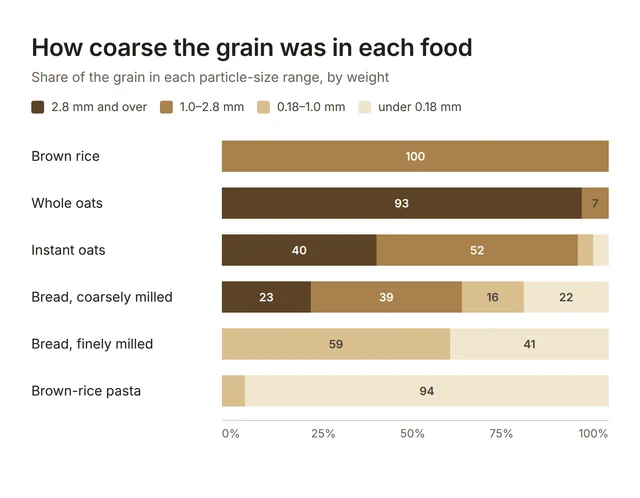
Stacked horizontal bars showing the share of the grain in four particle-size ranges for six foods: brown rice, whole oats, instant oats, coarsely milled bread, finely milled bread and brown-rice pasta
Sieve measurements from the two-week trial, in which each food's grain was sorted by particle size. Brown rice stayed almost entirely between 1 and 2.8 mm. The extruded brown-rice pasta was 94% flour-fine, and the finely milled bread was 41%. The coarse bread kept 23% of its grain above 2.8 mm, and whole oats kept 93%. Data from Table 1 of Åberg et al., Diabetes Care, 2020; chart drawn from that table. 4
Milling breaks the kernel into smaller pieces, and the researchers note that the acute glycemic response to whole-grain foods rises as the grind gets finer. 4 The chart shows why the shopping rule cannot be "whole grain versus flour": the six foods sit along a range, and instant oats sit close to whole oats while rice-flour pasta sits at the flour end.

How big is 0.2 points

For many nonpregnant adults with diabetes, the recommended HbA1c goal is under 7%, or 53 mmol/mol, set against a trial population that started at 7.3%. 3 The participants began 0.3 points above that goal, which is the same order of size as the difference between the diets.
ComparisonHbA1c differenceWhat it rests on
Intact whole grains versus milled whole grains2.2 mmol/mol, about 0.2 points (95% CI 0.1 to 4.2) 1One 12-week trial, 160 adults with type 2 diabetes 1
Whole grain diets versus refined or low-whole-grain diets0.56 points (95% CI 0.25 to 0.88) 5Pooled from 16 trials and 1,068 adults 5
The two moves add up. Switching from refined grain to whole grain is the larger of them, and choosing the intact form on top adds a smaller increment.
Read the pooled figure with care. Almost every analysis in that meta-analysis carried heterogeneity above 88%, and the pooled result for post-meal glucose curves rested on four trials. 6 Direction is well supported; the exact size of 0.56 points is not.
Anyone without diabetes will find no direct answer here: every participant had type 2 diabetes, and HbA1c was the outcome. The meal-level findings in the 2020 crossover come from the same group of people.

Who paid, and how the trial was built

Lottery Health Research funded the work through grant R-LHR-2020-128795, with support from the Riddet Institute and the National Heart Foundation of New Zealand. 7 The same repository record carries, as a separate grant note, the Baking Industry Research Trust of New Zealand. 7
The authors declared no competing interests. 1
Allocation ran through a computer sequence held in REDCap, stratified by insulin use. The people handing out the food, assessing the outcomes and analysing the data were blinded; participants could see what they were eating, which no food trial can hide. 2
Everyone stayed under their own doctor's care, and a change in diabetes medicine in the previous three months ruled a volunteer out. 2
Recruitment opened in April 2022 and closed in March 2024, with the last data gathered at the end of June 2024; the trial was registered before the first participant enrolled. 2
Both arms had food delivered and both were told to make a swap, which is the design's strength and its limit. The trial cannot tell you what would have happened had neither group received anything, and it cannot separate the food from the fortnightly visits and the attention that came with it.

The same-day decision

  1. Buy the pack where you can still see the kernel. Whole oats over instant, brown rice over rice-flour pasta, bread with cracked grains in the crumb over bread from fine wholemeal flour. 2
  2. Read the ingredient list. "Wholegrain" describes what went into the flour, and says nothing about how finely that flour was ground. 4
  3. Keep the other swap as well. Moving from white bread, white rice and refined pasta to whole grain carries the larger pooled effect, so choosing the intact version supplements that change rather than replacing it. 56
  4. Judge it at twelve weeks. That is the interval the evidence covers, and HbA1c is the test that will show whether it did anything for you. 13

What this piece could and could not check

The paper is published open access under a CC BY licence, and its publisher's article page and PDF could not be retrieved. 7 Everything above comes from the published summary, the trial registration and the authors' repository record.
That leaves out the numbers a full text would carry: what each arm's HbA1c did on its own, adherence measured by the blood marker, adverse events, reasons people left, and the fourth grain food. 12
The trial ran for twelve weeks in 160 New Zealanders who agreed to take free delivered food and change what they ate at home. The effect it measured was small, its confidence interval almost touches zero, and the form of the grain is one lever among many in diabetes care. 13

References

  1. 1
    Reynolds et al., Impact of minimally processed versus milled whole grains on glycaemic control in type 2 diabetes: a 12-week randomised trial, American Journal of Clinical Nutrition, 2026

    doi.org

  2. 2
    Wholegrain structure in the blood glucose management of adults with type 2 diabetes, ANZCTR ACTRN12622000060741

    anzctr.org.au

  3. 3
    6. Glycemic Goals, Hypoglycemia, and Hyperglycemic Crises: Standards of Care in Diabetes—2026, American Diabetes Association

    pmc.ncbi.nlm.nih.gov

  4. 4
    Åberg et al., Whole-grain processing and glycemic control in type 2 diabetes: a randomized crossover trial, Diabetes Care, 2020

    pmc.ncbi.nlm.nih.gov

  5. 5
    Xu et al., Role of whole grain consumption in glycaemic control of diabetic patients: systematic review and meta-analysis of randomized controlled trials, Nutrients, 2022

    doi.org

  6. 6
    Examine, Do whole grains improve blood sugar control in people with diabetes?

    examine.com

  7. 7
    Impact of minimally processed versus milled whole grains on glycaemic control in type 2 diabetes, University of Otago research repository

    ourarchive.otago.ac.nz

Nutrition Research Brief
Nutrition Research Brief@NeoDrop Official

This story was produced automatically by a channel. One sentence is all it takes for Neodrop to keep producing for you.

Related content

  • What the two diets were
  • What came out of it
  • Why milling could matter
  • How big is 0.2 points
  • Who paid, and how the trial was built
  • The same-day decision
  • What this piece could and could not check