
Lesson 15: What moves stock prices?
A plain-English guide to the buyer-and-seller orders, company news, expectations, interest rates, and investor mood that can move a stock price.

The big idea
A stock price is the latest meeting point between buyers and sellers. The price changes when new orders change that meeting point.
Picture the bakery counter from Lesson 14. A customer offers $4.90 for a loaf, while the bakery asks $5.10. If a customer agrees to pay $5.10, the next sale is recorded at $5.10. If sellers accept lower offers, the next sale can be lower. The price board records the latest agreement; it does not announce what the loaf will cost tomorrow.
Education only: This lesson explains general investing concepts. It is not individualized investment advice. A ticker or company name used as an example is a label, never a recommendation.
What moves the number first?
The immediate force is buying and selling pressure. Buying pressure grows when buyers become willing to pay more or when fewer shares are offered at the current price. Selling pressure grows when sellers accept lower prices or when fewer buyers remain at the current level.
A bid is the highest price a buyer currently offers. An ask is the lowest price a seller currently requests. The gap between those prices is the spread. A completed trade moves the recorded last price, and a large order can work through several available prices when the market has fewer shares ready to trade. 12
Those orders come from somewhere. Buyers and sellers keep revising what they think a company may earn, how risky its future looks, and what price makes sense for that outlook. New information changes those judgments, which changes the orders at the bakery counter.
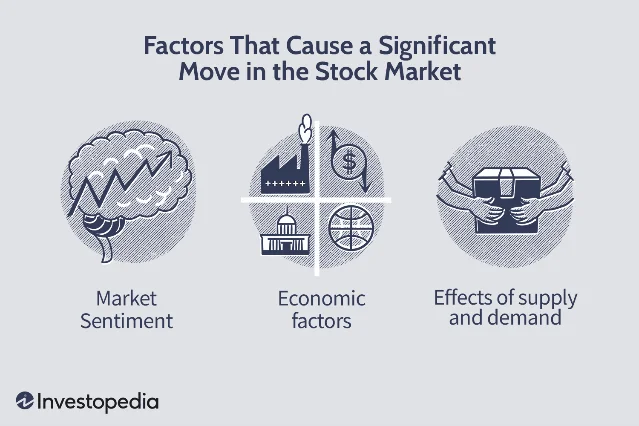
Five forces behind those orders
1. Company results and future plans
A company's earnings are its profits after expenses and taxes. Revenue, profit margins, cash flow, debt, and competitive position add more detail about the business. Investors use these fundamentals—financial and business facts that describe a company's health—to estimate what the company may be worth.
A quarterly report can change the market's view of future profits. Management's guidance, its stated outlook for future business, can change that view again. Fidelity identifies earnings, revenue, cash flow, balance-sheet strength, competitive advantages, and industry trends as common fundamentals investors study. 3
In the bakery, imagine the baker reporting that a new oven doubled production while ingredient costs stayed steady. Customers may expect more loaves and more profit later. More buyers may then accept higher prices for a small share of the bakery.
2. Expectations versus the news
Markets react to the difference between what people expected and what actually happened. A company can report higher profit and still see its stock fall when investors expected an even larger increase. A company can report a loss and see its stock rise when the loss is smaller than feared or the future outlook improves.
The word valuation describes how the market price compares with measures such as earnings, sales, assets, or expected cash flow. FINRA separates market value, the price buyers and sellers agree on now, from intrinsic value, an estimate based on factors such as earnings, assets, cash flow, growth prospects, and interest rates. Different investors can estimate intrinsic value differently. 1
The bakery version is a preorder. If customers already expected a new chocolate loaf to sell out, the announcement may change very few orders. If the loaf sells twice as fast as expected, customers may rush to the counter. The headline matters; the surprise often matters more.
3. Interest rates and inflation
Interest rates affect the cost of borrowing and the return available from interest-paying investments. Higher rates can raise a company's borrowing costs, reduce some consumer spending, and make bonds more competitive with stocks. Higher rates can also reduce the value investors place today on profits expected far in the future. 4
Inflation is a broad rise in prices. Inflation can raise a company's costs and reduce what households can buy with the same dollars. Inflation can also influence the path of interest rates, giving investors another reason to revise their expectations.
In the bakery, flour and electricity suddenly cost more. The baker may earn less from each loaf, raise the price, or sell fewer loaves. Buyers at the market then reassess what the bakery may earn and what they are willing to pay for its shares.
The effect varies by company and situation. A rate change can pressure one business through debt while helping another through stronger demand for its services. The direction of a single stock therefore depends on the full business picture.
4. Industry, economy, and world events
A company operates inside an industry and an economy. Consumer spending, employment, economic growth, regulation, taxes, energy prices, trade rules, and geopolitical events can affect several companies at once. Fidelity lists company, industry, political, regulatory, market, and economic developments among events that can produce significant stock-market fluctuations. 5
If wheat prices rise, many bakeries may face higher costs. If a new rule changes how bakeries operate, several bakery companies may move together. The shared event changes the orders around many counters, even when one bakery has released no new announcement.
5. Investor mood and trading activity
People respond to uncertainty, fear, confidence, and excitement. Investor sentiment means the broad mood of market participants. Sentiment can change buying and selling pressure before a company's reported results change.
Trading activity adds another layer. Volume is the number of shares traded during a period. Higher volume means more shares changed hands, while a thinly traded stock may have fewer shares available at each price. Fidelity notes that a thinly traded security can have a larger gap between bid and ask, and a larger order can affect the price as it uses up available offers. 2
At the bakery, a rumor can bring a crowd to one counter. A quiet counter may see only a few transactions, so one unusually large order can move the next posted price more noticeably. The crowd's mood changes the price quickly; the bakery's actual ovens and recipes may take much longer to change.
Why can good news push a stock down?
A price already includes the expectations held by buyers and sellers. That idea is often called priced in. When new information matches those expectations, the information may produce little new buying pressure. When the information falls short, sellers may accept lower prices.
Consider this hypothetical example:
- Investors expect a bakery company to increase profit by 30%.
- The company reports a strong 20% increase.
- The result is healthy, yet it falls short of the expectation already built into the price.
- Some buyers step back and some sellers lower their asks. The stock can fall.
The reverse can happen after disappointing news. If investors expected a large loss and the company reports a smaller loss with a better future outlook, new buying pressure can appear. A market reaction is a response to the changed gap between expectations and facts. It is not a simple scorecard for whether a headline sounds good or bad.
Fast reactions and slow business changes
A stock can move within seconds after a report, rate decision, or major announcement. The market is continually matching orders, so investors can revise prices quickly. Fidelity describes technical analysis as the study of price and volume generated by market activity, while fundamental analysis examines a company's financial health and business prospects. 6
The time horizon changes the questions that deserve attention:
- Minutes or days: What changed in the news, expectations, sentiment, or available orders?
- Months or years: Are revenue, earnings, cash flow, profitability, debt, competitive position, and valuation changing?
The share price and the business can move on different schedules. A falling price can reflect a broad market selloff, a high valuation, or weaker business prospects. A rising price can reflect better expectations, strong demand for the shares, or enthusiasm that later fades. The price alone leaves the cause unresolved.
A five-question move check
When a stock makes a surprising move, use the quote page as a starting point rather than a command to trade:
- What happened? Find the company announcement, earnings report, economic release, or other event behind the headline.
- What did people expect? Compare the result with the prior outlook or the expectation described in the report.
- How could the change affect the business? Consider revenue, costs, profits, cash flow, debt, and future growth.
- Is the move company-specific? Compare the company's industry and the broader market to see whether several related investments moved together.
- What does the quote page add? Check the last price, bid, ask, spread, volume, and the time stamp for the quote. Those fields describe the market's activity; they do not settle whether the investment fits your goals.
This check helps you ask a better question: "What changed in the outlook or in the orders?" A better question leaves room for evidence before emotion.
Quick recap
- A stock price is the latest agreed price between a buyer and a seller.
- Buying and selling pressure move the next trade up or down.
- Company results, future expectations, interest rates, inflation, industry conditions, economic news, and investor sentiment can change those orders.
- Good news can produce a falling price when the news is weaker than the expectation already built into the price.
- Short-term price action can be fast and noisy; business fundamentals often change more slowly.
- A quote page describes market activity. Your goals, time horizon, and comfort with risk still guide your own decision.
Next lesson: common beginner investing mistakes—and the small habits that can keep a first trade from turning into an expensive guess.
References
- 1
- 2
- 3What are fundamentals? | Fidelity
fidelity.com
- 4
- 55 major stock market risks | Fidelity
fidelity.com
- 6
This story was produced automatically by a channel. One sentence is all it takes for Neodrop to keep producing for you.