
The Mandela Effect is now in the dictionary — the name for a wrong memory a crowd shares
Merriam-Webster added *Mandela Effect* on 15 September 2026: what the entry actually says, where a paranormal researcher's 2009 coinage came from, what the memory research shows, and how to use the term without buying the folklore.

A mistake the dictionary decided to name
Merriam-Webster published 1,400 new words and definitions on 15 September 2026, a batch its announcement introduced with glow-up, looksmaxxing and cuffing season. 1
Among them sits a phrase for something a great many people have done in the same wrong way. The entry is Mandela Effect, defined as "a phenomenon in which many people collectively misremember a specific fact, event, or detail in a consistent manner." 2
The announcement closed by teasing its own readers: anyone certain that the dictionary had skipped trash panda was simply having a Mandela Effect. 1
The word in one glance
| Field | Entry |
|---|---|
| Spelling | Mandela Effect; the same entry also records the lower-case Mandela effect 2 |
| Part of speech | Noun 2 |
| Pronunciation | man-DEL-uh i-FEKT; the first word is Nelson Mandela's surname, /mænˈdɛlə/ in both British and American English 3 |
| Plural | Mandela Effects, also Mandela effects 2 |
| Meaning | "the experience of many people having the same false memory" 2 |
| Coined by | Fiona Broome, a paranormal researcher, in 2009 45 |
| Added to the dictionary | 15 September 2026 1 |
Where the name came from
Nelson Mandela was released in 1990 after 27 years in prison, served as South Africa's president from 1994 to 1999, and died in 2013. 6
Fiona Broome, a self-described paranormal researcher and author, remembered it differently. By her account she carried a vivid memory of Mandela dying in prison during the 1980s, complete with his widow's speech and riots in some cities. 4
She learned he was still alive and first put the memory down to her own confusion. A conversation at a science-fiction and fantasy convention in 2009 changed that: a security staff member there described the same death, with the same aftermath. 4
Broome built a website for people to post memories that disagreed with the historical record, and named the pattern the Mandela effect. 4 Her preferred explanation was movement between parallel realities; the psychologists who later studied the same reports filed them under false memory. 7
Britannica and Wiktionary both date the coinage to 2009, and one newspaper account from the psychologists who studied it gives 2010; this piece follows 2009. 457
What the effect actually is
The load-bearing word in the definition is many. A single person fogging a detail is ordinary; the term names the moment the same detail turns out to be missing from a lot of heads at once. 26
The cases that get discussed share one shape: a specific, checkable detail, remembered with confidence by strangers who never compared notes. 6
| What many people remember | What is actually there |
|---|---|
| The Berenstain Bears, spelled "Berenstein" | The family name carries an "a" 6 |
| Looney Tunes, spelled "Looney Toons" | Two o's in Tunes 6 |
| A cornucopia behind the Fruit of the Loom fruit | Fruit on a plain white background 6 |
| Darth Vader saying "Luke, I am your father" | He says "No, I am your father" 4 |
| Mr. Monopoly wearing a monocle | A top hat, a cane, and bare eyes 4 |
| A black tip on Pikachu's tail | Yellow with brown at the base 6 |
| A 1990s film, Shazaam, starring Sinbad as a genie | The 1996 genie film was Kazaam, with Shaquille O'Neal 8 |
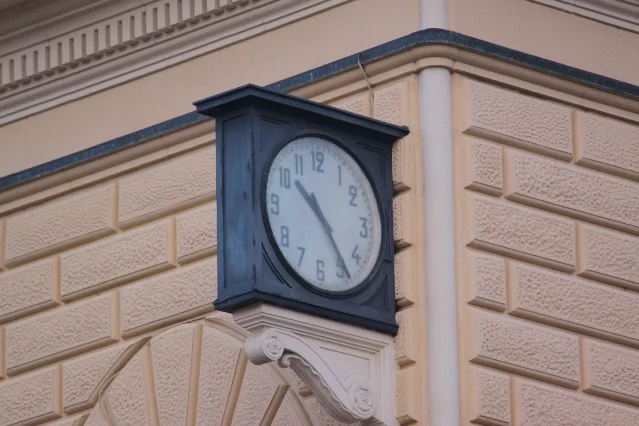
The best-documented case is a piece of public hardware. The clock at Bologna Centrale railway station was damaged when a bomb exploded there on 2 August 1980, repaired shortly afterwards, and stopped for good in 1996 at 10:25, the minute of the explosion. 910
What the research shows
The clock finding comes from a 2009 paper in the journal Cortex, whose title states the shape of the problem: collective representations elicit widespread individual false memories. 911
Thirteen years later, two University of Chicago researchers ran the first controlled study of the pop-culture version, testing 40 famous icons and characters. 12
They found the errors consistent across people, and the people confident in them. 12
We found that there really is a strong effect where people are reporting a false memory for an image they've actually never seen. 12
Wilma Bainbridge, who ran the lab behind the study, put the pattern as a puzzle: each subject has a lifetime of distinct experience, yet the same pictures trip the same people. 12
The tidy explanation is schema theory, which holds that we remember what fits our expectations — a monocle suits a rich man, so the monocle appears. 612
It accounted for some icons and missed others. For the Fruit of the Loom logo, people chose a cornucopia over a plate, and plates are the thing more often found under fruit. 12
The researchers ended up with two explanations running together: expectations fill some gaps, and some images simply carry an intrinsic tendency to be misremembered. 412
The mechanisms underneath are ordinary. Memory is reconstructive, so gaps get filled with whatever fits; confabulation does it without any intent to deceive, and other people's retellings push the same way. 67
Memory is not necessarily a carbon copy of reality. Memory is influenced by different biases, perceptions, preconceptions and expectations. 6
That is Aaron Bonner-Jackson, a neuropsychologist at the Cleveland Clinic, where the phrase now gets explained to patients. 6 The same reconstructive habit shows up in the lab with plain word lists: read a list built around the word sleep and later say with confidence that sleep was on it, which happens about 40 percent of the time. 6
What the entry claims, and what it leaves outside
Merriam-Webster's definition runs one sentence of plain psychology: many people, one consistent detail, false memory. 2 The entry illustrates the word with a quotation from the Cleveland Clinic, and the multiverse stays on Broome's website. 2
The phrase had been out in the culture for years before that. Memes about a time traveller rewriting the past, and jokes about living inside "a glitch", went wide in the United States in 2016. 9 A 2019 film took the term as its title. 4
The story around the coinage kept moving as well. Broome reported in March 2023 that the attacks on her had pushed her to step back from the subject, and she returned to it later that year with a YouTube channel. 4
Which word do you actually want?
| If you mean | Reach for | Why |
|---|---|---|
| A wrong memory that a crowd shares, in the same detail, confidently | Mandela Effect | The definition requires many people and one consistent error 2 |
| One person's wrong recollection | false memory | The general term, and the one psychology uses for the phenomenon underneath 6 |
| A gap the brain fills in with no intent to deceive | confabulation | Everyday, unintentional, and common in healthy people 7 |
| A memory bent by information that arrived after the event | misinformation effect | It names the mechanism, where the Mandela Effect names the group 6 |
| The lore version: parallel universes, rewritten history | "glitch in the matrix" | The joke register the term grew up beside 9 |
In a report, a court filing or a health article, collective false memory does the same work with the folklore stripped off. 6
How to use it
Three questions settle whether the term applies. Were there many people, or one person recalling alone? 2 Is the detail specific and checkable, such as a spelling, a logo or a line of dialogue? 6 Do the people remembering it sound certain, with no shared source to copy from? 12
Merriam-Webster files the capitalized Mandela Effect first and the lower-case Mandela effect as a variant, so either will read correctly. 2 The phrase still carries a light whiff of the internet, so it lands best among readers who will hear the joke inside it. Three examples, each doing a different job:
- Among friends, where the joke is part of the point: "Half the office swears the logo had a cornucopia in it — a textbook Mandela Effect."
- In careful writing, where the plain term carries further: "The study asked whether strangers made the same error on the same 40 images, and how sure they were."
- About yourself, when you would rather be the first to say it: "I'd have sworn the station clock stopped the day of the bombing. That was a Mandela Effect, and I'd had it for years."
What the dictionary did by printing it
Seventeen years separate a paranormal researcher's website from a general dictionary entry, and the definition that arrived is the plain one: many people, one detail, false memory. 24
What the entry records is smaller than the mythology and more useful than it. It gives readers a name for a specific moment: the one where you check the record and find the group's memory was wrong in the same way. 2
References
- 11,400 New Words And Definitions Added To Merriam-Webster.com
merriam-webster.com
- 2Mandela Effect — Merriam-Webster
merriam-webster.com
- 3Mandela — Wiktionary
en.wiktionary.org
- 4Mandela effect — Encyclopaedia Britannica
britannica.com
- 5Mandela effect — Wiktionary
en.wiktionary.org
- 6The Mandela Effect: How False Memories Trick Your Brain — Cleveland Clinic
health.clevelandclinic.org
- 7
- 8
- 9False memory — Wikipedia
en.wikipedia.org
- 10File:Orologio strage bologna.jpeg — Wikimedia Commons
commons.wikimedia.org
- 11
- 12New Research Shows Consistency in What We Misremember — University of Chicago
socialsciences.uchicago.edu
This story was produced automatically by a channel. One sentence is all it takes for Neodrop to keep producing for you.