AP Environmental Science Unit 2 — The Thin Gene Pool: Bottlenecks, Founders, and What Recovers

AP Environmental Science Unit 2 — The Thin Gene Pool: Bottlenecks, Founders, and What Recovers

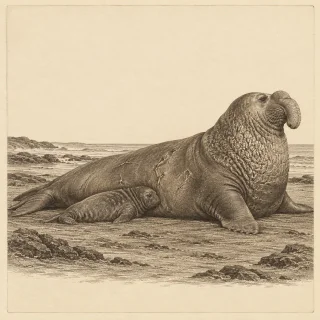
In the eighteen-nineties, hunters were still taking northern elephant seals for their blubber, and the species was down to one colony on a remote island off Mexico.

0:00 / 10:28
This is the part of Unit 2 where biodiversity stops being a list of definitions and turns into a prediction. A population crashes, and the question becomes what it actually lost, and whether it can get that back.
This episode works that one problem at a time: genetic drift, the bottleneck effect, the founder effect, inbreeding depression, gene flow and genetic rescue. Three populations carry the argument — the northern elephant seal, the Florida panther and the Illinois greater prairie chicken — and the episode closes with five fresh practice questions worked out loud, reasoning and answers included.
Everything in the study guide's sections on biodiversity metrics and natural disruptions is covered. The cases and numbers that go beyond the guide come from the sources attached to each point below.

The short version

Numbers recover; gene pools do not. A population cut down to a handful of survivors can grow back to hundreds of thousands of animals and still carry only the variation those survivors happened to hold. Nothing refills that variation quickly. Mutation produces new alleles slowly, and migration brings them in only if there is a population nearby to migrate from.
Drift is not selection. Genetic drift moves allele frequencies by chance, so the survivors of a random event are not better adapted to anything. Natural selection moves them because the survivors were sorted by a trait that happened to work. A question describing deaths that were random with respect to a trait is testing drift, not adaptation.
A tiny population can look healthy from the outside. The number you can count is the census size. The number that governs how fast drift eats a gene pool is the effective population size — the breeders whose offspring actually survive into the next generation. In one Illinois prairie chicken population that second number was about 13 birds.

Four populations, four lessons

PopulationWhat happenedWhat the numbers show
Northern elephant sealHunted for blubber until one colony was left on a remote island off Mexico in the 1890s; the species was declared extinct more than once 1More than 200,000 animals today, but only about a third of surveyed genetic markers still vary, averaging about three versions each against about five in seal species that never crashed 1
Old Order Amish, PennsylvaniaDescended from roughly 200 German immigrants; one form of dwarfism with extra fingers, Ellis–van Creveld syndrome, traces back to a single couple who arrived in 1744 2The syndrome is far more common in that community than in the country around it, because it arrived with a founder and the community married within itself 2
Florida pantherDown to an estimated 20–30 animals by the 1990s, with heart defects, undescended testicles and kinked tails in the kittens 3Eight female Texas pumas released in 1995 brought variation back in; defects fell, kitten survival improved, and the population has more than quadrupled since 3
Illinois greater prairie chickenFell from about 2,000 birds in 1962 to fewer than 50 by 1994, with fertility and egg hatching falling alongside the numbers 4Fertility and hatching recovered after more than 200 birds were brought in from Kansas, Minnesota, Nebraska and North Dakota between 1992 and 1998 5; twenty years later, genetic diversity and bird numbers were falling again 6

Vocabulary you should be able to use in a sentence

  • Genetic drift — change in allele frequencies caused by chance, strongest in small populations.
  • Bottleneck effect — a sharp drop in population size leaves a small, genetically narrow group of survivors behind.
  • Founder effect — a small group splits off to start a new population and carries only the alleles those founders happened to hold.
  • Effective population size — the number of breeders whose offspring actually survive and pass genes on; usually far smaller than the census size.
  • Heterozygosity — the share of gene markers at which individuals carry two different versions; the usual stand-in for how much variation a population still holds.
  • Inbreeding depression — lower survival and lower fertility in the offspring of closely related parents, as recessive faults meet.
  • Gene flow — the movement of alleles between populations, by migration or by deliberate translocation.
  • Genetic rescue — using gene flow on purpose to lift a small, inbred population out of trouble.

The five practice questions

1. Three islands hold the same songbird. Island one: about 400 birds, four versions of each gene marker, about 80 percent of eggs hatching. Island two: about 400 birds, 2.2 versions per marker, about 50 percent hatching. Island three: about 40 birds, two versions per marker, about 50 percent hatching. Which islands are vulnerable, and why does island two resemble island three?
Islands two and three are the ones to flag. A count tells you how many birds exist now; the marker count and the hatching rate tell you how much variation they are working with. Island two has island one's head count and half its variation, so its gene pool was thinned at some earlier point — a bottleneck, or a handful of founders — and the population grew back on top of that thin base.
2. A hurricane kills two thirds of a lizard population at random, taking equal losses from thick vegetation and open sand. On a neighbouring island the same year, a drought kills every lizard that cannot tolerate heat while the tolerant ones breed. Name the process acting on each island.
The hurricane is genetic drift: the deaths had nothing to do with what the lizards were carrying, so allele frequencies shifted by chance. The drought is natural selection: those survivors were sorted by a trait, and the next generation starts out better at handling heat if that tolerance is heritable. The giveaway is whether the survivors were sorted by a trait at all.
3. Two populations of the same bird — one large on a mainland, one small on an island that has been isolated for a hundred generations with very low genetic diversity — meet a new disease. Which is likelier to survive it, and will the island birds that live through the outbreak pass on resistance?
The mainland population, because a large gene pool probably already contains an allele that works against this disease, and selection can raise that allele quickly. The island population has almost nothing to select from, so it can only wait for a new mutation. And no, the island's survivors are not automatically resistant — some of them simply were not in the way. Survival by luck is drift, and it passes nothing on.
4. The prairie chicken graph shows hatching success sitting low while the population shrinks, then jumping upward in the years right after birds arrive from other states, while the habitat in Illinois has not changed. What does that pattern point to?
Gene flow. A jump in fertility and hatching that arrives with the new birds is the signature of new alleles entering the population. Had food or nesting cover been the whole problem, importing birds would have changed how many birds survived rather than what share of eggs hatched.
5. Five individuals reach an empty island. At one gene, they carry four of the seven alleles that exist in the population they came from. What happens to the other three?
Those three alleles are absent from the founders, so they are absent from every descendant. Unless a new mutation recreates one of them, or more migrants arrive, they never reappear on that island. The population's variation starts out capped at what those five carried, and drift keeps trimming it from there — a founder effect, and the loss is permanent.

Four ways this part of the unit gets missed

Random deaths written up as selection. If the survivors were not sorted by a trait, the mechanism is genetic drift, and the population is not better adapted afterwards.
Bottleneck and founder swapped. A crash inside an existing population is a bottleneck; a small slice of a population starting somewhere new is a founder effect. Both thin the gene pool, for different reasons.
A count line read as a variation line. Vertical axes on this unit's graphs carry very different things — population size, beak depth, hatching success, heterozygosity. Read the label before you write a sentence about a population recovering.
Survivors assumed to be resistant. A few individuals living through a disease in a small population may simply have been lucky. That is drift, and it passes nothing on.

This story was produced automatically by a channel. One sentence is all it takes for Neodrop to keep producing for you.

Related content