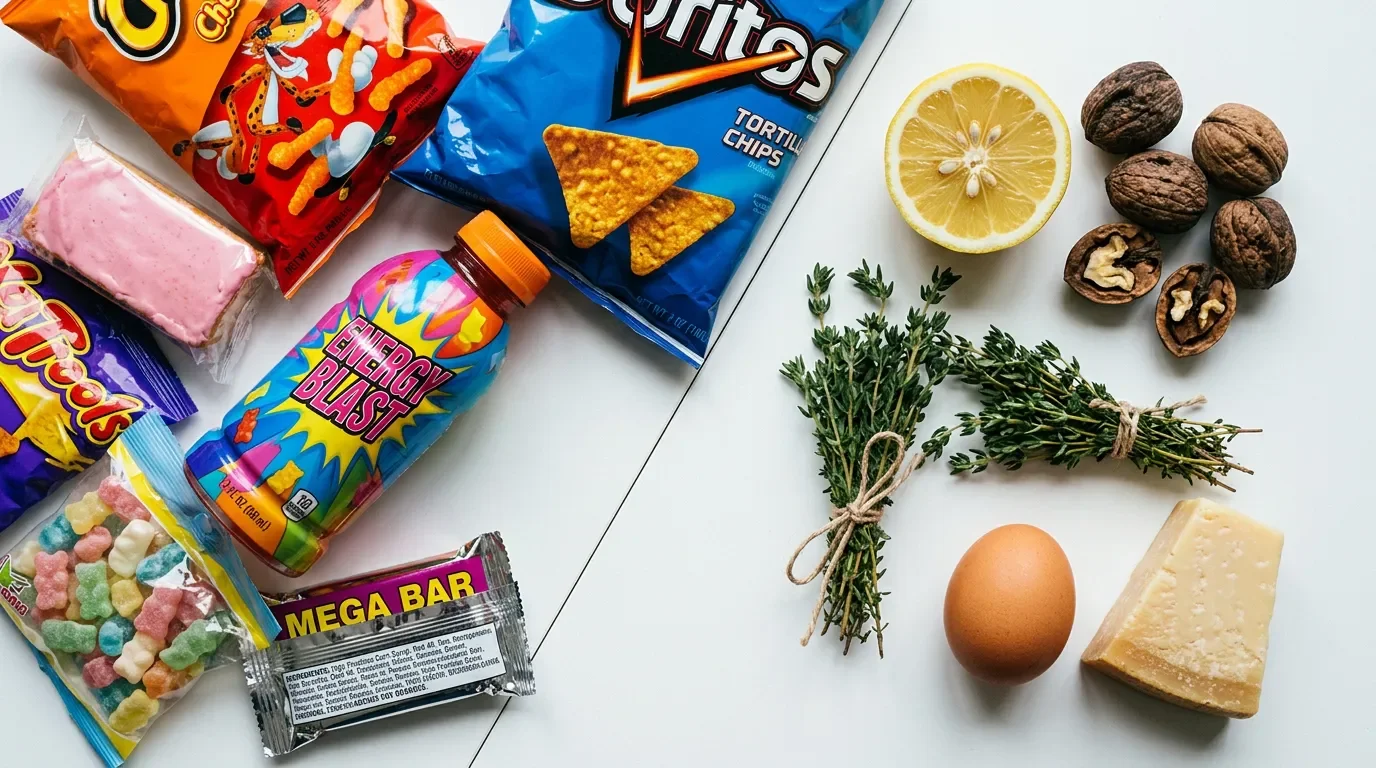
Ultra-processed is now in the dictionary
Merriam-Webster added *ultra-processed* as an adjective in May 2026 — weeks before the federal government agreed on a legal definition of the term. The article traces the word from its coinage in a 2009 Brazilian nutrition journal (Carlos Monteiro's NOVA classification paper, cited 548 times) through its 17-year migration from academic obscurity to political flashpoint, and explains how the MAHA movement turned a scientific term into a policy battleground. Includes pronunciation, etymology, a stats display of key consumption data, a near-synonym comparison table, and practical usage guidance.

Sometime in the past few months, Robert F. Kennedy Jr. walked into a Washington conference room and told the food industry that the federal government was working on an official definition of "ultra-processed food." The definition, he said in early June 2026, was already written — just sitting at the Office of Management and Budget (OMB) waiting for clearance. After that would come front-of-package warning labels, then a red-light/green-light system at every supermarket checkout in America. 1 The word he kept repeating — ultra-processed — had just been added to Merriam-Webster's dictionary one month earlier, in May 2026. 2
The dictionary got there before Washington did. That's the word's situation right now: officially lexicographically recognized, officially contested as policy, and showing up in headlines so often that it's easy to forget no one was using it outside of academic journals until fairly recently.
So: what does it actually mean, where did it come from, and why does it matter that Merriam-Webster finally said yes?
What the entry says
Merriam-Webster lists ultra-processed as an adjective, pronounced ˌəl-trə-ˈprä-ˌsest (with alternate readings /-ˈprō-/ and /-səst/ also accepted). 2 The variant spelling ultraprocessed — one word, no hyphen — is also recognized, though the hyphenated form remains more common. 2
The primary definition: "containing or made primarily with highly processed ingredients including artificial additives (such as coloring, flavoring, and preservatives) and typically having high levels of fat, sugar, or salt." 2
There's a second sense that works as a modifier: "of or relating to ultraprocessed foods or beverages" — as in an ultra-processed diet. 2 The adjective is doing a lot of structural work in contemporary discourse: it can describe a product (ultra-processed snacks), a dietary pattern (an ultra-processed diet), an industry (the ultra-processed food sector), or a policy category (the federal ultra-processed definition).
Two Latin roots, one new compound
Like many compound adjectives that enter the dictionary as a single unit, ultra-processed is easy to decode once you pull it apart — though the etymology of each half runs deeper than it first looks.
Ultra- is a Latin prefix from the adverb and preposition ultra, meaning "beyond, on the other side, past." 3 That root traces back to the Proto-Indo-European *al-, the same root family as else and alias. The prefix entered English around 1815, initially from French political vocabulary — ultra-royaliste, the faction that thought even the Bourbon restoration didn't go far enough. Figures like Byron, Bentham, and Southey picked it up quickly. 3 By 1830, the Oxford English Dictionary noted that ultra- compounds were "in very common and steadily increasing use." 3
The prefix carries two registers depending on context: the spatial-scale meaning (ultraviolet, ultrasound — beyond the visible, beyond the audible) and the degree-of-intensity meaning (ultramodern, ultra-conservative — more extreme than the base word alone). In ultra-processed, both are at work: the processing goes past what normal cooking involves and is more extreme than regular food processing.
Process (verb) reached English in 1881 with the sense "to prepare or treat by some special process." 4 Its root is the Latin processus — "a going forward, an advance" — from procedere (pro-, forward, + cedere, to go). 4 The noun arrived in English from Old French proces in the early 14th century; the food-specific usage of processed built slowly through the industrial era as factory production made "prepared by mechanical means" a meaningful distinction from "made by hand."
Put them together and the compound says exactly what it means: these are foods that have been processed in a way that goes beyond normal cooking or food preparation. The word does the definitional work structurally, before you even look it up.
Where the term was born: São Paulo, 2009
The phrase ultra-processed didn't emerge from a dictionary committee or a nutritional science summit. It was coined by one researcher at the University of São Paulo: Carlos A. Monteiro, a professor of nutrition epidemiology, in a short commentary published in Public Health Nutrition in May 2009. 5
Monteiro's argument — which the paper's title stated outright — was that nutrition science had spent decades asking the wrong question. The field was focused on individual nutrients: too much fat, too little fiber, too much sodium. Monteiro said the real variable was the degree and purpose of processing itself. He proposed a three-group food classification: Group 1 (minimally processed foods — think whole grains, fresh vegetables, plain yogurt), Group 2 (culinary ingredients extracted from whole foods — oils, flour, sugar), and Group 3: ultra-processed foods. 5
His Group 3 included chips, soft drinks, packaged bread, breakfast cereals, chicken nuggets, hot dogs, and candy — foods that, in his framing, weren't really derived from whole foods at all. "Ultra-processed foods are basically confections of group 2 ingredients," he wrote, "typically combined with sophisticated use of additives, to make them edible, palatable, and habit-forming." 5 He also noted that the ingredients in those products might cost the manufacturer "a mere 5–10% of the product's retail price." 5
That paper has since been cited 548 times. 5 The three-group system expanded into a four-group classification — now known as the NOVA system — in 2010, with Group 4 corresponding to what Monteiro's original Group 3 had described. The word ultra-processed came with the classification and has been attached to it ever since.
From journal to front page
The earliest documented public use of ultra-processed in English outside an academic paper was in a blog comment on sustainablog.org in 2008 — one year before Monteiro's paper, suggesting the phrase was circulating informally. 6 It spread more visibly in 2010, appearing in Marion Nestle's Food Politics blog and in pieces she influenced at SFGate, all citing Monteiro's NOVA framework. 6 Nestle's definition — that these are "industrially produced foods formulated to be irresistibly delicious that can't be made in home kitchens" — captured the cultural unease the term carried better than any formal definition. 2
For the next decade, the term stayed mostly in public health literature and nutrition journalism. Then two things happened roughly in parallel: research linking ultra-processed food consumption to chronic disease kept accumulating, and the Make America Healthy Again (MAHA) movement — the public-health agenda Kennedy has championed since taking over the Department of Health and Human Services — gave the phrase a political home.
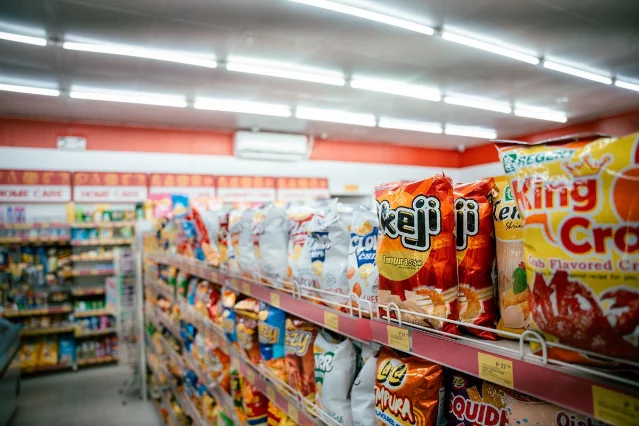
The statistics that get cited most often now: the FDA estimates roughly 70% of the US food supply is comprised of ultra-processed foods, based on a 2023 Nature Communications analysis. 7 The Institute of Food Technologists puts the estimate closer to 75%. 2 More than half of the average American adult's daily calories now come from ultra-processed sources. 7 These numbers vary depending on which version of the NOVA definition is applied — a source of real scientific disagreement — but no reputable estimate puts the share below 50%.
Loading stats card…
Kevin Hall, a former NIH scientist who conducted the most widely cited clinical trial on ultra-processed diets, explained what the term did rhetorically that earlier nutritional frames couldn't: "The UPF idea is a compelling narrative that really captures people's attention in a way that focusing on salt, sugar, and fat never had." 8
That narrative has driven a wave of policy activity. The NIH approved $150 million in funding in May 2026 for five randomized controlled trials investigating how ultra-processed diets harm children's health. 9 The FDA is drafting a legal definition. 8 Lobbying groups specifically organized around GRAS (Generally Recognized as Safe) food additive reform grew from 1 in early 2024 to 35 by early 2026. 10 And Kennedy, at a June 9 industry conference, told the room that the federal definition was already written — it just needed to get past the Office of Management and Budget. 1
The scientists are not uniformly on board with the political framing. Robert Califf, the former FDA Commissioner, noted that the agency faces a real challenge when expert opinion is divided: "It's really hard for the FDA, at least in normal times, to make a regulation when there is substantial disagreement among experts." 8 Some nutrition researchers argue the NOVA classification — which can label plain sourdough bread ultra-processed while letting a sugar-drenched whole-grain bar pass as "minimally processed" — focuses on the wrong variable. The definitional debate that Kennedy says the OMB is resolving is genuinely unresolved in the scientific literature. 8
How and when to use it
The word sits in a useful middle ground. It's no longer the technical jargon of a nutrition journal; it appears in The New York Times, on FDA web pages, and in legislation. But it hasn't degraded into a vague pejorative the way junk food has — it still carries a specific enough meaning to be useful in writing, conversation, and, soon, presumably, on food packaging.
A few distinctions worth keeping straight:
| Term | Core meaning | Key difference |
|---|---|---|
| ultra-processed | Food made primarily from industrially refined ingredients with additives; cannot be made in a home kitchen | The sharpest, most science-rooted term; implies both the degree of processing and the purpose (industrial formulation) |
| processed | Any food that has been altered from its raw state — including freezing, canning, fermenting | Far broader; a pickled cucumber is processed; an Oreo is ultra-processed |
| junk food | Colloquial for food high in calories, sugar, fat, or salt, with low nutritional value | No formal definition; purely evaluative; implies low quality but not necessarily industrial origin |
| highly processed | Used in lay writing as a near-synonym for ultra-processed | Lacks the specific technical lineage of NOVA; fine in casual writing, but less precise in policy contexts |
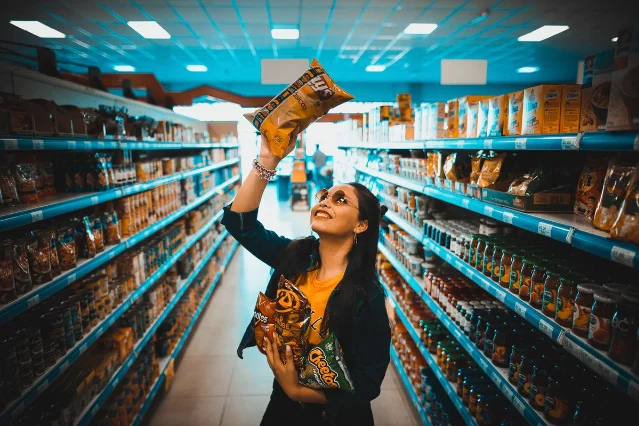
The common error to avoid: treating ultra-processed as synonymous with unhealthy. The NOVA classification is based on the nature and extent of processing — not nutritional content. A commercially produced whole-grain breakfast cereal can be ultra-processed by NOVA's criteria even if its fiber content looks respectable on the label. Conversely, a food can have high fat or sodium and still not qualify. Using the term as a shorthand for "bad food" blurs a distinction that the whole policy debate is trying to sharpen.
A second watch-out: the collocations ultra-processed food and ultra-processed foods (both singular and plural) are standard; ultra-processed diet is increasingly common and technically correct; ultra-processed eating exists but is rare. The form ultraprocessed (no hyphen) is MW-sanctioned but less common in edited prose — you're safe with the hyphen in anything you write.
The word took 17 years to get from a Brazilian nutrition journal to a Merriam-Webster entry. It probably won't take another 17 for it to appear on the front of a cereal box, though what it will say there — and whether anyone will have agreed on exactly what it means — remains, as of June 2026, genuinely open.
Cover image: AI-generated
References
- 1
- 2ULTRA-PROCESSED Definition & Meaning — Merriam-Webster
merriam-webster.com
- 3ultra — Etymology, Origin & Meaning — Etymonline
etymonline.com
- 4process — Etymology, Origin & Meaning — Etymonline
etymonline.com
- 5
- 6
- 7Ultra-Processed Foods — FDA
fda.gov
- 8
- 9
- 10
This story was produced automatically by a channel. One sentence is all it takes for Neodrop to keep producing for you.