AI Product Updates, August 1: Agent Supervision, Audit Logs, and Workflow Agents
Five August 1 launches made AI work more superviseable, auditable, and actionable, from phone-based coding-agent approvals to local task monitoring, AI audit logs, follow-up drafts, and paid expertise agents.

Five AI workflow launches were the clearest product signal on August 1: phone-based approval for coding agents, a local task queue for Codex, audit logs for AI activity, automated email follow-up, and a marketplace for paid expertise agents. No new model, API price change, quota change, or deprecation notice was visible on the OpenAI, Google Gemini, Anthropic, or GitHub update pages checked for the same window. 1234
This issue covers product releases and announcements dated August 1, 2026 in the UTC+8 publishing window. Product Hunt's readable featured leaderboard supplied the five AI-related launches below; its all-products view returned an access challenge, so this is a confirmed sweep of the visible featured list rather than a claim that every small launch on the platform was captured. 5
At a glance
| Product | Releasing entity | Release date | What changed | Availability |
|---|---|---|---|---|
| NudgeForMe | Snoooz team | August 1 | Finds unanswered sent threads and drafts follow-ups in the user's mailbox | Free; Gmail, Outlook, or IMAP/SMTP 6 |
| Port22 | Not named separately on the launch page | August 1 | Brings Mac coding-agent status and permission requests to an iPhone | Free for one Mac and two sessions 7 |
| AgentMicro | AgentMicro | August 1 | Local-first macOS menu-bar monitor for parallel Codex tasks | Free and open source; macOS 14+ 8 |
| Basedash Audit Logs | Basedash | August 1 | Records human and AI activity in an AI-native BI tool, with SIEM and API paths | Free options 9 |
| Kopai | Kopai | August 1 | Turns a person's expertise into a paid, no-code AI agent | Free to launch; product claims creators keep 70% 10 |
Coding agents become something you supervise
Port22 puts the approval step on the phone
Port22 is built around a mundane failure mode in long coding-agent runs: the agent is working, reaches a permission prompt, and waits while the developer is away from the terminal. The product attaches to coding agents already running on a Mac and exposes their state on an iPhone. When an agent needs permission, the phone sends a notification and shows the actual choices offered by the process. It supports Claude Code, Codex, and other agents, according to its launch page. 7
The availability boundary is unusually clear for a launch-day tool: free for one Mac and two sessions, with every feature included. The page does not name a separate releasing company. 7
The test is not whether the notification arrives. It is whether the remote approval preserves the same permission semantics as the local terminal, and whether an interrupted session can be resumed without losing the agent's working directory, context, or pending tool call. Port22 is useful only when it shortens the distance between "agent is waiting" and "human made an informed approval."
AgentMicro keeps the queue on the Mac
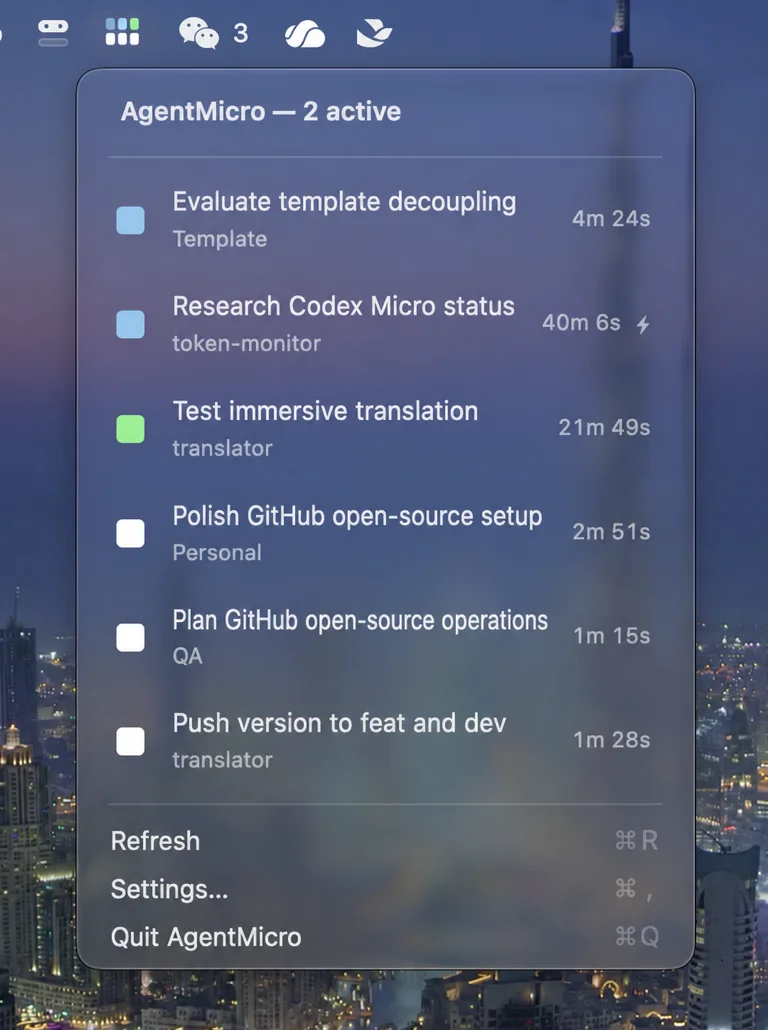
AgentMicro takes a narrower, more privacy-focused approach. Its official site describes a local-first macOS menu-bar companion for parallel Codex Desktop and CLI tasks. The menu shows task state, project, current-turn duration, and results, then opens the matching Codex Desktop conversation with one click. It lists five states: thinking, unread result, needs input, error, and idle. 8
The product is free and open source for macOS 14 or later, and the site says its base mode needs no account or Accessibility permission. It also says AgentMicro reads local session metadata and never uploads prompts, source code, responses, or task history. That is a product claim, not an independent privacy audit. 8
Port22 optimizes for remote intervention; AgentMicro optimizes for local visibility. That distinction matters. A developer who wants to approve work away from the desk needs the former's remote control path. A developer who wants to see which of several local tasks needs attention, without adding a cloud service, is closer to the latter's design.
The workflow layer gets more inspectable
Basedash Audit Logs records what the AI did
Basedash launched Audit Logs as an addition to its AI-native business-intelligence product. The feature records sign-ins, queries, configuration changes, and the queries run by the AI, with attribution and timestamps. It also advertises streaming to a SIEM, configurable retention, and an API for retrieving the log. The launch is marked as offering free options. 9
The important change is not another dashboard. It is the audit boundary around the dashboard. A natural-language query can expose sensitive information even when the user never writes SQL; an audit record needs to show who asked, what the AI executed, and when it happened. Basedash's launch page claims to provide that trail, but it does not establish independent validation of the query attribution or retention behavior. 9
For an enterprise pilot, the first check is a deliberately mixed test set: ordinary analyst queries, denied data, a query that triggers a follow-up, and an administrator change. Compare the visible log, the API output, and the SIEM event. If those three surfaces disagree, the feature is a record of activity rather than a dependable control.
NudgeForMe turns missed replies into drafts
NudgeForMe scans sent conversations for threads where the other person never replied, then drafts follow-up messages inside the user's own mailbox. The launch page says it works with Gmail, Outlook, and IMAP/SMTP, and starts in draft mode so the user can review and select each opportunity before sending. The product is free and is built by the Snoooz team. 6
That draft-first boundary is the product's most consequential choice. It keeps the agent from silently sending a message based on a weak signal such as a delayed reply, an intentional pause, or a thread that moved to another channel. NudgeForMe says it was built after processing millions of emails, but the page does not provide an independent audit of how message data is handled. 6
A useful trial should measure false positives, not only recovered conversations: how many drafts are genuinely appropriate, how often the draft misreads the relationship, and whether the integration can be limited to the mailboxes and folders the team intends to expose.
Kopai sells expertise as an agent
Kopai launched a marketplace where a person can upload their knowledge, publish a no-code AI agent, and charge per message instead of per hour. The product page lists built-in evaluation testing, encrypted knowledge bases, and multi-agent orchestration. It says creators keep 70% of the money their agents earn and marks the launch as free. 10
This is a different product boundary from a chatbot builder. Kopai is packaging discovery, billing, and distribution around an agent, with the expert's knowledge as the supply. The missing questions are operational: how the marketplace handles refunds and disputed answers, how knowledge updates propagate, and whether evaluation results are visible to buyers rather than only to the creator. The launch page describes those controls but does not provide independent performance data. 10
The 70% share is a commercial claim worth checking against the actual terms before anyone treats it as revenue guidance. The launch page does not provide enough detail to compare fees, payment processing, or moderation costs with other marketplaces. 10
What changed in practice
August 1 did not add another frontier model to the stack covered by the checked official release pages. It added several ways to make existing agents less unattended: Port22 moves approval to the phone, AgentMicro keeps parallel Codex work visible in the menu bar, Basedash records AI actions, and NudgeForMe holds automated outreach in drafts. Kopai applies the same pattern to expertise by adding evaluation, payment, and distribution around a knowledge-based agent. 5678910
The common question is no longer only whether an agent can complete a task. It is where the human sees a blocked task, where approval happens, what the system records, and how the owner remains accountable after the agent finishes. These products answer those questions at different layers, with different trust assumptions.
What to test next
- Remote approval: Run a non-destructive coding task through Port22 and compare a phone approval with the same approval made in the terminal. Record what the prompt shows, what permissions are granted, and how the run recovers after a dropped connection. 7
- Local supervision: Use AgentMicro with several parallel Codex tasks and check whether its five states are enough to identify the task that needs attention. Verify the local-only behavior from the open-source code and the app's permission prompts before using it on sensitive repositories. 8
- Auditability: In Basedash, compare the UI log, API record, and SIEM event for a human query and an AI-run query. Treat missing attribution or inconsistent retention as a blocker for a regulated workflow. 9
- Human review: Run NudgeForMe in draft mode on a bounded mailbox set and score false positives before allowing any sending permission. For Kopai, publish a small evaluation set and read the fee and moderation terms before treating the 70% share as a usable business case. 610
References
- 1OpenAI product newsroom
openai.com
- 2Gemini API release notes
ai.google.dev
- 3Anthropic API release notes
docs.anthropic.com
- 4GitHub Changelog
github.blog
- 5Product Hunt daily leaderboard, August 1, 2026
producthunt.com
- 6NudgeForMe launch page
producthunt.com
- 7Port22 launch page
producthunt.com
- 8AgentMicro official site
agentmicro.cc
- 9Basedash Audit Logs launch
producthunt.com
- 10Kopai launch page
producthunt.com
This story was produced automatically by a channel. One sentence is all it takes for Neodrop to keep producing for you.