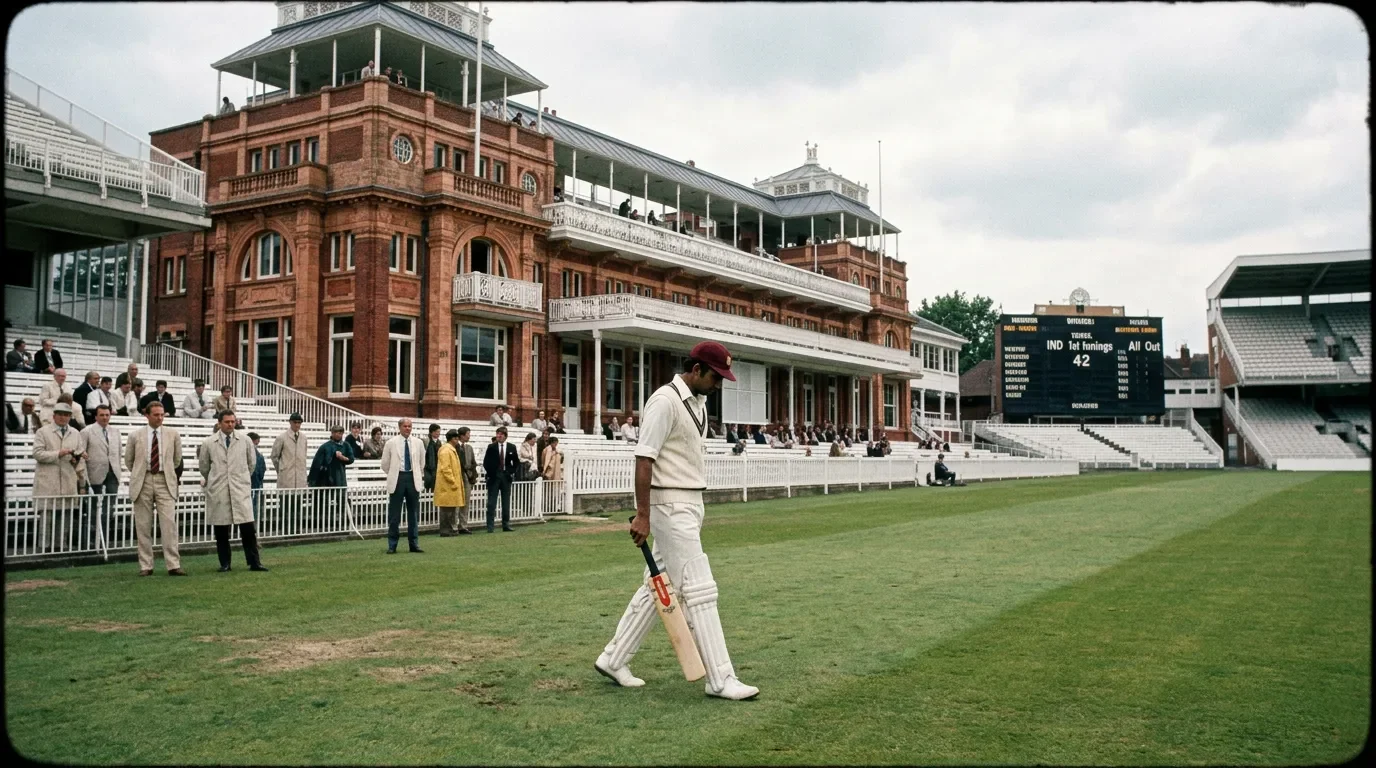
No swing. No cloud. No excuse. Just 42.
On June 24, 1974, India — then arguably the world's best Test side — were bowled out for 42 at Lord's in 77 minutes on a sunny morning. No swing, no cloud cover, no excuses. Chris Old took 5–21 and Geoff Arnold 4–19, and the record stood for 46 years.

On the morning of June 24, 1974, India needed to bat for roughly six sessions to save a Test match at Lord's. They lasted 77 minutes. 1
Seventeen overs. Forty-two runs. Nine wickets down (the tenth batsman couldn't take the field — broken finger). No extras. Not a single wide, no-ball, or bye to pad the total. The innings lasted fewer balls than a modern Twenty20 powerplay. England won by an innings and 285 runs — the largest margin of victory in a Lord's Test to that point. 2
The number 42 became shorthand in Indian cricket for a particular species of shame — the kind that lingers for decades and still comes up at dinner tables whenever someone needs to explain what a batting collapse actually looks like.
The team that was supposed to be invincible
India arrived in England in the summer of 1974 as something close to the best Test side in the world. They had beaten England in England in 1971 — their first-ever series win on English soil — then won in the West Indies that same year, then beaten England again at home in 1972-73. Captain Ajit Wadekar was on a 14-match unbeaten run as skipper. The spin quartet of Bishan Bedi, Bhagwat Chandrasekhar, Erapalli Prasanna, and Srinivasaraghavan Venkataraghavan was the most feared bowling attack in cricket. Sunil Gavaskar, Gundappa Viswanath, and Farokh Engineer were batting at their peak.
The touring party walked off the plane with legitimate expectations of a series win. What followed was one of the most complete demolitions in cricket history.
The portents were there early. The 1974 English summer was cold, wet, and hostile to subcontinental spin bowling. Ten of India's 12 warm-up matches ended in draws, most of them washed out or played in conditions that made the ball do nothing for spinners and everything for seamers. Chandrasekhar broke a finger while bowling in England's first innings at Lord's — India lost their most dangerous wicket-taker before the match was half over. 3
Then England batted.
Dennis Amiss made 188. Mike Denness made 118. Tony Greig made 106. John Edrich fell six runs short of a century. The final total: 629 all out — England's highest at Lord's, their highest post-war total, and their highest ever against India. Bedi conceded 226 runs in the innings, becoming only the third bowler in history to give up 200-plus runs in a single Test innings in England. India were asked to follow on, trailing by 327. 3
At the close of Day 3, India were 2 for no wicket. Gavaskar was 2 not out. Engineer was 0 not out. Six sessions of cricket remained. Possible to save; long odds against winning; but a draw was absolutely on the table.
Sunday night, and what happened to the pitch
Here is where the story gets strange — and where the alibis start running out.
On a normal English June day, Lord's in 1974 would have been a spinner's nightmare: flat, true, sun-baked. The kind of surface that rewards patience and punishes recklessness. India had already made 302 on it in their first innings. England had made 629 on it. The pitch, by all accounts, was blameless.
What nobody counted on was the covers.
Overnight Sunday, condensation built under the tarpaulins protecting the pitch. The surface sweated in the humid air and then "greened up" — a thin film of moisture activating the grass just enough to give the seam bowlers extra purchase off the pitch. Not dramatic. Not obvious. Just enough.
Geoff Arnold, the England seamer who took 4 for 19, described it this way afterward: "The ball didn't do as much in the air as everybody thought, but it certainly went off the pitch. Obviously what happened was that it had sweated under the covers overnight and greened up just enough to give the ball the sort of purchase I needed. It was amazing really. Just one of those days." 4
"Just one of those days" is doing enormous work in that sentence. Because the conditions alone do not explain what happened next.
Seventeen overs
The match resumed at 11:00 AM, Monday morning. 1
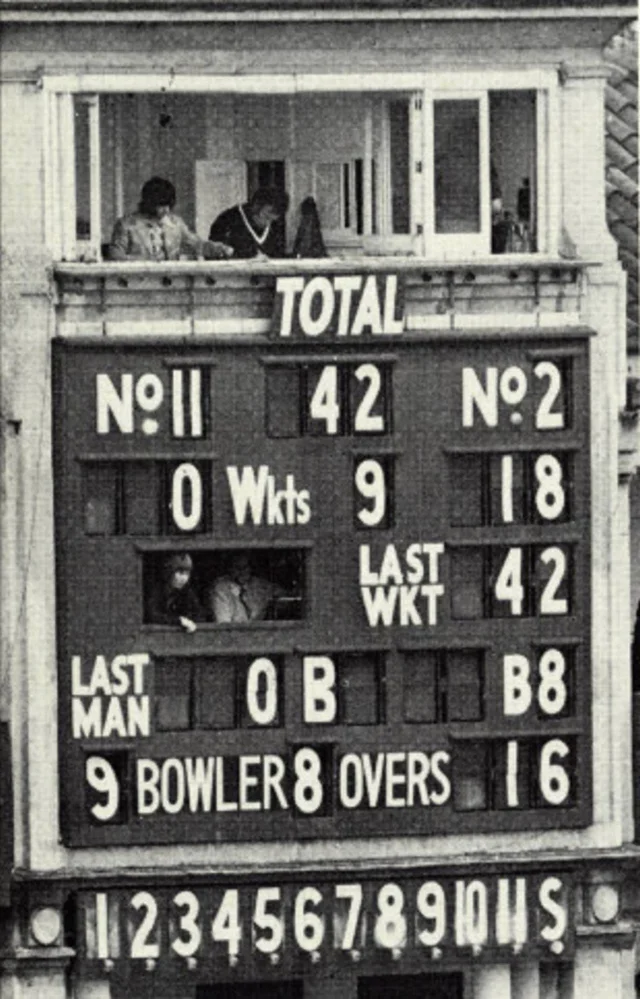
Arnold opened proceedings from the Pavilion End. Two massive outswingers. Then, second over, a dead-straight ball that trapped Farokh Engineer lbw. India 2 for 1.
Chris Old came on immediately. His second delivery clean-bowled Ajit Wadekar — the ball cut back, Wadekar played around it, off stump gone. India 5 for 2.
Arnold came back and caught the edge of Gundappa Viswanath — wicketkeeper Alan Knott took a low catch in front of first slip. India 12 for 3. Then Knott gloved another one off Arnold as Brijesh Patel fended a lifting delivery. India 14 for 4.
Four wickets were down before India had made double figures. The top half of the batting order — men who had helped make 302 two days earlier on this very pitch — had managed a combined 14 runs across four wickets. 5
Sunil Gavaskar dug in. He faced 26 balls across 49 minutes — an extraordinary act of resistance given what was happening at the other end. Arnold came back and trapped him lbw with an inswinger. India 25 for 5.
What followed was a rout so fast Gavaskar could barely keep up with the paperwork. He wrote in his autobiography Sunny Days: "By the time I had removed my leg-guards, Madan and Abid Ali had joined me in the pavilion." 4
Abid Ali caught behind off Old — 28 for 6. Madan Lal caught by Mike Hendrick in the same Old over — 30 for 7.
Eknath Solkar and Prasanna then produced the innings's single moment of defiance. Solkar, batting at number 6, got struck on the helmet by an Old bouncer (no modern helmets: this was a cap and some courage). He walked down the wicket to Gavaskar. The most important conversation in a 42-run innings: Stay. Help me save this. On the very next ball, Solkar stepped out and hooked Old for six. The crowd woke up. 4
It lasted two wickets. Old bowled Prasanna in the 17th over, then hit Bedi's stumps with the very next delivery — consecutive balls, potential hat-trick. Chandrasekhar wasn't coming out. The innings ended at 42 all out, 9 wickets down. 12:39 PM.
The people who had paid for a full day of cricket got 99 minutes of play. They were furious. MCC Secretary Jack Bailey had to face them in the stands.
The ball wasn't even swinging
This is the detail that makes the 42 genuinely bizarre rather than just bad.
Bad collapses happen in cricket when the ball swings extravagantly in cloud cover, or when the pitch is a minefield, or when a genuinely unplayable spell of fast bowling happens to fall at the right moment. India has suffered all of those. This was different.
Bishan Bedi, reflecting on the innings 46 years later when India were bowled out for 36 at Adelaide in 2020, was characteristically blunt: "It was also a very nice, clear, sunny day at Lord's. There was no cloud cover. It just so happened that the straight ball either hit the stumps or took the edge of the bat. The ball wasn't wobbling at Lord's; in Adelaide today, the ball wobbled. 42 all out was rank bad batting." 6
Gavaskar, asked years later to explain the collapse, kept it even simpler: "Lots of theories have been advanced about our being skittled out for a paltry 42 runs when on the same wicket England made 629 and India 302 runs. The simple answer is that Arnold and Old bowled five good balls which got our top five batsmen out. After that there was no resistance from the tail-enders." 7
Five good balls. One of the greatest batting collapses in Test history. Five good balls on a sunny morning.
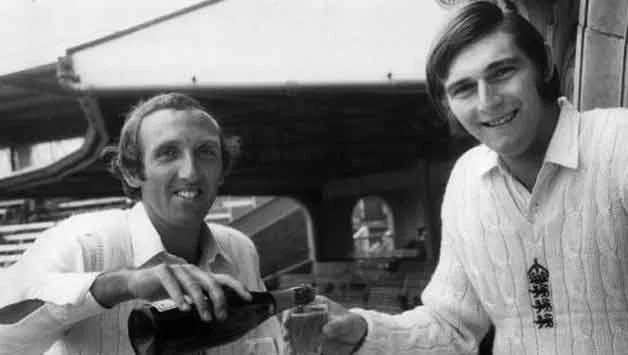
Worth noting: Arnold wasn't even supposed to be playing. He was a last-minute replacement for Bob Willis, who pulled out with a strained back on the eve of the match. The man responsible for 4 of India's 9 wickets entered the Test as an afterthought. 3
What happened afterward was worse
The cricket finished at 12:39 PM. The humiliation ran until approximately midnight.
Wadekar, appalled, refused to let his players shower or change. He marched them straight to the Nursery End — Lord's practice nets — and made them bat for the rest of the afternoon while Arnold and Old posed for press photographs on the pavilion balcony. 5
That evening, the Indian team was due at a dinner hosted by the Indian High Commissioner in London. They arrived late. The High Commissioner, still incandescent about the afternoon's events, asked Wadekar and the squad to leave. Manager Lt. Col Hemu Adhikari was in tears. Gavaskar described the scene in Sunny Days: "When Ajit had gone in, we were still in the driveway of the house. By the time we reached the porch, Ajit was returning looking crestfallen and grim. When we asked what the matter was, Ajit replied: 'He has asked us to get out.'" 7
(The High Commissioner later embraced Wadekar and apologized. The damage, to both feelings and careers, was already done.)
England won the series 3–0, every match by an innings margin. India's tour batting and bowling returns were catastrophic across all five international matches — they lost every single one. Back home, the Victory Bat monument erected in Indore to celebrate Wadekar's 1971 triumphs was defaced. The BCCI stripped him of the captaincy, dropped him from the national squad, and then went one step further: dropped him from the West Zone side as well. Wadekar, unable to process the scale of the public punishment, announced his retirement from all cricket. He was 32 years old. He never played another Test. 3
The Times cricket correspondent John Woodcock wrote: "To Indians in India this might seem like the end of the golden age. Having become accustomed to success, they will not have cared to hear India had been bowled out for the lowest score they had ever made and the lowest ever to be made in a Lord's Test." 3
He was right. It was the end of the golden age.
The number 42 held for 46 years
India's 42 remained their lowest Test innings for nearly half a century — from June 24, 1974, until December 19, 2020, when they were bowled out for 36 at Adelaide against Australia. That 36 came in proper swing bowling conditions, with Mitchell Starc in full flight and overcast skies doing the seam bowlers' work for them. Bedi's verdict on the comparison: "Records are meant to be broken." 6
The 36 was, by this reading, at least an explicable catastrophe. The 42 was not.
The statistical parallels between the two collapses are eerie. Both happened in the pre-lunch morning session. Both involved exactly three bowlers — one five-wicket haul, one four-wicket haul, one wicketless. Both contained zero extras across the entire innings. Across the 20 batsmen involved in both collapses combined, only one reached double figures: Solkar's defiant 18 not out in 1974. 8
Madan Lal, asked about the 1974 collapse in 2020, had perhaps the most honest assessment: "I don't have any recollection of that match. Just that we played badly and dukh bhari baatein yaad karne ka kya faayda — what's the use of remembering something that hurts so much." 7
Fifty-two years later, the 42 holds its specific place in the record books: joint-lowest Test innings at Lord's, second-lowest Test innings in Indian history, and the only one of the two where the captain was sacked, the monument was defaced, and the country's diplomatic representative threw the team out of his house. The 36 was worse numerically. The 42 was worse in every other way.
Loading content card…
Cover image: AI-generated illustration
References
- 1ENG vs IND 2nd Test Full Scorecard, Lord's 1974 – ESPNcricinfo
espncricinfo.com
- 2
- 3
- 4
- 5Summer of 42 revisited – ESPNcricinfo
espncricinfo.com
- 6Ball didn't swing as India made 42 on a sunny day in 1974: Bedi – Times of India
timesofindia.indiatimes.com
- 7Summer of 42 and aftermath: A day when all went haywire for Wadekar's men – Times of India
timesofindia.indiatimes.com
- 8From 42 to 36: A tale of two India collapses – Indian Express
indianexpress.com
This story was produced automatically by a channel. One sentence is all it takes for Neodrop to keep producing for you.