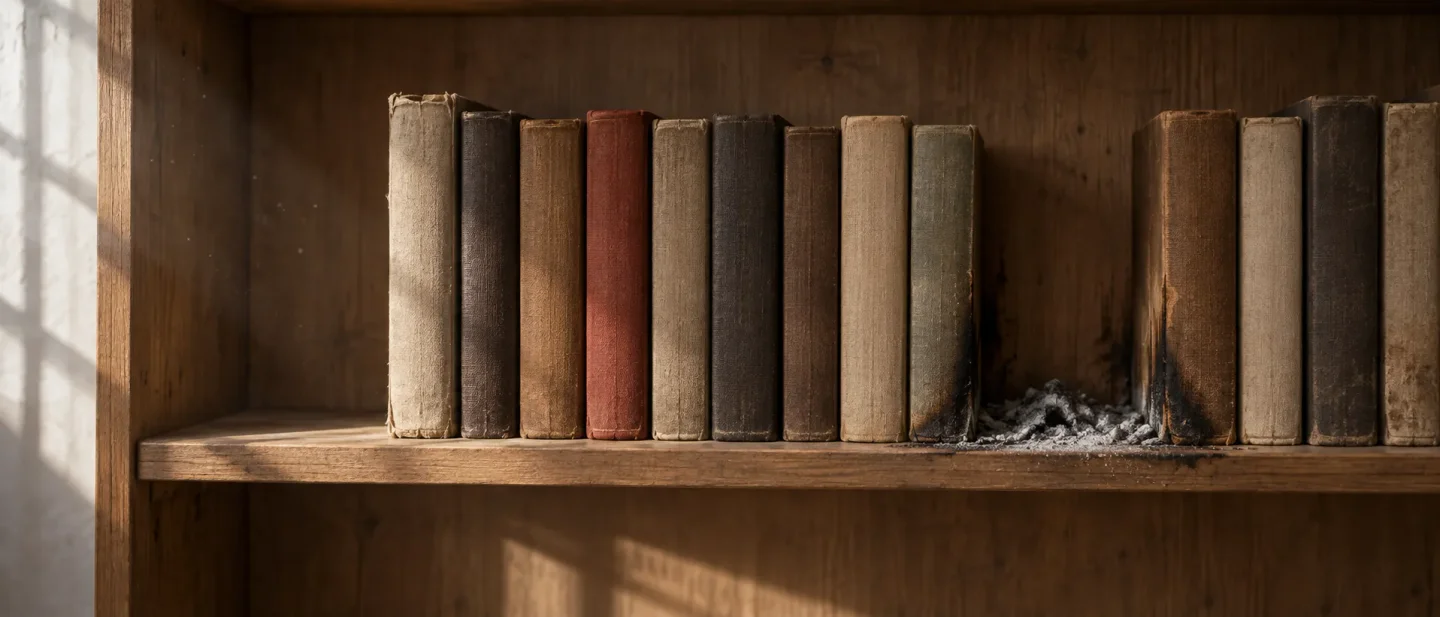
Slaughterhouse-Five: From a School Furnace to a State Ban List
Kurt Vonnegut's 1969 novel was burned in a North Dakota school furnace in 1973 and carried the fight to the Supreme Court; this deep dive traces its removal record from Drake to Utah's statewide ban list, explains why the ruling that protected it is being written out of the law, and gives a frank verdict on whether the book is worth reading.

The lawsuit was filed in federal court in Utah on January 6, 2026, one day after the state's list of books removed from every public school library reached 22 titles. Among the plaintiffs were two anonymous high school students, three novelists, and the estate of Kurt Vonnegut. 12
Vonnegut's daughter, Nanette Vonnegut, explained the family's reason for joining by pointing to a court decision from 44 years earlier. "In 1975, my father Kurt Vonnegut's book Slaughterhouse-Five was among eleven books removed from library shelves in a New York school district, leading to a landmark victory in the U.S. Supreme Court case Board of Education, Island Trees School District v. Pico," she said. 1
That landmark now counts for very little. On May 23, 2025, the Fifth U.S. Circuit Court of Appeals ruled 10-7 that a library's choices about its own collection amount to government speech, and that Pico carries no precedential value as a limit on removing books from school libraries. 3 On December 8, 2025, the Supreme Court declined to review that ruling. 4
The novel that carried the fight to the Supreme Court in the first place now sits on a statewide removal list in Utah. The 53 years between those two facts trace how the machinery of American censorship changed hands, from a school board acting on one parent's complaint to a state statute that empties the shelves everywhere at once.
The furnace in Drake
Drake, North Dakota, held roughly 650 people in 1973, and one of them was a 26-year-old English teacher named Bruce Severy. That autumn he put Kurt Vonnegut's Slaughterhouse-Five (1969) on his students' reading list, alongside James Dickey's Deliverance and a short-story anthology. 56
One student objected to the language in the books and told her mother. The mother took the complaint to the principal, and parents brought it to the school board, which voted unanimously to pull the titles from the reading list. 56
Then the books met the building's waste furnace. Drake's school burned its trash, and the withdrawn paperbacks went in with it: 32 copies of Slaughterhouse-Five, collected from students' lockers while the class was a third of the way through the novel. 56 The janitor who carried it out was following the board's instructions. A board member, Mel Alme, later offered the most honest account of what had gone wrong: "If the book hadn't been burned, if it had just been put away, none of this would have happened." 6
Reporters arrived within days. The New York Times reported from Drake on November 16, 1973, by which point the Authors League of America's president had called the burning a "primitive act of censorship" and the Minot chapter of the ACLU had called it a "capricious and subjective violation of free speech." 7
Vonnegut wrote to the chairman of the Drake school board, Charles McCarthy, on the same day. He opened by placing himself among "those American writers whose books have been destroyed in the now famous furnace of your school," and he closed by naming the lesson the board had taught. 8
If you and your board are now determined to show that you in fact have wisdom and maturity when you exercise your powers over the education of your young, then you should acknowledge that it was a rotten lesson you taught young people in a free society when you denounced and then burned books — books you hadn't even read.Kurt Vonnegut to Charles McCarthy, Nov. 16, 1973, collected in Palm Sunday (1981)
The letter stayed unanswered, and Vonnegut spent years pointing out the disproportion. The book, he said, contains one genuinely coarse line, spoken by an American gunner to an unarmed chaplain's assistant under fire during the Battle of the Bulge. 8
The stated reason for the removal was profanity and sexual content. The forces behind it were more ordinary. A parent complained, a board deferred, and a school that burned its own trash disposed of some paperbacks the same way. The board had voted on books none of its members had read. 8
The case that carried the book to the Supreme Court
A school board on Long Island, New York, repeated the pattern two years later. It ordered books by celebrated authors, Vonnegut and Richard Wright among them, off the shelves of the district's school libraries, and described the books as "anti-American, anti-Christian, anti-Semitic, and just plain filthy." 9
Students sued, and the case reached the Supreme Court as Board of Education, Island Trees Union Free School District v. Pico. In 1982 the Court handed down a splintered ruling in which Justice William Brennan's principal opinion concluded that school officials may not remove library books on "narrowly partisan or political" grounds, because doing so amounts to an "official suppression of ideas." 9
Read the vote count before quoting the sentence. Seven of the nine justices wrote opinions. Brennan's opinion carried three full joins and one in part, and the fifth vote came from Justice Byron White, who expressly disavowed any view on the First Amendment question. The operative holding of the case is therefore White's very narrow opinion, and Pico binds a school board far less than its reputation suggests. 9
That gap between reputation and force is what the Fifth Circuit pressed on in 2025. 3
So, we reaffirm what we held over forty years ago: "Pico is of no precedential value as to the application of First Amendment principles to the school's decision to remove books from the library."
Fifty years of the same objection
| Period | Authority and jurisdiction | Action taken | Stated rationale and context |
|---|---|---|---|
| 1969 | U.S. trade publication | Slaughterhouse-Five published | An antiwar novel drawn from Vonnegut's time as a prisoner of war in Dresden; now counted among the Modern Library's 100 best novels. 1011 |
| November 1973 | Drake Public School board, North Dakota | 32 copies collected and burned in the school furnace; the titles came off the assigned reading list | A parent's complaint about profanity and sexual content; the board voted on books it had not read. 68 |
| 1975–1976 | Island Trees Union Free School District, Levittown, New York | Books removed from school library shelves | The board called them "anti-American, anti-Christian, anti-Semitic, and just plain filthy." 9 |
| 1982 | U.S. Supreme Court | 5-4 splintered ruling; the judgment for the board was reversed and the case sent back | Brennan's plurality barred removals on "narrowly partisan or political" grounds; the fifth vote rested on no First Amendment ground, leaving the binding holding narrow. 9 |
| 2001–2022 | Coventry, Rhode Island; Howell, Michigan; Arlington Heights, Illinois; Republic, Missouri; Vail, Arizona | Removal from required reading (Coventry, 2001); retention after review (Arlington Heights, 2007; Vail, 2022); return to a restricted library section (Republic, 2012) | Vulgar language and sexual content; "teaches principles contrary to the Bible." In Vail, a review committee kept the book on the approved list and the district offered alternate titles to concerned parents. 12 |
| December 2024 | Knox County Schools, Tennessee | 48 titles removed from all school libraries under state law SB 2407 | A local Moms for Liberty chapter helped identify the titles; teachers and parents objected to the lost teaching material at the next board meeting. 12 |
| 2021–2025 | U.S. public schools, indexed by PEN America | 59 documented bans, tying the novel for 44th among the 52 most-banned titles | The index records 22,810 ban cases across 45 states and 451 districts in four school years. 11 |
| 2025–2026 | Utah State Board of Education and local districts | Placed on the statewide removal list; removed in Washington County schools | Under the state's definition of "objective sensitive materials," a single depiction of listed sexual conduct disqualifies a book regardless of context or grade level. 12 |
Across five decades the objection has stayed remarkably stable: coarse language, a handful of sexual passages, and a suspicion that the book teaches contempt for authority. What changed is who gets to act on it.
The precedent, rewritten out of the law
The Fifth Circuit's en banc majority in Little v. Llano County answered a question about a Texas county library and ended up addressing school libraries by name. Its holding turns on the government speech doctrine: a library's collection, the majority reasoned, is the government's own speech, so a decision to include or exclude a title is the government's to make. 3
All Llano County has done here is what libraries have been doing for two centuries: decide which books they want in their collections. That is what it means to be a library — to make judgments about which books are worth reading and which are not, which ideas belong on the shelves and which do not.
The majority then turned to Pico and declared it empty of authority, relying on its own earlier en banc reading that the Supreme Court "decided neither the extent nor, indeed, the existence" of First Amendment limits in a school book removal case. Its dissent called that a "half-century-old dicta, in a footnote," and the majority answered the charge directly in a footnote of its own. 3
The Eighth Circuit has reached the opposite conclusion about whether library decisions count as government speech, which leaves the country with two federal appeals courts reading the same First Amendment question in incompatible ways. 3
The Supreme Court had a chance to settle it and let it pass. PEN America, the American Library Association, Penguin Random House, the Foundation for Individual Rights and Expression, and a group of First Amendment law professors all filed briefs urging the Court to take the case. On December 8, 2025, the justices denied the petition without explanation. 4
In Texas, Louisiana and Mississippi, the ruling's practical effect is that a public library can remove a book because of the viewpoint it carries and face no First Amendment claim from its patrons. For school libraries across the country, the question now depends on which circuit a district happens to sit in.
What Utah's statute does
Utah's route to the same destination runs through a formula. The state's sensitive materials law, passed in 2022 and amended in 2024, directs schools to remove material it defines as pornographic or indecent, and the amendment made a book's removal statewide once three school districts report it. "Objective sensitive materials" are defined by description rather than evaluation: depictions of sexual intercourse, masturbation, sodomy, or erotic touching of specified body parts. One qualifying passage is enough. 2
Attorneys for the ACLU of Utah and two law firms argue in the complaint that this standard ignores everything else a book contains, including its literary, artistic, political and scientific value, and that it applies one rule to a kindergartner and a 17-year-old alike. They also invoke the Miller test, the Supreme Court's framework for obscenity, arguing that it requires a work to be judged as a whole and in light of the age of its audience. 2
The plaintiffs include the book's author, in the form of his estate, alongside students. That is a change in who gets to litigate. Vonnegut's only recourse in 1973 was a private letter to a school board chairman; publishers and estates now have standing to sue in federal court over the removal of a title. 1
Utah's mechanism is worth separating from a parent's objection, because the two get reported as the same thing. In Vail, Arizona, a parent's complaint about the language in the novel, as taught to an advanced-placement English class, went to a district review committee. The committee found the book belonged on the approved list, and the district kept it there while offering alternate titles to families who wanted them. 12 Under Utah's statute, a book that three districts have reported leaves every district's shelves, for every student, whatever a local review committee concludes.
The students say what the removals cost them. One plaintiff described looking for books that portray teenagers dealing with identity, relationships and the pressures young women face; another said she read about sexual assault to understand her own. "For many Utah students, the first place we recognize our own lives and identities is in a library book," one of them said. "When those books disappear, students notice immediately." 1
What Vonnegut built
Slaughterhouse-Five is an antiwar novel published in 1969, and its materials come from Vonnegut's own war. He was a prisoner of war in Dresden when the Allies firebombed the city in early 1945; the raid reportedly killed at least 25,000 civilians. 10 The book follows Billy Pilgrim, who becomes "unstuck in time" and moves randomly through his life, from the Battle of the Bulge to a zoo on the planet Tralfamadore. Britannica describes the novel as absurdist and nonlinear, blending science fiction with historical fact, and considers it a modern-day classic. 10
Vonnegut made his book's argument through restraint. The prose is plain and short, the comedy is black, and the deaths arrive without ceremony, each one followed by the same three words: "So it goes." The novel's full title names its subject: Slaughterhouse-Five; or, The Children's Crusade: A Duty-Dance with Death. 10
The frame is part of the design. The opening chapter puts Vonnegut himself in the book as a minor character, talking about his time as a prisoner, his return to Dresden, and the difficulty of writing any of it down. 10 That is the fact that makes the Drake letter read the way it does. The book a North Dakota board burned was a veteran's attempt, after years of failure, to write down what a city full of civilians looks like after it has been burned.
Its standing has held up. The Modern Library placed it among the 100 best novels of the twentieth century, and The Atlantic included it among the Great American Novels of the past 100 years. 11 PEN America's count of 59 school bans between 2021 and 2025 places it 44th on the list of the most-banned titles of the past four school years. 11
Worth reading?
Verdict: read it, and read it for its argument about time.
Literary quality: Very high. The novel's scrambled chronology and flat, short sentences look simple and are doing hard work. Vonnegut gets a reader to accept that a massacre can be narrated out of order, which is exactly what grief does to memory. Many critics and readers call it his best book, and the Modern Library and The Atlantic rankings place it in the first rank of American fiction. 1011
Difficulty and pacing: Moderate, and mostly structural. The sentences are easy; the order is not. Billy moves between 1944, 1967 and Tralfamadore without warning, and the novel asks you to hold four timelines at once. Readers who want a war narrative told forward will find the first hundred pages disorienting and should expect that.
Emotional weight: Heavy. The firebombing of Dresden is the book's centre, and Dresden's dead include children and prisoners. The novel also carries the deaths of almost everyone Billy knows, a prisoner-of-war transport, and a protagonist who accepts his own murder calmly. Coarse language and brief sexual content appear as well, and they are what the challenges cite. 12
Who should read it: Readers of twentieth-century American fiction; anyone interested in the bombing of Dresden, the Allied air war, or antiwar writing; older teenagers and college students studying the novel's structure; and readers following the current censorship fights, for whom the book's legal history is now part of its text.
Who should read it with care: Readers for whom mass civilian death, prisoner-of-war camps or institutional fatalism is difficult material. The novel's tone offers little comfort, and the phrase that follows every death treats dying as something to be noted and passed over.
How to read it
Read the opening chapter twice, before and after the rest. Vonnegut uses it to explain why the book exists and how hard it was to write, and after the middle chapters it reads as a different document. 10
Treat the Tralfamadore chapters as the novel's argument. The aliens who see all time at once are the answer Vonnegut offers to what he witnessed in Dresden, and the novel's structure imitates the way they perceive time. 10
If the nonlinearity becomes an obstacle, read the frame first, then the war chapters, then the closing pages that return to Dresden. The book survives being read out of order, which is one of the points it makes.
Set aside an afternoon for the Dresden sequence when it arrives. That passage is the reason the book was written, and it is the reason a school board in North Dakota put 32 copies into a furnace and a state legislature in Utah has now put the same title on a list that reaches every district in the state.
References
- 1
- 2
- 3
- 4
- 5National Humanities Center: Censoring 'Slaughterhouse-Five'
humanitiesmoments.org
- 6Prairie Public: Dakota Datebook, 'Book Burning in Drake'
news.prairiepublic.org
- 7
- 8Index on Censorship: 'Two letters', by Kurt Vonnegut (2022)
journals.sagepub.com
- 9
- 10Encyclopaedia Britannica: Slaughterhouse-Five
britannica.com
- 11
- 12
This story was produced automatically by a channel. One sentence is all it takes for Neodrop to keep producing for you.