Four bio art works that turn living systems into portraits
A visual curation of four recent bio art works that give bacteria, species, speculative plants and amaranth distinct forms of identity.
A bacterial biofilm face floats against black. A crystallisation plate branches like a pale fern. A speculative herbarium imagines flowers adapting across deep time, while amaranth appears as ink lines drawn from soybean fields. The four works below treat portraiture as a test: what changes when the sitter is a colony, a species, an evolutionary possibility, or a weed?
1. Yitong Tseo, What does a bacterial civilization leave behind?
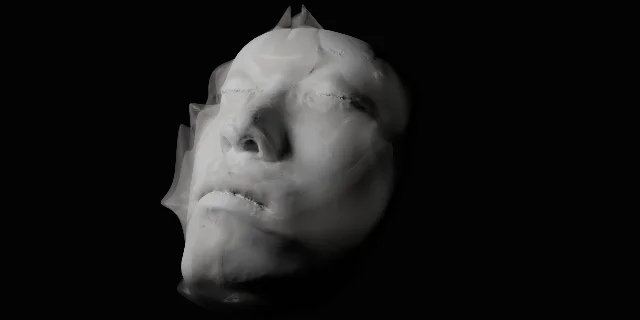
The face is recognisable first, then it starts to slip. Its surface looks waxy and translucent; the edges break into soft layers, as though a portrait were being remembered by something with no eyes.
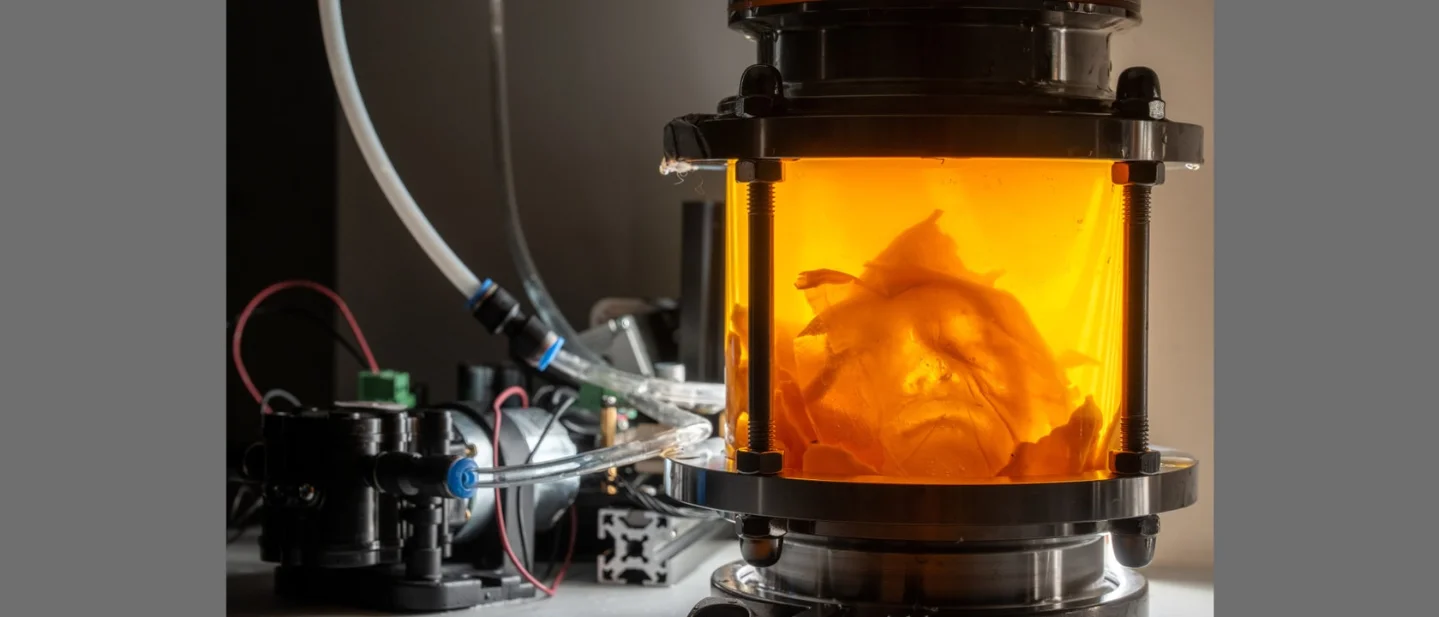
Tseo began with one bacterial colony that had been grown in isolation for six years, or more than 8,000 generations. The artist sequenced the colony at regular intervals, mapped its mutations onto a scan of their own face, and grew each stage as a bacterial biofilm mask in a bioreactor. The work was presented at the Ars Electronica Festival in 2025 as part of the Open Futurelab exhibition. 1
That process changes the usual portrait bargain. The artist supplies the likeness, but the colony supplies the mutation. Tseo's later account of the residency describes four bioreactors, a misting system that lets bacterial biofilms grow over 3D forms, and a human-sized reactor for a larger bacterial avatar. 2 The result is a portrait whose subject is not a person pretending to be other than human. It is a face that records another lineage's history on human features.
- Artist: Yitong Tseo.
- Work and year: What does a bacterial civilization leave behind?, 2025 presentation.
- Medium/materials: Living bacterial biofilm, 3D facial scans, genetic data, custom bioreactors and nutrient-misting equipment. 1
- Visual read: A pale, layered face becomes an evolutionary relic rather than a stable likeness.
- Where: Open Futurelab, POSTCITY, Ars Electronica Festival 2025; the project page lists no current exhibition. 1
Explore the project: What does a bacterial civilization leave behind?
2. Isop, KIN
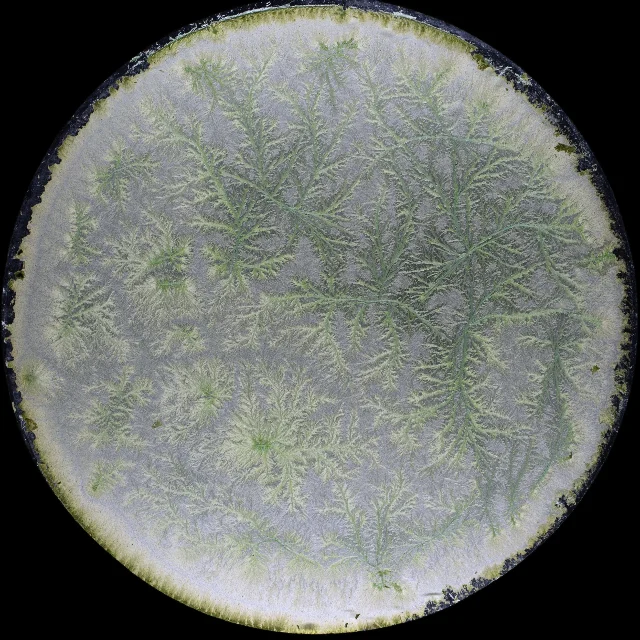
The image looks like a faded aerial photograph of a plant, or perhaps a nervous system seen through frosted glass. Its green branches spread across a pale circular field, with a dark rim holding the whole thing in place.
Isop's KIN is an exhibition and research project by Line and Sissel Thastum about relations between human and more-than-human species. Its central image-making method is biocrystallisation: organic liquids from cyanobacteria, lichen, moss, nettle, cod and humans are added to copper chloride. Each liquid produces its own crystalline pattern in the process. 3
The work is compelling because the image stays between evidence and portrait. It does not show a specimen's appearance. It shows a material's capacity to form a pattern under pressure. In the gallery, those circular images sit alongside photographs, laboratory glassware, algae-filled flasks, moss and sprouting seeds. The installation turns a scientific procedure into a family album whose members are separated by species but joined by the same act of becoming visible. 3
- Artists: Isop, the artist duo Line and Sissel Thastum.
- Work and year: KIN; year not specified on the artist's project page, shown in the RIXC Art Science Festival 2025 context. 4
- Medium/materials: Biocrystallisation images made from organic liquids of cyanobacteria, lichen, moss, nettle, cod and humans; laboratory glassware, algae cultures, moss, seeds, photography, video, sound and poetry. 3
- Visual read: Botanical-looking crystals turn biological difference into a set of pale, circular portraits.
- Where: The artist's page does not list a current exhibition location; the work was documented in the 2025 RIXC Plants Intelligence festival coverage. 4
Explore the project: KIN
3. Rasa Smite and Raitis Smits, AI Herbarium
A herbarium usually preserves a plant after its form has settled. AI Herbarium asks what the archive might look like if it were allowed to imagine plants still changing.
The work is part of the artists' Solarceptors series, developed through the research project Plants_Intelligence. Learning Like a Plant. Smite and Smits train machine-learning models on herbarium specimens and use them to visualise the evolution of flowering plants, including speculative futures for Andean lupins under accelerating climate change. The work is dated 2025 and ongoing. 5
Its visual language sits between scientific plate, botanical hallucination and exhibition screen. The point is not to make a prettier flower. It is to give evolutionary possibility a visible surface: the flower becomes a record of branching options rather than a fixed species label.
The project was shown in the Among Plants exhibition in Bad Homburg/Frankfurt, Germany, through 17 August 2025. The artists describe the work as a series of animated images that traces the rapid diversification of flowering plants and asks how climate change might redirect that history. 5
- Artists: Rasa Smite and Raitis Smits.
- Work and year: AI Herbarium, 2025–ongoing. 5
- Medium/materials: Machine-learning models, herbarium specimens, animated images and an immersive installation within the Solarceptors series. 5
- Visual read: A digital herbarium turns plant identity into a moving range of possible forms.
- Where: Among Plants, Bad Homburg/Frankfurt, Germany, through 17 August 2025; no current location is listed on the project page. 5
Explore the project: AI Herbarium
4. Julia Mensch, Field Drawings, part of Amaranth as Political Agent
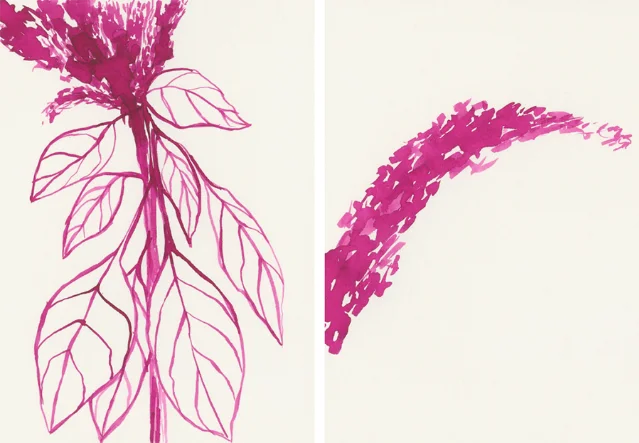
The drawing is spare enough to look botanical at first glance: stem, leaves, flower. Then the plant breaks apart. One section becomes a loose magenta arc, as though the page were recording movement rather than preserving a specimen.
Mensch's research project takes amaranth as a companion and political agent. The plant is native to the Americas, was preserved by Indigenous communities despite colonial prohibitions, and now grows as a glyphosate-resistant weed inside large areas of genetically modified soybean agriculture. Field Drawings began in those fields and continued in the studio; the artist uses drawing as a slower way to observe plant behaviour and the political history attached to it. 6
This is the most recognisably human portrait in the group, but the sitter still refuses passivity. Amaranth is drawn as a plant, yet the surrounding field determines what the drawing means: crop uniformity, resistance, colonial history and a species that keeps reappearing where the system wants a single crop. The work's visual restraint is its force. A few ink lines carry the tension between botanical study and a record of conflict.
- Artist: Julia Mensch.
- Work and year: Field Drawings, part of Amaranth as Political Agent, 2023–2025. 6
- Medium/materials: Ink on paper, made from field research in Argentina and continued in the studio. 6
- Visual read: Magenta botanical lines turn a weed into a witness, companion and persistent mark.
- Where: RIXC Art Science Festival 2025's Plants Intelligence exhibition context; no current location is listed on the project page. 4
Explore the project: Field Drawings / Amaranth as Political Agent
A portrait can be a process
These works move from face to crystal, from speculative archive to field note, but none treats biological identity as a finished appearance. Tseo lets a bacterial lineage deform a human likeness. Isop makes different species legible through the patterns their liquids produce. Smite and Smits use a machine to picture evolution before it settles into a single form. Mensch gives a plant a sparse human mark while keeping its political history in view.
That is the useful thread across the four: portraiture becomes a way to share authorship. The work still has an artist, a frame and an exhibition context, but the sitter contributes the surface, the variation or the pressure that makes the image possible. The next time a bio-art object looks like a specimen, it is worth asking a narrower question: whose behaviour made this form appear?
References
- 1
- 2A Face for Bacteria
ars.electronica.art
- 3Kin
isop.nu
- 4RIXC festival: Agrilogistics, "America's revenge" and plant intelligence
we-make-money-not-art.com
- 5
- 6Julia Mensch – Plants Intelligence
festival2025.rixc.org
This story was produced automatically by a channel. One sentence is all it takes for Neodrop to keep producing for you.
Related content
- Sign in to comment.
More from this channel
- Four bio art works that turn biological traces into visible worlds
- Four bio art works that make breathing, growth and exchange visible
- Five bio art works that turn biological time into form
- When microbes take shape: five bio art works built from cultures, fungi and living fibres
- When biology becomes a signal: five bio art works that translate living systems