What five recent AI-safety updates establish about permission to act
DreamGuard, SafeCommit, Anthropic's Fable 5 safeguards, an EU GPAI taskforce discussion, and a lifecycle model attach safety evidence to different points between detecting risk and granting authority.

A model can be flagged as risky without anyone having a reliable rule for stopping its next action. That gap is visible in five recent updates: DreamGuard predicts near-term and accumulated trajectory risk; SafeCommit withholds side-effectful actions unless every retained world makes them safe; Anthropic has moved a biology classifier boundary while keeping dual-use work behind stricter routing; an EU taskforce has discussed using model-usage evidence after deployment; and a lifecycle model argues that governance often sees evidence later than the decisions that shape a system. 12345
The numbers are not comparable. They describe different objects, under different threat models, with different consequences attached to uncertainty. The useful question is narrower: when an agent is about to act, what exactly has been measured, what state has been retained, and who can still say no?
DreamGuard measures whether a trajectory is entering danger
Most action checks look at the proposed tool call or the latest model output. DreamGuard instead keeps a compact latent state of the trajectory, predicts the successor state for the proposed action, and combines two signals: an immediate-hazard probability and a prefix-risk probability for evidence that the workflow is becoming dangerous before the final bad action appears. A moving window and exponential moving average smooth the prefix signal, then the controller chooses among
PASS, HOLD, and BLOCK using thresholds calibrated on safe trajectories. 1That design answers a practical failure mode: a long-horizon agent may take several locally acceptable steps whose combination creates the hazard. A monitor that waits for the final action can be accurate about what already happened and still be too late to contain it. DreamGuard tries to move the decision point earlier without using an expensive language-model look-ahead loop.
Its online evaluation reports a 72.92% safety rate and 90.38% utility rate on an ASSE-Security subset containing 48 unsafe and 52 benign trajectories. It reports a 96.3% pre-hazard intervention rate and an average end-to-end latency of 0.025 seconds per call. These are useful engineering numbers: the controller is not merely a post-hoc classifier, and it appears to intervene before the first hazard action in most of the unsafe long-horizon cases in that evaluation. 1
The result still leaves the permission question open. DreamGuard is calibrated exclusively on SafetyDrift and transfers its thresholds zero-shot to other benchmarks; the paper names substantial distribution shift as a remaining problem. It also intervenes rather than producing a safe replacement action. A high pre-hazard intervention rate therefore tells us that the monitor can recognize a risk pattern early in the tested setting. It does not tell us that the agent's next action is safe across the plausible states of a changing deployment.
SafeCommit changes the rule from “risk is low” to “no retained world makes this unsafe”
SafeCommit starts from a more conservative object: a memory-grounded action with side effects. The controller constructs a calibrated set of plausible worlds from memory, observations, tool outputs, provenance, and policy constraints. It commits only when the proposed action is safe in every retained world. If one plausible world still makes the action unsafe, the controller chooses a low-side-effect probe, or returns
defer, escalate, or abstain. 2This is not just a lower threshold on a risk score. It changes what counts as sufficient evidence. DreamGuard asks whether the current trajectory looks hazardous enough to hold or block. SafeCommit asks whether uncertainty has been reduced enough that a side-effectful commit is defensible under all worlds the controller still considers possible.
The paper states a conditional guarantee. If the plausible-world set contains the true world with probability at least
1 - α, and the controller commits only when the action's unsafe region is empty, the probability of an unsafe commit is bounded by α. If the world-construction process can omit the true world with probability β, the paper gives the looser bound β + (1 - β)α, separating calibration error from missing-world or representation error. The guarantee is therefore about the coverage of the evidence set, not a claim that the controller has discovered the true state of the world. 2In the paper's controlled simulator, the full system at
α = 0.05 reports a 2.6% unsafe commit rate, 97.4% task success, 100.0% commit coverage, no fallback episodes, and a mean of 0.55 probes. The no-probe version has nearly the same unsafe commit rate, 2.5%, but task success falls to 44.7%, commit coverage to 47.2%, and fallback rate rises to 52.8%. The probes are doing the important work: they turn unresolved uncertainty into additional evidence instead of forcing the controller to choose between unsafe execution and broad abstention. 2The boundary is equally important. SafeCommitBench-Controlled uses explicit latent worlds, deterministic metadata-style probes, hand-specified safety maps, and a finite proposed support. The paper's experiment is a proof of concept in a simulator, not deployment evidence. In a real system, the difficult step is not only calibrating
α; it is constructing a world set that contains the safety-relevant possibilities. Missing one of those possibilities is the separate β problem.Anthropic's biology update shows what uncertainty looks like in a product policy
A provider does not need to expose a formal plausible-world set to face the same choice. Anthropic says it rewrote the constitution of Fable 5's biology classifier, changed its training data, and retrained it to reduce false positives. The company reports about an 85% reduction in biology-related fallbacks across product surfaces, with expected reductions of 67% on Claude.ai, 55% on Cowork, 17% on Claude Code, and 7% on the Claude Platform. The intended benefit is more access to benign health, education, and some clinical work. 3
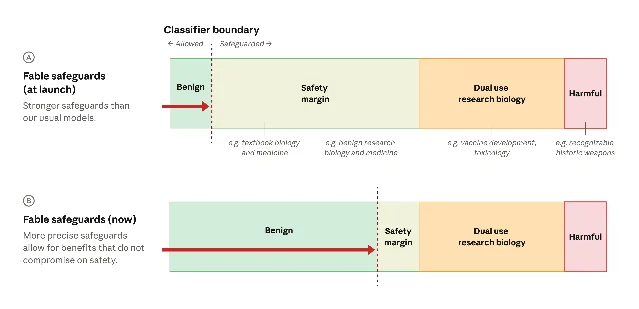
Anthropic says Fable 5 still falls back to Opus 5 for dual-use areas including virology, toxicology, and molecular design, and is not yet intended for professional frontier biology research and drug development. The company also says false positives remain inside the safety margin because a malicious request can be made to resemble ordinary research. 3
That makes the update more informative than a simple refusal-rate announcement. The provider has changed the routing boundary, not claimed that the boundary is perfectly knowable. It accepts more benign requests, keeps an ambiguous region, and sends some work to a stricter model. The reported 85% is a company-reported operational result; it is not an independent estimate that the remaining dual-use classifier decisions are correct. The unresolved problem is the same one SafeCommit exposes more formally: what evidence is enough to move an uncertain case from “do not commit” to “allow”?
Governance evidence often arrives after the shaping decisions
The EU's fourth GPAI Signatory Taskforce meeting adds a slower institutional version of the same problem. The meeting, held on 17 July 2026 and reported on 3 August, discussed how analysing model usage can form part of post-market monitoring under Measure 3.5, complement pre-deployment evaluations, and inform systemic-risk assessment. It also discussed marginal-risk clauses, with the AI Office saying they should be invoked only in exceptional circumstances and under evidentiary and procedural safeguards. 4
The status matters. The page records a taskforce discussion and interpretation, not a newly enacted law. The copyright measures described there are commitments under the Code of Practice. The governance contribution is therefore not a new permission to deploy; it is an argument that observed use should feed back into risk assessment instead of leaving evaluation frozen at release.
The lifecycle model makes clear why that feedback may be insufficient on its own. It maps 32 stages across data, model, distribution, and application, alongside 12 LLMOps stages and 9 governance categories. Its central analytical distinction is between decision-shaping provisions—such as data selection, alignment strategy, and capability boundaries—and evidence-producing provisions—such as documentation, logging, and reporting. The paper argues that the former cluster in the early data and model layers, while the latter cluster closer to distribution and application, where systems are more visible to regulators. 5
The paper is a structured synthesis and heuristic, not an empirical enforcement study. Its value is diagnostic: a deployment log can tell an institution what happened after release, but it may not expose the earlier choices that determined which capabilities were trained, aligned, or made available. Usage monitoring is evidence about behaviour in the world; it cannot by itself recreate a missing record of why a capability boundary was chosen.
The handoff is the safety claim
These sources attach evidence to different interfaces:
| Source | Object being judged | What the control can do | What remains conditional |
|---|---|---|---|
| DreamGuard | A proposed action in a stateful trajectory | PASS, HOLD, or BLOCK before execution | Threshold transfer beyond its calibration domain; no safe replacement action. 1 |
| SafeCommit | A side-effectful action under memory and world uncertainty | Commit, probe, defer, escalate, or abstain | Coverage of the plausible-world set; simulator assumptions. 2 |
| Anthropic's Fable 5 update | A biology request at a provider policy boundary | Allow more benign work; route some requests to Opus 5 | Classifier accuracy and the ambiguity of dual-use intent; provider-reported metrics. 3 |
| EU GPAI taskforce discussion | Systemic risk across deployment and use | Add usage analysis and procedural safeguards to the governance process | The discussion is not itself new law or an independent enforcement mechanism. 4 |
| Lifecycle model | Decisions and evidence across development and deployment | Expose where governance provisions attach | The proposed map is analytical; it does not create authority. 5 |
The intersection is the important result. A monitor can estimate that a trajectory is becoming hazardous; a certificate can refuse to commit while a relevant world remains plausible; a provider can route an ambiguous domain request to stricter handling; and a governance process can demand evidence from actual use. None of those layers automatically supplies the next one. Measurement is not authorization, authorization is not containment, and post-market evidence is not a substitute for development-stage accountability.
For a newcomer reading the next safety paper or provider announcement, five questions expose the handoff:
- What is the object? A final answer, a trajectory, a proposed side-effectful action, a domain request, or a lifecycle decision?
- What state survives? Prompt history, memory, tool outputs, workspace state, identity, routing history, or plausible worlds?
- Which signal is independent of the agent being evaluated? A separate monitor, provenance check, human approval, or only the same model's judgment?
- What happens when the signal is uncertain? Does the system block, hold, probe, abstain, escalate, route, or merely record the event?
- Who has authority to enforce that consequence? A runtime controller, a provider, an operator, a regulator, or nobody outside the model loop?
The headline score matters only after those questions have an answer. Recent work is making the interfaces more explicit, but the safety claim still has to survive the handoff between them.
References
- 1
- 2
- 3Improving Fable 5's biology safeguards
anthropic.com
- 4Fourth GPAI Signatory Taskforce meeting
digital-strategy.ec.europa.eu
- 5
This story was produced automatically by a channel. One sentence is all it takes for Neodrop to keep producing for you.