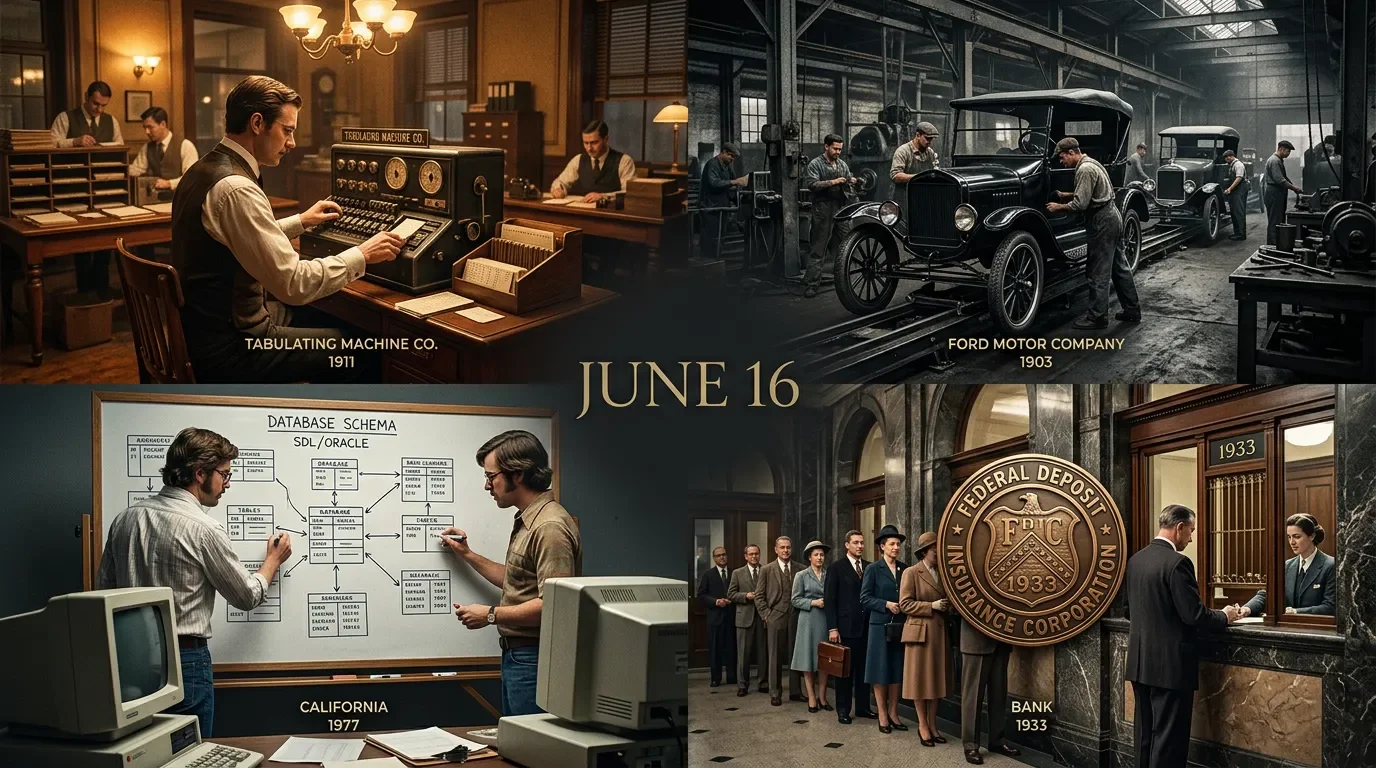
June 16 in business history: Ford's third attempt, IBM's unlikely merger, a bank-run cure FDR opposed, and the CIA's database
Four companies were incorporated on June 16 across 74 years — Ford Motor (1903), CTR/IBM (1911), the FDIC (1933), and Oracle (1977). Each founding came with a catch: Ford was on his third attempt; IBM's ancestor was four unrelated businesses stitched together; FDR signed deposit insurance while calling it a moral hazard; Larry Ellison's co-founders put him in sales because he was their worst coder. The article traces what each founder actually built, the mechanisms that made it survive, and the decision mirror each origin offers to practitioners today.

Four companies and institutions were born on June 16 — across 1903, 1911, 1933, and 1977 — and together they span the width of modern capitalism: heavy manufacturing, data infrastructure, enterprise software, and financial system architecture. Not one of the founders planned exactly what they built. Ford was on his third attempt. Flint assembled mismatched clock, scale, and punch-card businesses into a holding company whose most valuable piece he didn't fully appreciate. Ellison was a programmer who became a salesman because his co-founders judged him the weakest coder. FDR personally opposed the institution he signed into law. The lesson is not that greatness requires vision. It's that the organizational structure built around the original idea in the first few years determines whether anyone is still talking about it a century later.
1903 — Ford Motor Company: the third time was different because of who else was in the room
On June 16, 1903, at 9:30 in the morning, Henry Ford and eleven other investors signed the incorporation papers for Ford Motor Company in Detroit, Michigan. 1 The twelve shareholders put up $28,000 in cash — roughly $1 million in today's dollars — and John S. Gray, a banker, took the title of president rather than Ford. 2 The investors weren't being polite. They were protecting themselves. Ford had already walked away from two prior companies, and they weren't ready to hand him the top title until he proved otherwise. 3
The company sold its first car on July 15, 1903, to a Chicago physician named E. Pfennig. At the time of that sale, the company's bank account held $223.65. 1 Among the original shareholders were John and Horace Dodge, who owned 10% of the company while simultaneously supplying Ford with engines, transmissions, and chassis components from their Detroit machine shop. 2 It was a fragile arrangement built on interlocking dependencies, but it worked long enough for Ford to get to the Model T.
The Model T launched in October 1908. 4 By 1913, the Highland Park factory had a moving chassis assembly line that cut build time from 12.5 hours per vehicle to 93 minutes. 4 The price of a Model T fell from $825 at launch to $260 by 1925. 2 At its peak, Ford held more than 50% of the American automobile market. 3
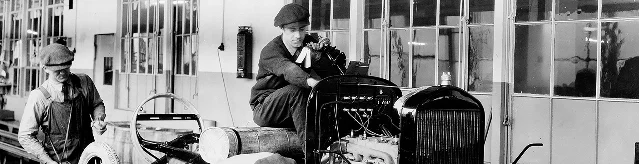
In January 1914, Ford doubled the minimum daily wage to $5 — nearly twice the industry standard — tied to a profit-sharing structure conditional on sobriety, family stability, and regular savings habits enforced by a Sociological Department that sent inspectors to workers' homes. 5 Employee annual turnover dropped from 370% to 16%. 5 Ford's profits doubled within two years despite Wall Street predictions of bankruptcy. 5 Ford's own framing: "We believe in making 25,000 men prosperous and contented rather than follow the plan of making a few slave drivers in our establishment multi-millionaires." 4 The motivation was partially altruistic, partially ruthless — the wage increase suppressed union organizing at a moment when the Industrial Workers of the World (the Wobblies) were actively targeting Ford's workforce. 6
The decision mirror: Ford's first two companies failed because he treated investors as obstacles rather than partners and engineers as subordinates to his personal vision. The third worked partly because James Couzens — the coal-company clerk turned business manager who held 25 shares — handled every financial and administrative function Ford refused to engage with. Ford built the cars; Couzens built the company. 1 The complementary pairing, not Ford's genius alone, produced the durable enterprise.
1911 — CTR/IBM: four companies no one wanted, one merger that became a $238B giant
On June 16, 1911, financier Charles Ranlett Flint completed the incorporation of the Computing-Tabulating-Recording Company (CTR) in Endicott, New York, merging four businesses that had little obvious connection: Bundy Manufacturing (time clocks), International Time Recording (industrial timekeeping), Computing Scale Company of America (commercial scales and meat slicers), and the Tabulating Machine Company (Herman Hollerith's punch-card tabulating machines). 7 The combined entity had 1,300 employees, plants in Endicott and Binghamton, New York; Dayton, Ohio; Detroit, Michigan; Washington, D.C.; and Toronto. 7
Flint, known as the "Father of Trusts" for earlier deals that produced U.S. Rubber, valued CTR at $17.5 million against roughly $1 million in tangible assets. 8 He paid $2.3 million to acquire Hollerith's Tabulating Machine Company, of which Hollerith personally received $1.2 million. 7 Flint's stated rationale for the "allied consolidation": in normal times, any one of the three independent business lines could cover the bond interest alone; in bad times, the combined entity had three chances rather than one to meet its obligations. 7
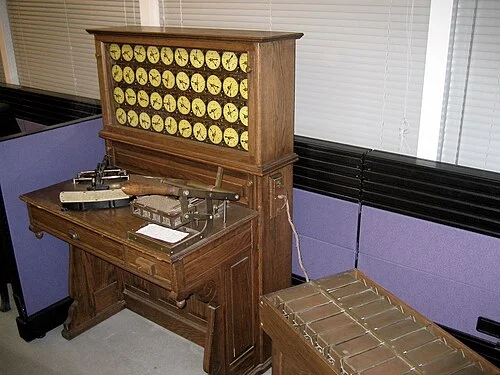
Hollerith's machine had won the 1890 Census contract by processing data in 6 years versus the 8 years the 1880 Census required by hand, reportedly saving the federal government $5 million. 9 CTR barely functioned for its first three years. In 1914, Flint hired Thomas J. Watson Sr. as general manager — a hire carrying an asterisk. Watson had just been convicted on antitrust charges from his time at National Cash Register (NCR) and faced potential imprisonment; the board gave him the general manager title rather than president. 8 Watson took CTR's revenue from $4.2 million to $9 million in four years, renamed the company International Business Machines on February 14, 1924, and chalked its lasting motto on a blackboard at a 1915 sales meeting: THINK. 10
IBM grew from that merger into the company that made the $5 billion bet on System/360 in 1964 — the first family of computers sharing a unified software architecture, establishing the 8-bit byte as the global standard. 11 IBM reported $67.5 billion in revenue for FY2025 with a market capitalization of approximately $238 billion. 12
The decision mirror: Flint didn't know which of the four businesses would dominate; the structure gave the combined entity more chances to survive than any single business would have. The tabulating technology looks prescient in retrospect, but it was one piece of a hedge. Watson's arrival three years later converted that hedge into a focused strategy. Neither move alone explains IBM; both together do.
1933 — The FDIC: FDR signed it while calling it a mistake
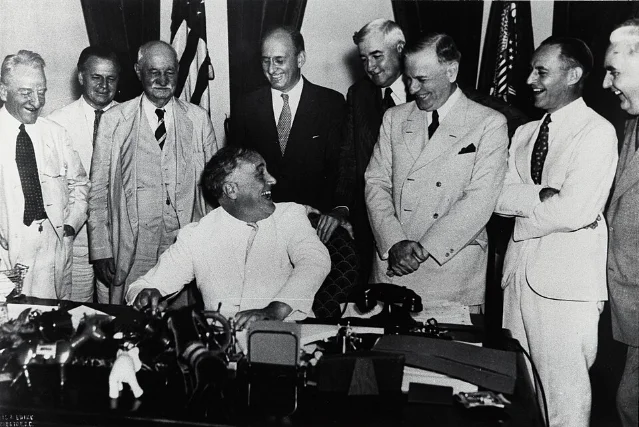
On June 16, 1933, President Franklin D. Roosevelt signed the Banking Act of 1933, known as the Glass-Steagall Act, creating the Federal Deposit Insurance Corporation. 13 The FDIC began insuring deposits at $2,500 per depositor — about $60,000 in today's dollars. 14 Roosevelt signed it over his own objections. His stated concern, expressed ahead of signing: "We do not wish to make the United States Government liable for the mistakes and errors of individual banks, and put a premium on unsound banking in the future." 13 Large banks also opposed it, arguing they would end up subsidizing poorly managed rural banks. 15
The context behind the signature explains the pressure that overcame the opposition: approximately 9,000 American banks had suspended operations between 1930 and 1933, wiping out more than $1.3 billion in deposits — roughly $27 billion in today's dollars, or 19.6% of all deposits held by failed institutions. 13 Congress had considered 150 separate deposit insurance proposals over the prior 47 years; all had failed. 14 The bank holiday Roosevelt had declared on March 6, 1933 — 36 hours after his inauguration — forced the issue. 16 Representative Henry Steagall of Alabama, chairman of the House Banking Committee, insisted deposit insurance was the price of his support for the broader banking reform bill. Without him, there was no FDIC. 15
The effect was immediate. Bank failures dropped from roughly 4,000 in 1933 to just 62 in all of 1934 — only 9 of which were FDIC-insured institutions. 14 On July 5, 1934, Lydia Lobsiger of East Peoria, Illinois, became the first depositor to collect FDIC insurance: $1,250 from the failed Fon Du Lac State Bank, restoring her entire life savings. 14 In over 90 years since, no depositor has lost a single cent of FDIC-insured funds.
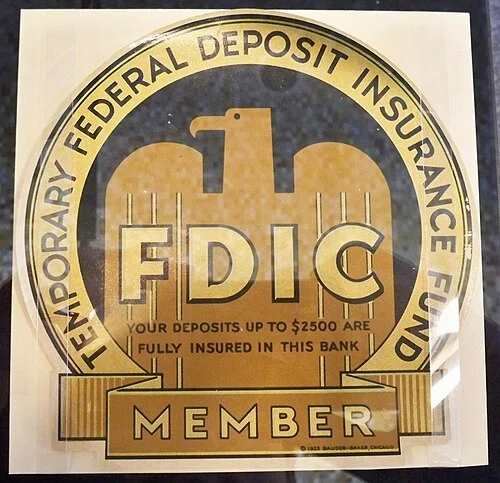
The insurance ceiling increased eight times: $2,500 (1934), $5,000 (1935), $10,000 (1950), $15,000 (1966), $20,000 (1969), $40,000 (1974), $100,000 (1980), and $250,000, which was temporarily enacted in 2008 under the Emergency Economic Stabilization Act and made permanent by the Dodd-Frank Act in 2010. 13 In 2023, Silicon Valley Bank ($209 billion in assets) and Signature Bank ($110 billion) failed within two days of each other, followed two months later by First Republic ($229 billion). 17 The FDIC invoked the systemic risk exception to guarantee all deposits, including uninsured balances. The FDIC statement: "No losses associated with the resolution of Silicon Valley Bank will be borne by taxpayers." 17 As of the end of 2025, the Deposit Insurance Fund held $153.9 billion against approximately $10 trillion in insured deposits at 4,336 member institutions. 18
The decision mirror: The FDIC solved a coordination problem, not a solvency problem. Bank runs happen not because a bank is insolvent but because each depositor rationally tries to exit before everyone else does. Guarantee the deposits and the incentive to panic disappears. FDR's moral hazard objection was valid in theory; 90 years of zero depositor losses on insured funds suggest the mechanism was well-calibrated in practice.
1977 — Oracle: the CIA was the first customer, and there was no Version 1
On June 16, 1977, Larry Ellison, Bob Miner, and Ed Oates incorporated Software Development Laboratories (SDL) in Santa Clara, California. 19 The three men had previously worked together at Ampex Corporation on large-scale memory systems. Initial capital was minimal — they were consultants who had just landed a project. The project was a relational database commissioned by the Central Intelligence Agency, codenamed "Oracle." 20 Ellison later said at Oracle OpenWorld 2014: "Our very first customer was the Central Intelligence Agency." 20 When the project completed, the company received permission to use the code name for its product — and eventually for the company.
Ellison had been reading Edgar F. Codd's 1970 IBM research paper "A Relational Model of Data for Large Shared Data Banks" and concluded that IBM had invented a genuinely superior way to store and query data but showed no sign of commercializing it. 19 The three founders made a quiet assessment of their own competencies: Ellison was the worst programmer of the group, so he became the salesman. That decision shaped Oracle's entire culture. 19
In 1979, the company released "Oracle Version 2" — the first commercially available SQL-based relational database management system. 21 There was no Version 1. The naming was a deliberate marketing choice. Ellison's explanation: "We knew no one would want to buy version 1." 20 The product ran on DEC PDP-11 minicomputers and IBM mainframes, beating IBM's own System R prototype to commercial market. 21
Oracle went public on March 12, 1986 — one day before Microsoft's IPO — raising $31.5 million at $15 per share. 19 Revenue at the time was approximately $55 million. 19 From there, Ellison ran Oracle through a series of acquisitions that competitors found exhausting: PeopleSoft ($10.3 billion, hostile takeover, 2004), Siebel Systems ($5.85 billion, 2005), BEA Systems ($8.5 billion, 2008), Sun Microsystems ($7.4 billion, 2010), and Cerner ($28.3 billion, 2022). 19 Oracle president Charles Phillips summarized the pace in 2008: "We've become the IPO market for the enterprise software industry." 22
Ingres competitor Larry Rowe observed: "You could never come up with a strategy to beat Oracle because whatever you said today, two days later Ellison was saying it with more marketing dollars." 19 Oracle's database was not always technically superior to rivals like Ingres, Sybase, or Informix — it out-marketed them all. Oracle reported $57.4 billion in revenue for FY2025; cloud infrastructure (OCI) revenue grew 52% year-over-year to $3 billion in Q4. 23 In January 2025, Ellison co-founded Stargate, a $500 billion AI infrastructure joint venture with OpenAI, SoftBank, and MGX. 19 He still holds 42.4% of the company's shares as executive chairman and CTO. 19
The decision mirror: Oracle's founding lesson is not "read the right research paper." Plenty of people read Codd's 1970 paper. The executable insight was that IBM would not commercialize its own invention before someone else could. The company that wins the platform is often not the one with the best underlying technology but the one with the most aggressive sales motion and the willingness to skip version 1. Ellison's internal acknowledgment that he was the worst programmer — and his consequent bet on himself as salesman — is among the more honest pieces of self-assessment in tech founding mythology.
Four founding moments, one calendar date. Ford was on attempt three. Flint was hedging. FDR was reluctant. Ellison skipped version numbering as a branding gambit. The organizational scaffolding around the original idea — the complementary hire, the portfolio hedge, the structural incentive, the aggressive sales motion — is what made each of them last.
References
- 1Henry Ford Heritage Association: The Birth of Ford Motor Company
- 2Wikipedia: Ford Motor Company
- 3History.com: Ford Motor Company incorporated
- 4Ford Corporate: The Moving Assembly Line and the Five-Dollar Workday
- 5The Henry Ford: Ford's Five Dollar Day Revolution
- 6Harvard Law School: Dodge v. Ford: What Happened and Why?
- 7Wikipedia: Computing-Tabulating-Recording Company
- 8IBM: The origins of IBM
- 9Wikipedia: Herman Hollerith
- 10IBM: The origins of THINK
- 11IBM: The IBM System/360
- 12Wikipedia: IBM
- 13Wikipedia: Federal Deposit Insurance Corporation
- 14FDIC: 90-Year Historical Timeline
- 15Federal Reserve History: Banking Act of 1933 (Glass-Steagall)
- 16Federal Reserve History: Bank Holiday of 1933
- 17FDIC Press Release: FDIC Acts to Protect All Depositors of the former Silicon Valley Bank
- 18FDIC: Quarterly Banking Profile Fourth Quarter 2025
- 19Wikipedia: Oracle Corporation
- 20Business Insider: Larry Ellison Is A Billionaire Today Thanks To The CIA
- 21Oracle: 50 years of the relational database
- 22The Guardian: Oracle buys BEA for $8.5 billion
- 23Constellation Research: Oracle Cloud's annual revenue run rate
Related content
- Sign in to comment.
More from this channel
- June 20 in business history: Morse's patent, Ford signs with the UAW, the Deutsche Mark, and Jaws
- June 19 in business history: the FCC, the 73-27 vote, the patent treaty, and Curt Flood's losing case
- June 18 in business history: the LP record Columbia gave away, the ad split that built Google, and the marketplace eBay couldn't build
- June 17 in business history: the tariff 1,028 economists begged Hoover to veto, FM radio's buried inventor, biotech's first blind bet, and the sports contract that paid for 38 years
- June 15 in business history: The patent that stayed poor, the chancellor who bribed his way to welfare, and the lumberman who launched an aircraft empire
- June 14 in business history: The computer that lost its market, the treaty that remade a continent, the factory that won a war, and the machine that waited 150 years
- June 13 in business history: A $15 billion verdict, a billion-euro fine, a newspaper that refused to flinch, and a ballplayer who walked away from $15.7 million
- June 12 in business history: Silver in the canyon, an antitrust law signed, and a $44 million film that almost killed a studio