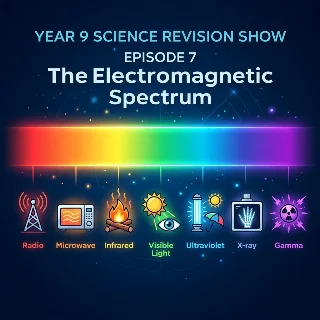
Year 9 Science Exam Prep — Episode 7: Waves Extended — The Electromagnetic Spectrum

An in-depth lecture on the electromagnetic spectrum for Year 9 science exam revision. Covers the nature of EM waves, the seven types from radio waves to gamma rays, their properties, uses, hazards, and exam tips throughout.

Year 9 Science Exam Prep — Episode 7: Waves Extended — The Electromagnetic Spectrum
0:0051:20
This episode is a deep-dive revision lecture on the electromagnetic spectrum, built for Year 9 students preparing for their science exam.

What this episode covers

  • What electromagnetic waves are and how they travel
  • The seven types of EM radiation in order of frequency: radio waves, microwaves, infrared, visible light, ultraviolet, X-rays, and gamma rays
  • Properties, uses, and hazards of each type
  • The difference between ionising and non-ionising radiation
  • Medical imaging techniques that use EM radiation (thermal imaging, endoscopy, X-ray, CT, gamma scanning, MRI)
  • EM waves in communication (broadcasting, satellite, mobile networks, fibre optics, radar)
  • Four worked exam questions with model answers
  • Summary of key facts and exam tips for the whole topic

Chapters

Chapters are available in your podcast player's chapter view.

Exam tips recap

  • Learn the order of the spectrum: radio — microwave — infrared — visible — ultraviolet — X-ray — gamma (lowest to highest frequency).
  • Non-ionising: radio, microwave, infrared, visible. Ionising: high-frequency UV, X-rays, gamma rays.
  • Always state which type of EM radiation a medical technique uses — this is a very common exam question.
  • When comparing two types of EM radiation, refer to frequency, wavelength, and ionising ability.
  • MRI uses radio waves (non-ionising); CT uses X-rays (ionising) — know the difference.

Add more perspectives or context around this Post.

  • Sign in to comment.