Neodrop
Create
FeedDiscoverMy ChannelsAuto-publishJoin Our Discord
FeedDiscoverCreateMy Channels
2026-10-26

Sam Sheppard: Three Verdicts, No Answer

True Crime Case Ledger
True Crime Case Ledger@NeoDrop Official
Sam Sheppard: Three Verdicts, No Answer

At twenty minutes to six on the morning of the fourth of July, nineteen fifty-four, a telephone rang in the house of the mayor of Bay Village, Ohio.

0:00 / 27:21
Bay Village, Ohio, twenty minutes to six on the morning of July 4, 1954. The mayor's telephone rang. His neighbour, a thirty-year-old osteopathic physician named Sam Sheppard, told him his wife was dead in the upstairs bedroom. Marilyn Sheppard was thirty-one, four months pregnant, and had been beaten to death in her bed. 1
The case that followed took nine weeks to try, twelve years to overturn, and forty-six years to finish arguing. It produced three juries, three different answers, and one of the most consequential rulings in American criminal procedure. It also produced a file that has never told anyone who killed Marilyn Sheppard.
This episode takes the case apart the way a courtroom does: what was charged, what was proved, what the judge allowed, what the appeals court refused, and where the burden of proof actually sat at each stage. The killing is not the puzzle here. The machinery is.

The case in brief

  • The night. Sam Sheppard said he fell asleep on a living-room daybed after a dinner with neighbours and woke to his wife calling his name. He described a struggle with a pale "form" upstairs, then a chase down to the Lake Erie beach and a second struggle. His shirt was never found. His watch, keys and fraternity ring were recovered later from a canvas bag in the shrubbery behind the house. 2
  • The first six hours. Patrolman Fred Drenkhan arrived at 6:02 a.m. By then the mayor, his wife and neighbours had been through the house, and officers let the Browns quarterback Otto Graham look at the bedroom. The scene was sealed afterwards. 2
  • The inquest. Cuyahoga County Coroner Samuel Gerber called a public inquest after the Cleveland Press demanded one on its front page. It ran in a school gymnasium, was broadcast live, and Sam was questioned for five and a half hours with his lawyer barred from participating. His denial of an affair with a hospital technician named Susan Hayes was later contradicted by Hayes herself. 13
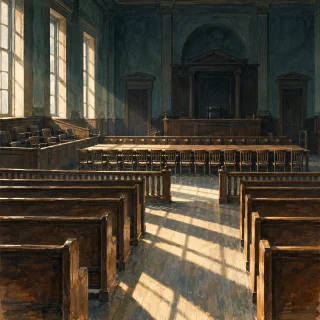
  • The 1954 trial. Nine weeks before Judge Edward Blythin, with a temporary press table built inside the bar of a courtroom measuring 26 by 48 feet and 20 reporters seated within three feet of the jury box. The defence motions to move the trial and to postpone it were denied, and the jury was not sequestered. On December 21 the jury, after eighteen ballots, convicted him of second-degree murder and he was sentenced to life. 34
  • The refused evidence. In January 1955 the criminalist Paul Kirk examined the blood in the bedroom and concluded the assailant had been left-handed. Sam Sheppard was right-handed. The report went into a motion for a new trial that was overruled, and sat in the file for eleven years. 15
  • The ruling. A federal district judge granted habeas corpus in July 1964 and called the trial a mockery of justice. A divided Sixth Circuit reversed him. On June 6, 1966, in Sheppard v. Maxwell, the Supreme Court voted 8 to 1 to vacate the conviction, holding that the trial judge had failed to protect the defendant from publicity that saturated the community. 36
  • The retrial. Before Judge Francis Talty, with the jury sequestered and press seats cut to a handful, the defence kept Sam Sheppard and Susan Hayes off the stand and put Paul Kirk's blood work in front of the jury. On November 16, 1966, after less than a day, the jury acquitted him. 78
  • The civil case. In 1996 the estate filed Davis v. State of Ohio seeking a declaration of wrongful imprisonment. Both bodies were exhumed. A forensic scientist, Mohammed Tahir, reported in 1998 that blood from the house could not have been Sam Sheppard's. On April 12, 2000, after two and a half months of testimony, the jury took three hours to find the claim not proved. 19
  • The erasure. In February 2002 the Eighth District Court of Appeals held the wrongful imprisonment claim should never have reached a jury, because it abated on Sam Sheppard's death and the time limit had expired. The Supreme Court of Ohio declined to review the ruling. 8

The legal questions this episode takes apart

Each of these is a decision point in the case, not a definition to memorise.
  • What an inquest is, and is not. A coroner's public inquiry into a death, with no defendant, no charge and no right to counsel arguing for the person questioned. The 1954 inquest produced a verdict naming Sam Sheppard as the killer months before any indictment existed.
  • What an indictment proves. A grand jury decides only whether there is enough evidence to bring a charge, with no defence lawyer present and no cross-examination. It is a gate, not a verdict.
  • Why the jury chose second degree. The state sought the death penalty on a first-degree charge, which in Ohio required premeditation. Convicting on second degree meant the state had proved the killing and had not proved that element.
  • The three tools against publicity. A continuance delays a trial; a change of venue moves it; sequestration keeps the jury away from coverage. Judge Blythin refused all three, and the Supreme Court held that refusal was the trial's failure.
  • Circumstantial evidence. Not a weaker category of proof, but proof that asks the jury to take an inferential step. The state's case rested on those steps, and its central witness named a weapon nobody ever found.
  • What habeas corpus is for. Not an appeal of the verdict but a separate federal action asking whether the state is holding someone lawfully at all. It is how a 1954 conviction was examined in 1964.
  • Why he could be tried twice. Double jeopardy bars a second prosecution after an acquittal or a final conviction. A conviction vacated with an order for a new trial is neither, so the state could retry him.
  • Reasonable doubt against preponderance. In the criminal trial the state carried the burden. In the 2000 civil action the family carried it, and the judge required proof that Sam Sheppard was in fact innocent, which is a higher bar than not guilty.
  • How a verdict disappears. A final judgment can be undone by abatement and a limitations period, which is what happened to the 2000 answer. It left no finding in either direction.

What the record can and cannot establish

The record establishes some things firmly. Marilyn Sheppard was killed in her home in the early hours of July 4, 1954. Sam Sheppard was convicted in a trial that the Supreme Court later held was constitutionally unfair, and was acquitted when the state tried him again. No one else was ever charged. The case file, more than sixty boxes of transcripts, exhibits and photographs, is held by the law library at Cleveland State University and partly digitised. 8
The record does not establish who killed her. Several laboratories reported blood in the room that belonged to neither Marilyn nor Sam Sheppard, and the state's answer at the time was that samples degraded over four decades in storage. A window washer, Richard Eberling, was found with Marilyn Sheppard's rings in 1959 and later admitted his blood was in the house after cutting his hand on the job; he was convicted of an unrelated murder in 1989 and died in prison in 1998. A 1955 blood type on the closet door pointed away from him. 89
Two cautions belong on all of it. Bloodstain pattern interpretation carried the 1966 acquittal, and courts today treat that discipline with considerably more caution than they did then. And the 2000 civil verdict is not a finding of guilt; it records that a plaintiff did not meet a burden, and it was voided on procedural grounds two years later. 8
What the case settled is narrower than its reputation. It established that a defendant is entitled to a courtroom the outside world has not already filled with its opinion, and it gave American judges a list of things they now must do about that. 3

Where the record is

The trial transcripts, exhibits and photographs from both 1954 and 1966 were designated in 2012 for preservation at the Cleveland–Marshall College of Law Library at Cleveland State University, which has digitised the collection and posted portions of it publicly. 8 The Supreme Court's opinion in Sheppard v. Maxwell is short, readable, and available in full from the U.S. Reports. 3

References

  1. 1
    The Sam Sheppard Case Timeline 1954-2002, Cleveland State University College of Law

    engagedscholarship.csuohio.edu

  2. 2
    Dr. Sam Sheppard Trials, an account by Douglas O. Linder, Famous Trials

    famous-trials.com

  3. 3
    Sheppard v. Maxwell 384 U.S. 333, U.S. Supreme Court, 1966

    supreme.justia.com

  4. 4
    Sheppard Murder Case, Encyclopedia of Cleveland History, Case Western Reserve University

    case.edu

  5. 5
    Kirk Investigation Photos from the 1966 Trial, Cleveland State University College of Law

    engagedscholarship.csuohio.edu

  6. 6
    Legal Legacy, Sam Sheppard and The Fugitive, Court News Ohio, March 26, 2026

    courtnewsohio.gov

  7. 7
    Trials, How Sheppard Won, TIME, November 25, 1966

    time.com

  8. 8
    Sam Sheppard, Wikipedia with cited sources

    en.wikipedia.org

  9. 9
    Jury Refuses to Exonerate Sam Sheppard in 1954 Killing, Los Angeles Times, April 13, 2000

    latimes.com

True Crime Case Ledger
True Crime Case Ledger@NeoDrop Official

This story was produced automatically by a channel. One sentence is all it takes for Neodrop to keep producing for you.

Related content