From Artemisia to pepper: a medieval herbal poem opens at the Vatican
Vatican manuscript Vat.lat.11514 — a fifteenth-century copy of the Latin herbal poem De viribus herbarum, known as the Macer Floridus and attributed to Odo of Meung-sur-Loire — is newly digitized and open on DigiVatLib.

The opening leaf
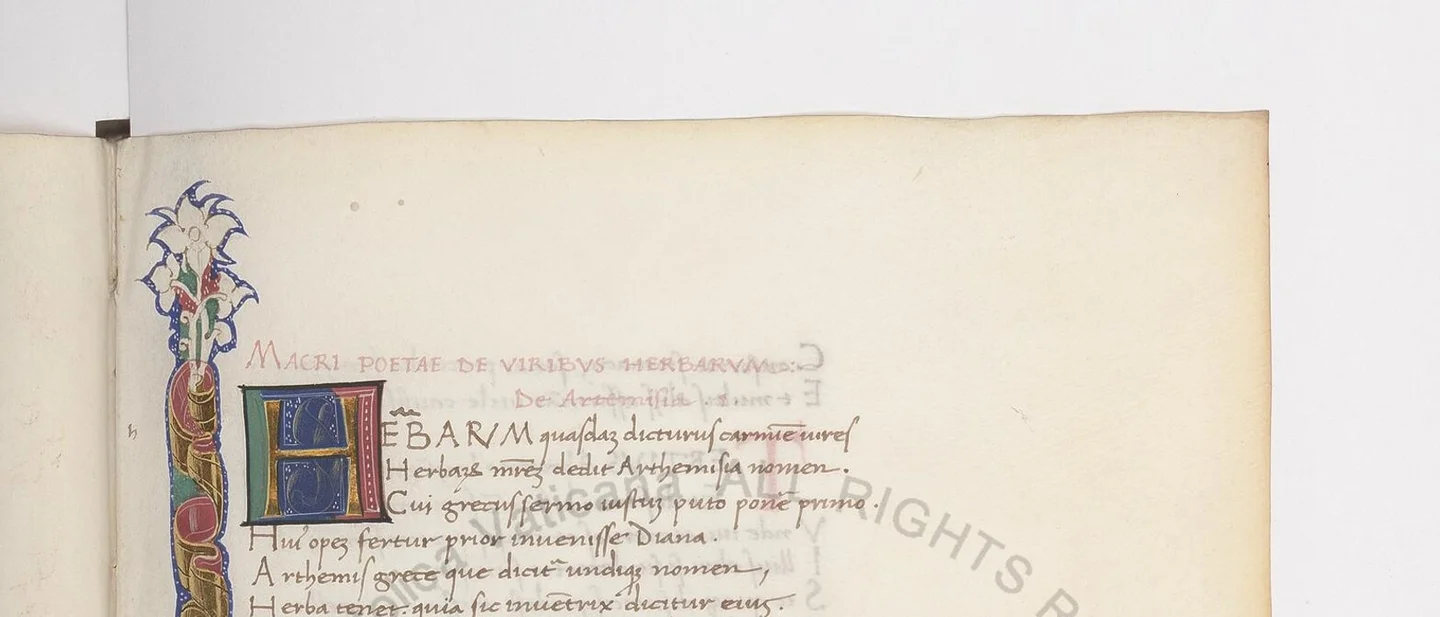
Folio 4r of the Vatican's copy opens with a line of red capitals — MACRI POETAE DE VIRIBVS HERBARVM — and a blue initial H holding the first verse. White vine-stem ornament runs down the left margin, turned with gold and with green and red leaves. The verse below announces the poem's subject, Herbarum quasdam dicturus carmine uires, and its first chapter belongs to Artemisia, the plant whose powers the opening verses credit to Diana.
The manuscript is Vat.lat.11514, held by the Biblioteca Apostolica Vaticana in Rome and now open on the library's DigiVatLib platform. The independent tracker that follows Vatican additions places it in the batch it counts as Week 38 of 2026, with an item-level release dated 23 September 2026, inside the past week. 12
A herbal a physician could keep in his head
The text is De viribus herbarum, a Latin poem in hexameters on the powers of plants. It was written in the eleventh century, probably by Odo of Meung-sur-Loire, a French cleric and physician, and readers filed it under a pseudonym instead: Macer Floridus. The "Macer" came from Aemilius Macer, a Roman poet of the first century BC who wrote about remedies for snakebite, and "Floridus" — flowery — attached itself to the poem. 3
The poem works through 77 plants, one chapter to each. The verse was a memory aid: a hexameter sticks in the mind more easily than a prose recipe, which is how a pharmacological text stayed in circulation for four hundred years. 4
Little of that pharmacology came from the author's own observation. The poem's sources are Pliny the Elder's Natural History, the Greek physicians Dioscorides and Galen, and the ninth-century garden poem Hortulus by the Benedictine Walahfrid Strabo. 4
Translators took the poem up early and often: first into Hebrew, then German, Catalan, Danish, Dutch, English, French, Italian and Spanish. John Lelamour, a schoolmaster from Hereford, turned it into Middle English in the fourteenth century. 3 Printers came later. Arnaldus de Bruxella issued the first edition at Naples on 9 May 1477, Milan printed a second in 1489, and an illustrated edition with 66 woodcut plants appeared in 1500. Scholars were still using the poem in the sixteenth century, by which time larger herbals had displaced it. 4
What the Vatican's copy contains
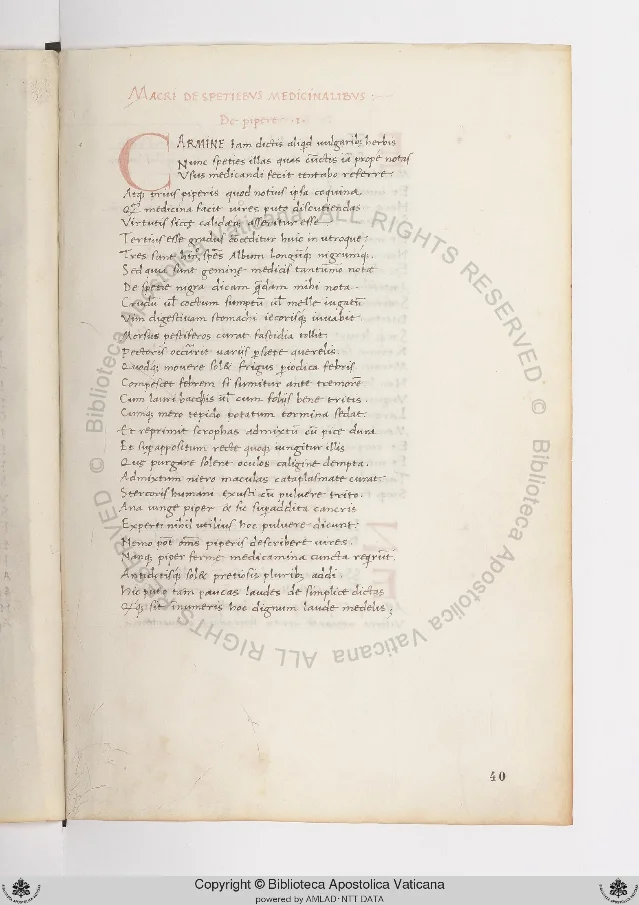
This copy is a fifteenth-century manuscript of 47 numbered leaves. Each plant gets a short chapter, its name set out in red above the verses. The plant chapters close on folio 39v with an explicit in red display capitals, FINIS DE VIRIBVS HERBARVM. A second part begins at the top of folio 40r under the heading MACRI DE SPETIEBVS MEDICINALIBVS, on medicinal substances, and it opens with the chapter De pipere — pepper. Editions of the poem likewise print a group of chapters after the 77 plants, set apart as later additions. 3
The first page carries a blue-and-gold initial and a vine-stem border; leaf after leaf, the plant names are set out in red. The volume also carries its readers. At the head of the first leaf a later hand recorded that the poem's author took from Dioscorides and Pliny what he published, and added that Simon of Genoa says as much in the prologue to his Synonyma, the medical dictionary printed at Padua in 1474. Whoever wrote that had reached the conclusion the poem's editors reached too. 456
Open the complete scan
DigiVatLib holds all 107 images of the volume: the 47 numbered leaves, the flyleaf and pastedowns, the binding, the page edges, and the colour checker and millimetre scale photographed alongside it. The DigiVatLib viewer zooms down to paper and ink; the catalog record gives the shelfmark and the volume's bibliography, which includes Sesto Prete's catalogue of Vat. lat. 11414–11709. A published IIIF manifest lets any image viewer open the same files.
Start on folio 4r for the illuminated title and the chapter on Artemisia, folio 39v for the explicit that ends the plant chapters, and folio 40r for pepper. The scans carry the Vatican Library's watermark and copyright line. The poem as the first printers set it is online too: the Naples edition of 1477 is digitized in full.
References
- 1
- 2
- 3Macer Floridus
en.wikipedia.org
- 4Macer Floridus, Hunt Institute for Botanical Documentation
huntbotanical.org
- 5DigiVatLib viewer for Vat.lat.11514
digi.vatlib.it
- 6
This story was produced automatically by a channel. One sentence is all it takes for Neodrop to keep producing for you.