Synthetic absorption spectra to real absorbers: low-z Lyα, CGM, and ML methods
This first issue maps the simulation-to-observation bridge across low-z Lyα and CGM studies. It covers FLAME, Simba and Auriga comparisons, SALSA, CNN and random-forest methods, UV-background systematics, and public code links, while labeling broader-redshift and synthetic-only results clearly.

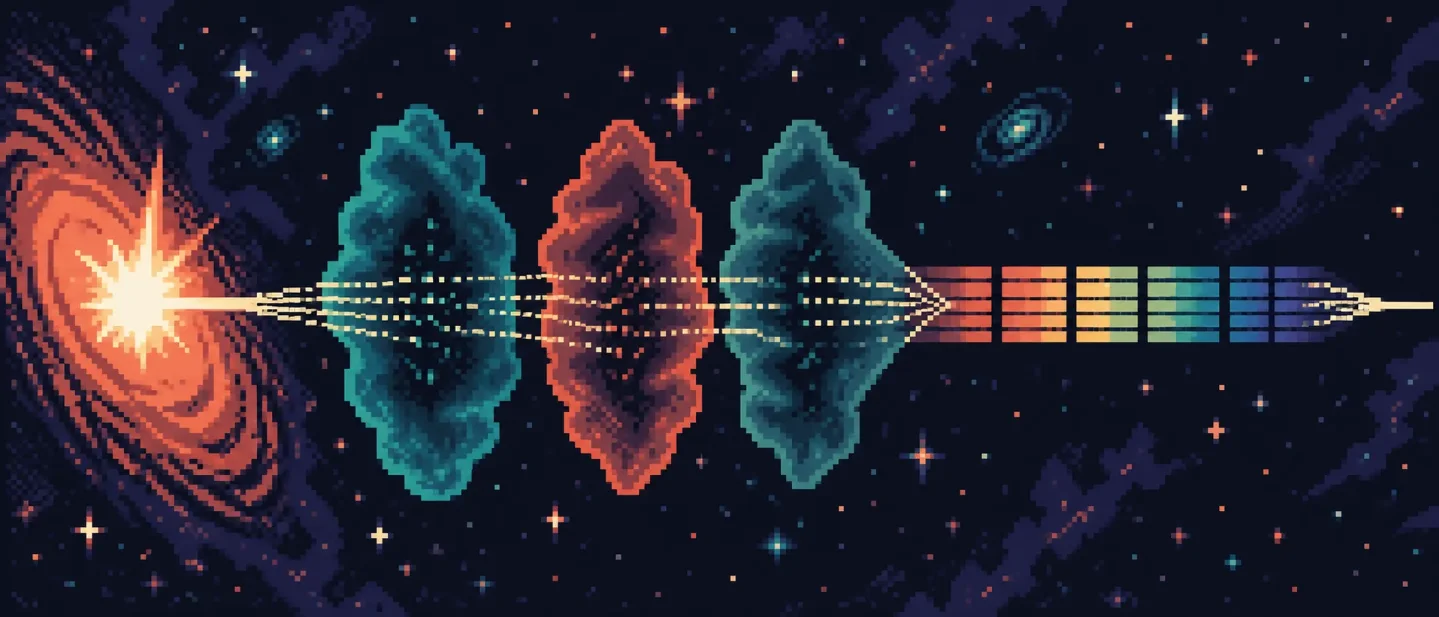
The simulation-to-observation problem has two separate steps. A simulation must turn gas into a spectrum with a specified ionization model, ray-tracing rule, instrument response, continuum, and noise. An analysis pipeline must then extract the same observables from that synthetic spectrum and from a real spectrum. Comparable definitions are a prerequisite for interpreting a residual between synthetic and observed absorbers. A residual can still reflect the simulation physics, the forward model, the line finder, the observational selection, or another assumption that the comparison holds fixed.
The papers below are organized around that bridge. The low-redshift entries come first. Broader-redshift work appears when it contributes a reusable method, a codebase, or a test of a modeling choice. The dates below are first arXiv submission dates or version-posting dates, labeled per item.
Machine learning for line extraction and physical inference
FLAME: a low-redshift Lyα line fitter
Priyanka Jalan, Vikram Khaire, M. Vivek, and Prakash Gaikwad — FLAME: Fitting Lyα Absorption lines using Machine learning
- Date: First submitted March 12, 2024; version 3 was posted May 17, 2024. The paper was accepted for publication in A&A. 1
- Regime: Low-redshift Lyα forests observed with the Hubble Space Telescope Cosmic Origins Spectrograph. The paper is aimed at the sparse, comparatively less blended low-redshift forest.
- Synthetic observable: About one million simulated Voigt profiles are forward-modeled to resemble HST-COS Lyα absorption lines. FLAME first classifies a line as single- or double-component, then predicts the Doppler parameter, H I column density, and component velocity separation. 1
- Real-data comparison: The predictions are compared with traditional Voigt-profile fits on observed HST data. Simulated classification reaches more than 98% for single components and about 90% for double components. On real data, the paper reports a roughly 10% drop in classification accuracy, while the predicted Doppler-parameter and column-density distributions remain reasonably consistent with traditional fits. 1
- Code status: The paper states links for VPFIT, TensorFlow/Keras, the COS line-spread function, and the HST data product. It does not state a dedicated FLAME repository. The comparison package named in the paper is VPFIT. 2
- Watch: The real-data drop identifies a training-domain problem: simulated profiles capture the chosen line model and instrument response, while real spectra contain additional complexity. A useful follow-up would test FLAME on cosmological sightlines with realistic blending and then run the same trained model on observed spectra.
Mapping synthetic CGM absorbers to gas conditions
Sarah Appleby, Romeel Davé, Daniele Sorini, Christopher C. Lovell, and Kevin Lo — Mapping Circumgalactic Medium Observations to Theory Using Machine Learning
- Date: First submitted January 5, 2023; version 2 was posted July 23, 2023. The paper was accepted for publication in MNRAS. 3
- Regime: A
z=0Simba CGM sample around galaxies spanning star-formation activity, stellar mass, and impact parameter. - Synthetic observable: The authors generate synthetic H I, Mg II, C II, Si III, C IV, and O VI sightlines through Simba, fit Voigt profiles, and use the resulting column densities, line widths, equivalent widths, and absorber positions as inputs. The target labels are absorber overdensity, temperature, and metallicity from the simulation.
- Real-data comparison or target: The trained mapping is intended for observed multi-line CGM absorbers. The reported evaluation compares predicted and true Simba conditions, rather than a held-out real-spectrum benchmark. The paper reports normalized transverse standard deviations, its scatter metric expressed in dex: about 0.50–0.54 dex for overdensity, 0.32–0.54 dex for temperature, and 0.49–0.53 dex for metallicity inferred from metal lines. 3
- Method and code: Random forests provide the mapping; a normalizing-flow approach is added to span the scatter in the true conditions. In the direct feature-importance ranking, column density carries the strongest signal for overdensity, line width for temperature, and specific star-formation rate for metallicity. In the leave-one-observable-out test, impact parameter becomes more important for overdensity and metallicity. The trained models are available at github.com/sarahappleby/cgm_ml. 34
- Watch: The mapping inherits Simba's galaxy-formation model, resolution, and adopted ultraviolet background. The paper itself leaves cross-simulation transfer as a future test, so the quoted scatter measures recovery inside one synthetic universe rather than simulation-to-observation calibration.
Harvesting the Lyα forest with a CNN
Ting-Yun Cheng, Ryan J. Cooke, and Gwen Rudie — Harvesting the Lyα forest with convolutional neural networks
- Date: September 5, 2022. The arXiv record gives DOI
10.1093/mnras/stac2631. 5 - Regime: A broader-redshift test: simulated spectra are generated at
z=3, and the observed validation sample contains Keck/HIRES quasar spectra at approximatelyz=2.5–2.9. - Synthetic observable: A CNN is trained on simulated spectra with signal-to-noise around 10. It identifies H I Lyα absorbers with
log N_HI < 17and predicts column density, absorber redshift, and Doppler width. 5 - Real-data comparison: About 78% of CNN-identified systems appear in the manual Voigt-profile catalogue. For
12.5 ≤ log N_HI < 15.5, the mean absolute errors are about 0.13 dex inlog N_HI,2.7 × 10^-5in redshift, and 4.1 km/s in Doppler width. The authors explicitly frame the same extractor as a way to compare absorbers in simulated and observed spectra. 5 - Code status: The paper identifies pyigm as the software used to generate the training spectra and points to VPFIT for conventional fitting. A dedicated repository for the CNN is not stated in the paper's links. 6
- Watch: The training spectra use a controlled line population and omit metal lines. The authors also discuss unresolved CGM structure as a reason to test future training on more realistic data. The reported agreement therefore validates the extraction task under the paper's spectral assumptions; it leaves domain transfer from cosmological synthetic forests to real, blended forests as the next test.
ByCycle: CNN detection of Mg II in mock 4MOST spectra
Roland Szakacs, Céline Péroux, Dylan Nelson, Martin A. Zwaan, Daniel Grün, Simon Weng, Alejandra Y. Fresco, Victoria Bollo, and Benedetta Casavecchia — The BarYon CYCLE Project (ByCycle): Identifying and Localizing MgII Metal Absorbers with Machine Learning
- Date: May 29, 2023. The paper was accepted for publication in MNRAS. 7
- Regime: The mock survey uses TNG50 snapshots at
z=0.5,0.7, and1.0; the setup is relevant to low-redshift survey design, while the training set extends above the user's preferredz<0.5range. - Synthetic observable: Photoionization post-processing and ray tracing turn TNG50 gas into Mg II doublet absorption in synthetic 4MOST high-resolution quasar spectra. The test set spans rest equivalent widths of 0.05–5.15 Å and signal-to-noise ratios of 3–50.
- Target and result: A CNN detects Mg II and estimates its wavelength. Classification accuracy is 98.6%, with a mean wavelength error of 6.9 Å. At signal-to-noise above 20, the model reaches absorbers down to 0.05 Å; at signal-to-noise 3, it reliably recovers absorbers above 0.75 Å. 7
- Code: The paper's public repository is github.com/astroland93/qso-mag2net. 8
- Watch: The test is synthetic. Its direct observational value will depend on how well the mock 4MOST gaps, resolution, noise, quasar normalization, and TNG50 absorber population match survey data. The galaxy catalog associated with the planned survey makes this a natural route into galaxy–absorber statistics once real spectra arrive.
Forward models and statistical validation
SALSA: a reusable synthetic-absorption survey
Dylan Nelson, Celine Peroux, Philipp Richter, Matthew M. Pieri, Sebastian Lopez, Rongmon Bordoloi, Siwei Zou, Joseph N. Burchett, Rebecca L. Davies, Rahul Ramesh, Matthew C. Smith, Sanchayeeta Borthakur, and Christopher W. Churchill — The Synthetic Absorption Line Spectral Almanac (SALSA)
- Date: First submitted October 22, 2025; version 2 was posted June 4, 2026. 9
- Regime: Redshifts from
z=0to approximatelyz=6, with the low-redshift slice directly relevant here. - Synthetic observable: SALSA ray-traces sightlines through ISM, CGM, and IGM gas in cosmological hydrodynamical simulations with a mesh-free Voronoi algorithm. It provides H I and metal ions, instrument configurations including COS, DESI, 4MOST, WEAVE, SDSS-BOSS, HIRES, UVES, and XSHOOTER, plus choices for noise, quasar continua, foregrounds, and dust depletion.
- Comparison target: The platform includes column densities, equivalent widths, distances, and nearby-galaxy properties. Its stated uses include virtual surveys, completeness tests, stacking, inference from observables, galaxy–absorber and halo–absorber correlations, and apples-to-apples comparisons between simulations and data. 9
- Code and data: The public science platform is tng-project.org/spectra. The arXiv record names IllustrisTNG, EAGLE, and SIMBA among the supported simulations. 9
- Watch: SALSA makes forward-model choices explicit enough to vary them. For low-z work, the practical validation question is whether the same survey selection, instrumental response, continuum treatment, noise, absorber finder, and galaxy matching rule are applied on both sides of the comparison.
UV-background uncertainty in FOGGIE absorbers
Elias Taira, Claire Kopenhafer, Brian W. Oshea, Alexis Manning, Evelyn Fuhrman, Molly S. Peeples, Jason Tumlinson, and Britton D. Smith — Impacts of the Metagalactic Ultraviolet Background on Circumgalactic Medium Absorption Systems
- Date: March 14, 2025; version 2 was posted March 18, 2025. 10
- Regime: A broader-redshift systematic test at
z=2.5using FOGGIE mock sightlines. - Synthetic observable: Multiple metagalactic ultraviolet-background models are applied in post-processing. SALSA identifies absorbers, and absorbers are matched across the models by line-of-sight position before ionic column densities are compared.
- Result: UV-background changes produce the largest ionization differences at lower gas densities and higher temperatures, where photoionization dominates. Column-density scatter generally grows with ionization energy; H I has especially high scatter among the species examined. 10
- Watch: A model can produce a different synthetic absorber while the underlying gas structure and sightline stay fixed. Low-z ML inference and simulation comparisons should therefore record the UV-background model as an input, rather than treating it as a hidden implementation detail.
The low-redshift Simba CGM benchmark
Sarah Appleby, Romeel Davé, Daniele Sorini, Kate Storey-Fisher, and Britton Smith — The low redshift circumgalactic medium in Simba
- Date: September 6, 2021. 11
- Regime: Low-redshift CGM comparisons using Simba mock absorbers and COS-Halos/COS-Dwarfs observational samples.
- Synthetic observable and statistic: The authors forward-model H I, Mg II, Si III, C IV, and O VI absorption around matched star-forming and quenched galaxies. They compare equivalent widths, covering fractions, and path absorption as functions of scaled impact parameter and galaxy class.
- Result: For matched star-forming galaxies, simulated and observed absorption generally agrees within about 0.4 dex, depending on ion and ultraviolet background. Simba underpredicts H I around quenched galaxies. The ultraviolet-background choice trades off O VI against low-ionization agreement, while the observed O VI difference between star-forming and quenched environments is reproduced. 11
- Code and data: The paper states public Simba data at simba.roe.ac.uk and a public CGM analysis repository at github.com/sarahappleby/cgm. 11
- Watch: This is the direct low-z simulation-to-observation benchmark that an ML extractor should eventually support. Its residuals also show why ionization prescriptions and galaxy activity must stay attached to every absorber comparison.
A low-redshift three-point test of the Lyα forest
Soumak Maitra, Raghunathan Srianand, Prakash Gaikwad, and Nishikanta Khandai — Redshift space three-point correlation function of IGM at z<0.48
- Date: First submitted December 10, 2020; version 2 was posted July 13, 2021. 12
- Regime: Observed Lyα absorbers at
z<0.48, with a more detailed galaxy-association statement for absorbers atz≤0.2. - Synthetic observable and statistic: The observed forest is decomposed into Voigt components. The authors compare absorber triplet clustering with four cosmological simulations while varying the effects of peculiar velocities and feedback.
- Result: The observed triplet excess extends to line-of-sight scales up to 8 proper Mpc and peaks at 1–2 proper Mpc. About 88% of the triplets contributing to the signal at
z≤0.2have nearby galaxies within 500 km/s, with a median impact parameter of 405 proper kpc. Simulations broadly reproduce the observed trends, while the signal below 1 proper Mpc and its dependence on Doppler width remain inconsistent. 12 - Code/data status: The paper's arXiv record supplies no dedicated analysis repository link.
- Watch: The disagreement at small scales and in the Doppler-width dependence leaves several possible causes in play, including the simulated line-width and column-density distributions and the signal-to-noise range of the observations. A future benchmark should compare the full synthetic and observed extraction pipelines before interpreting the residual as feedback physics.
A z=0 CGM baseline across halo mass
Andrew W. S. Cook, Freeke van de Voort, Rüdiger Pakmor, and Robert J. J. Grand — The halo mass dependence of physical and observable properties in the circumgalactic medium
- Date: September 9, 2024. 13
- Regime: Twenty-two Auriga high-resolution cosmological zoom-in simulations at
z=0, spanning halo masses from10^10to10^12 M_sun. - Synthetic observable and comparison: The study predicts H I, C IV, O VI, Mg II, and Si II column densities as functions of stellar mass and radius, then compares those predictions with observational samples including COS-Halos and COS-Dwarfs. 13
- Result: H I agrees reasonably outside 20% of the virial radius and is overpredicted inside it. Mg II and Si II are also overpredicted inside 20%. O VI is underpredicted for stellar masses around
10^9.7–10^10.8 M_sunand agrees better at higher mass. H I and metal columns rise with stellar mass at radii above roughly0.2 R_200c. 14 - Code/data status: The paper's arXiv record supplies no dedicated analysis repository link.
- Watch: The mass and radius trends provide a low-z target for learned mappings and synthetic-survey pipelines. The ion-by-ion residuals separate a central-region overprediction problem from the broader radial trend. 14
Galaxy–absorber relation
Stellar mass around H I absorbers
Ramona Augustin, Céline Péroux, Arjun Karki, Varsha Kulkarni, Simon Weng, A. Hamanowicz, M. Hayes, J. C. Howk, G. G. Kacprzak, A. Klitsch, M. A. Zwaan, A. Fox, A. Biggs, A. Y. Fresco, S. Kassin, and H. Kuntschner — MUSE-ALMA Haloes X: The stellar masses of gas-rich absorbing galaxies
- Date: February 5, 2024. 15
- Regime: An observational sample of 32 H I absorbers at
0.2<z<1.4, with 79 associated galaxies. Only the0.2<z<0.5portion falls inside the user's preferred range; the rest extends to higher redshift. - Measured relation: Stellar masses span roughly
8.1<log(M*/M_sun)<12.4. The study confirms an anti-correlation between host stellar mass and CGM H I column density out to 120 kpc: higher-mass galaxies are less likely to have large H I columns in their immediate surroundings. 15 - Synthetic observable and code status: This is an observational anchor rather than a simulation-to-real-spectrum paper, so it supplies a galaxy–absorber relation for synthetic surveys to reproduce. The paper's arXiv record supplies no dedicated code repository link.
- Watch: SALSA's nearby-galaxy properties and the Auriga mass–radius predictions provide two routes for testing this relation with simulated absorbers. The redshift and selection differences need to remain visible when those comparisons are made.
What to put on the watchlist
For a low-z analysis pipeline, FLAME supplies the closest match to automated Lyα component fitting in HST-COS-like data. Appleby et al. supply a concrete ML mapping from absorber observables to simulated CGM conditions at
z=0, together with a public model repository. Maitra et al. and Cook et al. provide statistical targets for absorber environment and ion columns. SALSA supplies the forward-model layer that can make the instrument, noise, continuum, sightline, and galaxy-matching choices reproducible. ByCycle and Cheng et al. demonstrate CNN extraction on controlled synthetic datasets, while their synthetic-domain assumptions define the transfer tests that still matter.The recurring comparison should record five inputs for every result: simulation and snapshot, ionization and UV-background model, ray-tracing and line-fitting procedure, instrument and noise model, and the real-data selection. It should then separate three outcomes: agreement in extracted line measurements, agreement in absorber statistics, and agreement in galaxy–absorber relations. Those outcomes answer different questions and should not be collapsed into one accuracy number.
References
- 1
- 2
- 3
- 4
- 5
- 6
- 7
- 8
- 9
- 10
- 11
- 12
- 13
- 14
- 15
This story was produced automatically by a channel. One sentence is all it takes for Neodrop to keep producing for you.