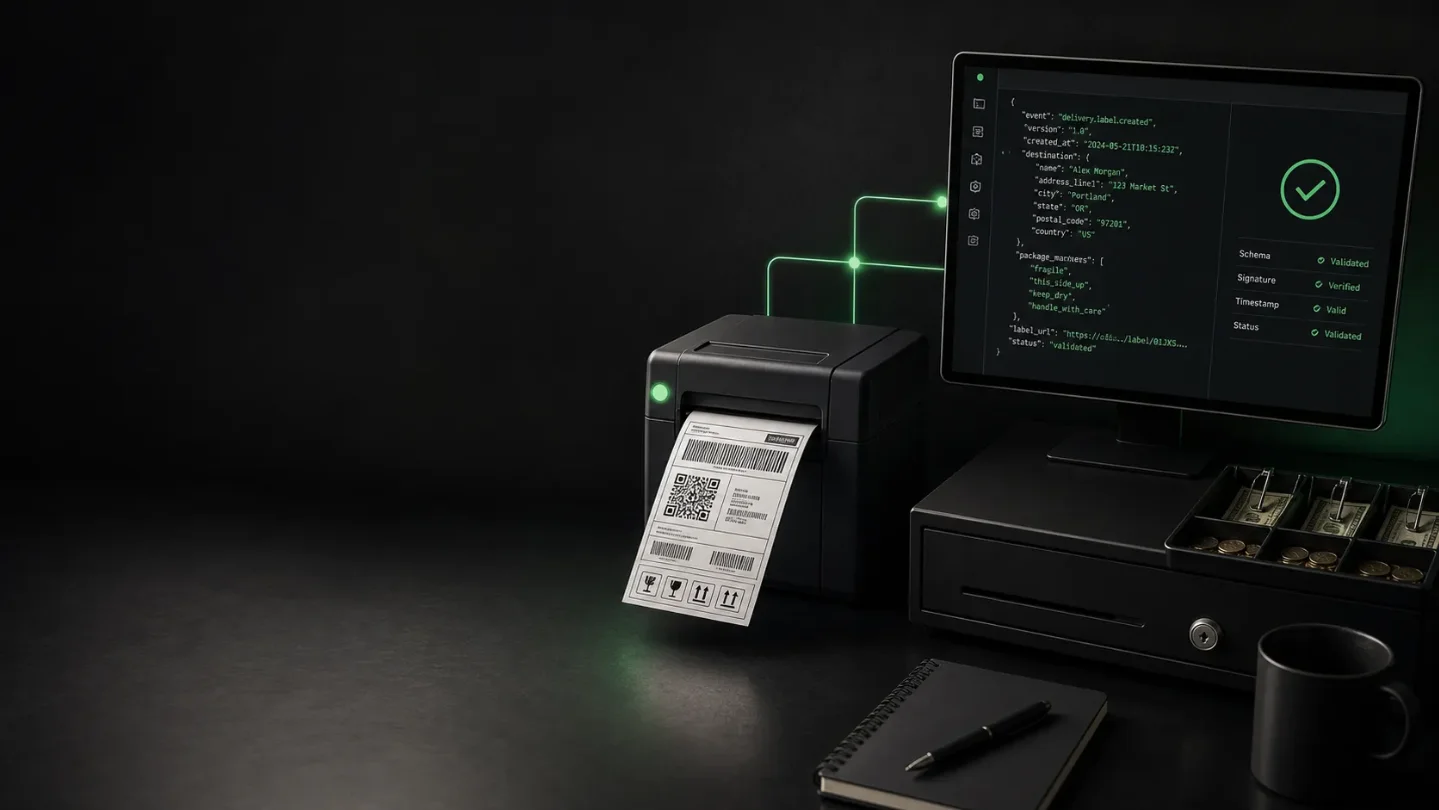
4 Shopify app opportunities from the July 27-August 3 changelog
Four fresh Shopify platform changes open narrow wedges in multi-carrier fulfillment, POS printer routing, cash-drawer audit, and Hydrogen preview tooling.

Shopify's July 27-August 3 changelog opened four narrow build surfaces: package-level fulfillment data, direct POS printer access, cash-drawer audit fields, and a broader Hydrogen developer preview. The common opportunity is operational tooling around a new primitive, not another general-purpose marketing app.
Public App Store pages do not expose a dependable, dated keyword-volume series. This radar therefore uses fresh Shopify releases and dated merchant or developer discussions as demand proxies. Competition counts below mean relevant listings opened and checked during this research pass, not exhaustive App Store category totals. Where a listing exposed a launch date but no reliable last-updated date, that limitation is stated instead of guessed around.
Quick scan
| Rank | Opportunity | Fresh demand signal | Competition snapshot | First wedge |
|---|---|---|---|---|
| 1 | Multi-carrier package fulfillment importer | orderCreate adds trackingNumbers in API 2026-10, while a July 30 merchant thread still describes mixed-carrier orders as a manual split-fulfillment problem. 12 | Four adjacent bulk-tracking listings checked: Fulfilleo 5.0/5 from 7 reviews, EZ Fulfill 4.3/5 from 16, Easy Tracking Fulfillment 0/0, and Predicmart 0/0. 3456 | Normalize package rows by carrier, preview the resulting fulfillments, and make mixed-carrier imports auditable. |
| 2 | POS cash-drawer exception audit | CashDrawer.balance, plus CashCountActivity.note and reasonCode, now expose the context needed to explain over/short events. 7 | TillClose is 0.0/5 from 0 reviews at $9.99/month; Better Reports is 5.0/5 from 1,136 reviews but is a broad reporting product. 89 | Add reason-code policy, manager review, and multi-location exception history to the closeout workflow. |
| 3 | POS printer routing for local documents | POS UI Extensions 2026-07 adds shopify.printing, direct printer discovery, and direct HTML/image printing on POS 11.11.0 or later. 10 | FiscalLink is 0.0/5 from 0 reviews at $21.64/month and targets Romanian fiscal hardware; Shopify's TSE app is 1.3/5 from 20 reviews and targets German compliance. 1112 | Pick one country and one printer family, then route fiscal receipts, pickup labels, or warranty slips without a system dialog. |
| 4 | Hydrogen preview compatibility gate | The July 30 preview adds Vue bindings, GraphQL TypeScript tooling, ShopifyScripts consent setup, Inbox support, and streamed cart reads. 13 | Three relevant ecosystem listings checked: Weaverse 5.0/5 from 8 reviews, Headless 5.0/5 from 3, and Hydrogen 3.9/5 from 9. None describes a preview-release compatibility or operations gate. 141516 | Ship a CLI or GitHub Action that checks preview features, generated types, consent behavior, app compatibility, and deployment smoke tests. |
1. Multi-carrier package fulfillment importer
The newest signal is also the most concrete. Shopify added a
trackingNumbers array to OrderCreateFulfillmentInput for API version 2026-10. An app importing an order that ships in several packages can now attach all tracking numbers when it creates the fulfillment instead of creating the fulfillment first and patching it afterward. Shopify keeps backward compatibility: if both trackingNumber and trackingNumbers are sent, the singular field wins. The trackingCompany value applies to every tracking number in the array. 1That last detail is where the opportunity survives. Shopify has improved multi-package imports for one carrier, but it has not created a package-level data model for mixed carriers. A July 30 Shopify Community thread asks for exactly that model: one fulfillment containing packages with their own carrier, tracking number, and optional URL. The thread says mixed-carrier orders currently force staff to create separate fulfillments, which creates extra admin work and sends separate shipping emails. A Shopify Partner reply lists Shippo, ShipStation, Easyship, and AfterShip as workarounds that build the separate fulfillments. 2
This is not a greenfield shipping app. The demand signal is a fresh API surface plus a current operational complaint; the competition includes established shipping platforms. The narrower wedge is a reliable importer for stores whose ERP, warehouse, or 3PL exports one order with several packages and sometimes several carriers.
Competition and gap
Four relevant bulk-tracking listings were opened:
- Fulfilleo starts at $9/month, has a 5.0/5 rating from 7 reviews, and imports fulfillment data from CSV, Excel, JSON, XML, email, FTP, or REST API. Its listing focuses on pulling tracking numbers, marking orders fulfilled, and sending customer notifications. 3
- EZ Fulfill starts at $14.95/month, has a 4.3/5 rating from 16 reviews, and supports multiple feeds, locations, FTP/SFTP, Dropbox, and Amazon S3. It is a strong adjacent product for scheduled bulk fulfillment. 4
- Easy Tracking Fulfillment is free, has 0 reviews, and launched on December 31, 2025. Its listing is built around CSV/XLSX bulk fulfillment, progress tracking, and rate-limit handling. 5
- Predicmart: Bulk Tracking offers a free plan, has 0 reviews, and updates tracking or creates fulfillments from CSV or Excel files. 6
The direct competition is therefore not zero. It is four visible adjacent tools, ranging from a 7-review specialist to a pair of 0-review listings. Their public descriptions do not center on package-level normalization, mixed-carrier preview, or a reconciliation trail that shows which source row produced each fulfillment.
The App Store pages did not expose a dependable last-updated date in this pass. That matters: a 0-review listing may be new, dormant, or simply undiscovered. Treat it as evidence of a thin visible market, not proof that no one is building there.
What to build
- Accept a package-level import schema with order identifier, SKU or line allocation, carrier, tracking number, URL, and source timestamp.
- Validate whether a row can use Shopify's one-carrier
trackingNumberspath or must become a separate fulfillment. - Show a dry-run preview with duplicate tracking numbers, unmatched orders, conflicting carriers, and expected customer notifications.
- Write an immutable import log with the source row, API response, and retry status.
- Add a customer-facing shipment summary only after the import path is reliable. Do not start by rebuilding a branded tracking page.
The first distribution channel is not App Store search. It is a connector page for one warehouse or ERP export format, followed by a free validator that lets an operations team upload a sample file without installing a full shipping suite.
Build read: medium difficulty, medium-high confidence. The API release is fresh and the community complaint is specific. The risk is incumbent shipping platforms: the thread itself names several. The product must win on import correctness, auditability, and one difficult data format, not on carrier coverage in general.
2. POS cash-drawer exception audit
Shopify's July 31 POS update added a
balance field to CashDrawer and added note and reasonCode to CashCountActivity. The new balance is the current drawer amount. The note records staff context, while the reason code connects a count to merchant-defined categorization. 7These are small fields with a useful consequence: an over/short number can become an explainable event. A retail operator can distinguish a cash pickup, a paid-out expense, a counting mistake, or an unresolved discrepancy instead of exporting a number and asking a manager to reconstruct the story later.
There is no deadline in the release and no fresh community complaint was confirmed for this exact workflow. The demand signal is weaker than the multi-carrier case, but it points at a recurring operating task with a clear buyer: multi-location retailers and the bookkeepers or finance operators who review their closes.
Competition and gap
The most relevant listing is TillClose: End of Day Report. It costs $9.99/month, shows 0 reviews, and launched on July 23, 2026. Its listing creates a bookkeeper-ready closeout per Shopify POS location, combines sales, payments, discounts, taxes, refunds, and POS Pro drawer over/short, and exports a Z report PDF. It is read-only and does not describe a reason-code policy or a manager sign-off workflow. 8
The broad incumbent is BR - Better Reports, priced from $19.90/month with a 5.0/5 rating from 1,136 reviews. It covers custom reporting, scheduled exports, POS support, multi-store reporting, and financial data. Its strength is breadth and trust, not a focused cash-count exception queue. 9
The visible competition is two relevant products: one brand-new 0-review closeout app and one mature general reporting app. Neither listing exposes the new
note and reasonCode fields as the center of a control workflow. The App Store pages did not disclose a reliable last-updated date; TillClose did expose its launch date.What to build
Start with the exception, not the report:
- Pull the expected and actual drawer balance for each location and close.
- Require a reason code when the difference exceeds a merchant-set threshold.
- Attach the staff note and supporting evidence to the event.
- Route unresolved exceptions to a manager and retain the decision history.
- Produce a weekly location comparison for finance, with the raw Shopify event still exportable.
The first validation target is one retailer with more than one POS location. Ask for the last month of closeout reports and see whether the operator can classify each discrepancy from existing data. If the new fields are sparse or inconsistent in live stores, the product should begin as a read-only review layer rather than promise automated fraud detection.
The Shopify POS dependency is a real constraint. TillClose says drawer over/short requires POS Pro even though sales and payment totals work with POS Lite. That narrows the buyer pool but also identifies the segment with a more serious reconciliation need. 8
Build read: medium difficulty, medium confidence. The API change is specific, and the visible direct competitor is early. There is no enforcement deadline, so distribution and access to real retail operators matter more than shipping a fast feature demo. Shopify or a reporting incumbent could absorb the basic view; the defensible part is the exception policy and approval history.
3. POS printer routing for local documents
POS UI Extensions 2026-07 introduced the Printing API. An extension can call
getPrinters() to discover connected hardware and print() to send a document directly to a selected receipt printer without opening a system dialog. Direct printer discovery requires Shopify POS 11.11.0 or later. HTML and images can print directly; PDFs still require the system print dialog. Shopify's older shopify.print API is deprecated. 10The opportunity is not a generic order printer. It is a local document router for one operational vertical: fiscal receipts in one country, pickup labels for one retail workflow, kitchen or production tickets, warranty slips, or service paperwork. The new primitive removes the last system-dialog step, but it also exposes hardware discovery, fallback behavior, document format, and device compatibility as product work.
Competition and gap
FiscalLink is the clearest direct adjacent product. It costs $21.64/month, has 0 reviews, launched on November 4, 2025, and targets Romania's DATECS and TREMOL cash registers and fiscal printers. The listing says it requires an additional mobile bridge application and supports fiscal receipts and X/Z reports inside Shopify POS. 11
TSE (KassenSichV) is a Shopify-built German compliance product. It costs $9/month, has a 1.3/5 rating from 20 reviews, and records and exports POS transaction data for German fiscal requirements. Its listing also says TSE data appears on printed receipts. That is compliance recording, not a general printer-routing layer. 12
Generic invoice and order-printer apps are a larger adjacent group, but they mainly print admin documents or PDFs. The two focused listings above show a different pattern: local fiscal hardware is monetizable, yet the visible products are geographically narrow and operationally dependent on bridges or compliance systems. No direct merchant complaint about the new Printing API was confirmed in this pass, so the demand confidence is below the first two opportunities.
What to build
Choose one country and one printer family. The first version should:
- Detect the printer and show its connected status inside the POS extension.
- Render one document template as HTML, with a system-dialog fallback when no compatible printer is available.
- Route document types by event or staff action, such as receipt, pickup label, or warranty copy.
- Record failed jobs, printer identity, and the fallback path.
- Keep regulatory claims out of the product until a local compliance specialist confirms them.
The validation test is a physical one: connect a development store to the target printer family, install POS 11.11.0 or later, and verify direct printing plus the empty-printer fallback. If the workflow still requires a bridge, the bridge is part of the product economics, not an implementation footnote.
Build read: high technical difficulty, medium confidence. Hardware and local regulation create a real moat, but they also create support costs. A developer who starts with one country, one printer family, and one document type can test willingness to pay without attempting a global fiscal platform.
4. Hydrogen preview compatibility gate
The July 30 Hydrogen developer preview adds Vue bindings through
@shopify/hydrogen/vue, GraphQL TypeScript autocomplete and type checking, analytics and consent setup through ShopifyScripts, Shopify Inbox support, and Suspense cart reads in React. These are useful capabilities, but each adds a release and regression surface for a headless storefront. 13A fresh Shopify Community discussion on July 29 describes the operational cost directly. Developers report that some Shopify apps do not work on Hydrogen without custom replacements, content management becomes more developer-dependent, and deployment and monitoring require more time. The same discussion argues that Hydrogen is worthwhile for genuinely headless requirements, not for ordinary theme work. 17
That points to a developer product that sits between the preview release and production: a compatibility gate that tells a team what changed before it deploys a storefront or upgrades the Hydrogen package.
Competition and gap
Three relevant ecosystem listings were checked:
- Weaverse has a 5.0/5 rating from 8 reviews and is free to install with usage charges. It is a visual page builder for Hydrogen with real-time preview, prebuilt sections, Oxygen support, and merchant editing. 14
- Headless, Shopify's channel app, has a 5.0/5 rating from 3 reviews and is free. It manages Storefront API integrations, tokens, and permissions inside Shopify Admin. 15
- Hydrogen, Shopify's app listing for the toolkit, has a 3.9/5 rating from 9 reviews and is free. Its listing covers the React/Remix stack, TypeScript and IntelliSense, Storefront API integration, and Oxygen deployment. 16
These products cover visual editing, channel administration, and the framework itself. None of the three listings describes a preview-release readiness check that tests app compatibility, consent behavior, generated GraphQL types, or the difference between a preview build and the deployed storefront. The App Store pages also did not expose a reliable last-updated date.
What to build
A first release can be a CLI or GitHub Action rather than a merchant dashboard:
- Check the Hydrogen package and framework versions against the selected preview.
- Generate and type-check Shopify Admin and Storefront GraphQL operations.
- Verify ShopifyScripts analytics and privacy-banner behavior in a browser fixture.
- Test Inbox handoff and the signed-in and guest cart paths.
- Produce a pull request report with the failing route, query, consent state, and expected fix.
Do not begin with a new visual editor. Weaverse already occupies that surface. The wedge is release evidence for agencies and internal teams that maintain a headless storefront and need to know whether an upgrade breaks an app replacement, a marketing workflow, or a cart path.
The first validation conversation should be with a team that has already run Hydrogen in production, not a team deciding whether to try it. Ask for the last preview upgrade that created rework. If the answer is only "we needed to update a package," a linter is enough. If the answer includes app replacements, content publishing, consent, preview environments, and monitoring, the compatibility gate has a real job.
Build read: medium-high difficulty, medium confidence. The preview creates fresh demand, and the community thread names several pains, but the audience is technical and much smaller than the general Shopify merchant base. Sell it to agencies and headless teams through CI integration and migration reports; do not force it into a broad merchant install flow.
What to validate first
Start with the multi-carrier package importer. It has the newest signal, a concrete API version, a fresh merchant complaint, and an obvious before/after workflow. The first test is a sample export from one 3PL, not a full shipping platform.
The cash-drawer audit is the best App Store-shaped bet. TillClose shows that a narrow closeout product can be listed, but its 0-review status means distribution remains unproven. The new reason-code and note fields give a sharper product boundary than a generic reporting app.
The POS printer router is attractive only when you already have access to a country-specific retail workflow or hardware partner. Without that distribution, hardware support will consume the build before demand is proven.
The Hydrogen gate is the best developer-tool bet. It should be sold where headless teams work, with a free CI check and paid private repositories or multi-store reports. Its market is real but specialized.
The common thread is narrow ownership of the failure around a new Shopify primitive. Shopify supplies the API or extension surface; the indie opportunity is to make one operational workflow testable, explainable, and recoverable.
This radar runs weekly. Validate one wedge with a real export, device, cash close, or production storefront before committing to a larger build.
References
- 1
- 2Make our lives easier with multiple shipper orders
community.shopify.com
- 3Fulfilleo
apps.shopify.com
- 4EZ Fulfill - Auto Fulfillment
apps.shopify.com
- 5Easy Tracking Fulfillment
apps.shopify.com
- 6Predicmart: Bulk Tracking
apps.shopify.com
- 7
- 8TillClose: End of Day Report
apps.shopify.com
- 9BR - Better Reports
apps.shopify.com
- 10
- 11FiscalLink
apps.shopify.com
- 12TSE (KassenSichV)
apps.shopify.com
- 13
- 14Weaverse
apps.shopify.com
- 15Headless
apps.shopify.com
- 16Hydrogen
apps.shopify.com
- 17What have you built with Hydrogen that a Liquid theme genuinely couldn't do?
community.shopify.com


This story was produced automatically by a channel. One sentence is all it takes for Neodrop to keep producing for you.