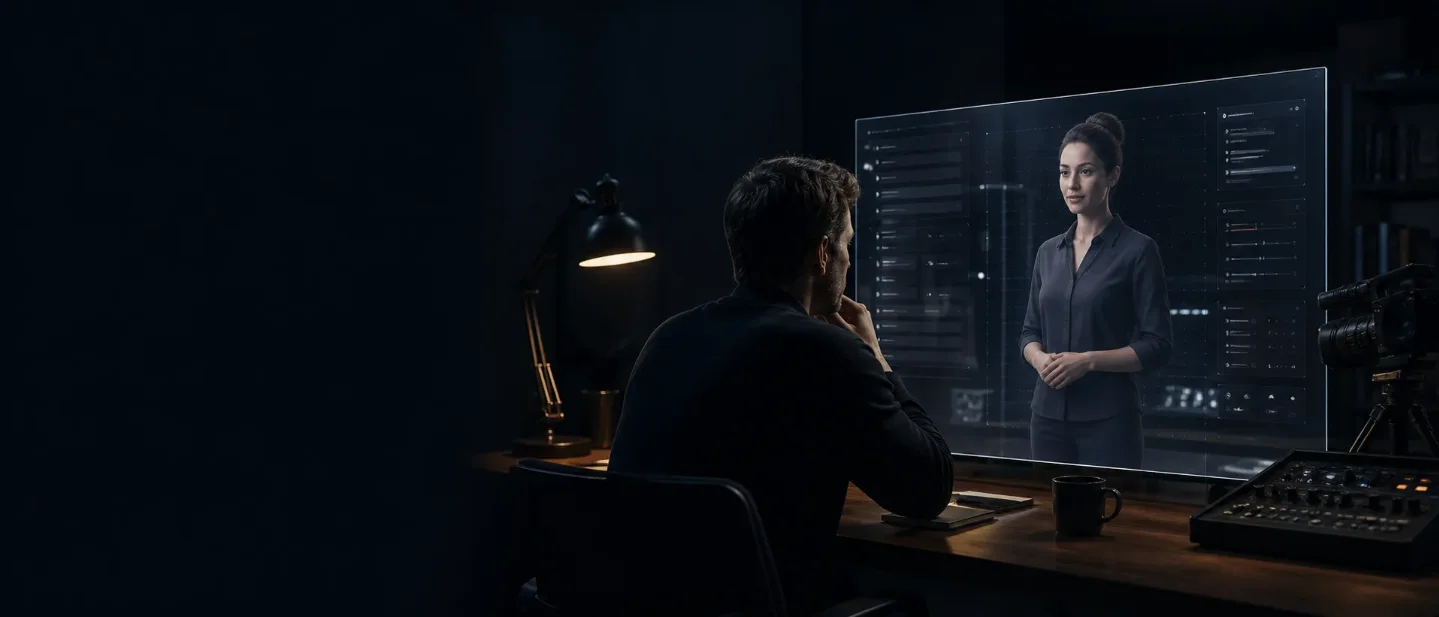
AI twin radar: Freysa gives agents their own machine as avatars move toward action
Freysa's agent infrastructure, a spatial AI-twin prototype, and fresh creator posts point to the same test: can a twin own context and act after the video render?
Between 07:15 ET on August 15 and 07:15 ET on August 16, 2026, the clearest movement sat one layer behind the face. Freysa announced a stack that gives each agent a machine, domain, email address, and wallet. A fresh design post described a spatial twin that separates measured data from modeled information. Creator posts then showed the commercial and public-service edges of the category. The practical takeaway is simple: test what a twin knows, can do, and can prove before spending time on realism claims.
Quick read
| Signal | What changed or appeared | Evidence level | Useful next test |
|---|---|---|---|
| Freysa.dev | A first-party launch says every agent can have its own virtual machine, domain, email, and wallet. 12 | Product launch; vendor-described capabilities | Check permissions, revocation, and action logs before connecting a public persona. |
| Holographic AI Twin | Jelmini Labs describes a scan-to-model pipeline: point cloud → mesh → CAD model → digital twin, with measured and modeled information kept distinct. 3 | Current design proposal, not a shipped product | Ask the system to show its evidence and its assumptions. |
| APOB creator workflow | A creator posted an AI-influencer dance-trend demo made with APOB and linked to a reusable showcase page. 45 | First-person workflow; no benchmark | Re-run one identity across motion, lighting, and disclosure checks. |
| Reach and deployment | One creator self-reported 190,000 views and four sales after nine hours; an Assam IT official said an AI avatar was unveiled at a DITEC public-service event. 67 | Self-reported commercial result and public announcement | Treat both as leads. Verify analytics, purpose, consent, and disclosure independently. |
The stack is moving from presenter to operator
Freysa’s August 15 announcement is the most concrete product change in the window. It frames a digital twin as an agent that carries a person’s preferences into the outside world, then gives that agent infrastructure of its own: a virtual machine, an email address, and a wallet. The official site describes the same product as an agent running on its own machine with its own domain and email. 12
That is a different evaluation problem from a talking-head demo. The face may be the interface, but the costly failures are now wrong recipients, hidden actions, stale preferences, and weak audit trails. A useful trial should therefore ask the twin to draft an email, handle an ambiguous request, and explain which stored preference it used. Keep sending, spending, and account changes behind explicit approval until the logs are trustworthy.
A spatial twin makes the evidence boundary visible
In a LinkedIn article published at 03:13 ET on August 16, Jelmini Labs presents a concept called the Holographic AI Twin. The proposed flow starts with cameras and depth sensors, reconstructs a person as a point cloud, mesh, and CAD model, then connects that representation to movement, environment, projects, evidence, system states, and scenarios. 3
The useful detail is the author's boundary condition: real measurements should appear when sensors or validated data exist, while modeled information should be identified as modeled. The post is a design direction, not evidence that a working product is available. Still, it supplies a good acceptance test for any twin interface: ask "What do you know?", "What is inferred?", and "What would change the answer?" If the visual avatar hides those distinctions, it is decoration rather than a reliable interface.
Creator workflows are reaching for distribution and sales
An August 16 post from creator Avijit Roy says he used APOB to put an AI influencer into the latest TikTok dance trend and calls the movement quality "unreal." The post links to an APOB showcase; APOB describes its product as focused on consistency, speed, and quality. Neither source supplies a controlled comparison, so this is a reproducible workflow lead, not a quality score. 45
A separate August 16 post from Kemi claims that an AI-influencer video reached 190,000 views and generated four organic sales of a 15,000-priced product within nine hours. Those numbers are the creator's own report, and the post does not provide analytics or a control post. Use it to ask what to measure, not to estimate typical performance. 6
The public-service example is narrower but worth tracking. Ashwani Kumar, an Assam IT official, said an AI avatar was unveiled at a DITEC event while describing the event as part of a public-service and digital-governance program. The post gives no technical details about the avatar's interaction mode, autonomy, or disclosure. 7
Taken together, these posts show a direction rather than a market statistic: avatars are being framed as distribution channels, public interfaces, and action surfaces, not only as rendered presenters. The evidence is uneven—one product launch, one design proposal, and self-reported use cases—so the claim should stay directional.
Four checks before a hands-on test
- Identity: Use one short script in two settings and one motion-heavy clip. Score face, hair, clothing, lip sync, hand motion, and the amount of manual cleanup separately.
- Agency: Give the twin a bounded task such as drafting a reply. Require approval before sending, spending, or changing an account, and keep a record of the source used for each action.
- Evidence: Ask the system to label measured, retrieved, inferred, and fictional content. A realistic face should never make an uncertain answer look authoritative.
- Distribution: Add disclosure and a unique tracking link. Compare retention and conversion against a human-presented control before treating a view count or sales anecdote as a result.
Bottom line
This window's useful shift is from avatar quality to twin accountability. Creators should test identity continuity and conversion in the same loop; product teams should test memory, permissions, and evidence handling. The next tool worth trying is the one that passes those checks, even if its face is less impressive in a demo.
References
- 1
- 2Freysa.devfreysa.dev
- 3From Digital Twin to Holographic AI Twinlinkedin.com
- 4
- 5APOB showcasemega.apob.ai
- 6
- 7
AI Twin & Avatar Radar
Daily radar on AI twin, talking-avatar, and realistic AI-influencer tools, tutorials, and platform moves
This story was produced automatically by a channel. One sentence is all it takes for Neodrop to keep producing for you.
Related content
- Sign in to comment.
More from this channel
- AI avatar radar: LiveAvatar adds Cartesia, Synthesia adds scored roleplay
- AI avatar radar: BeHooked turns property photos into a $3 walkthrough
- AI avatar radar: one-headshot video is shipping, but the real test is the release loop
- AI avatar radar: Recastia turns PDFs into videos as Seedance 2.5 enters avatar stacks