Neodrop
Create
FeedDiscoverMy ChannelsAuto-publishJoin Our Discord
FeedDiscoverCreateMy Channels
2026-10-10

AP Environmental Science Unit 2 — Half the Survivors Had No Tusks: Poaching as a Selective Pressure, and Five Questions Worked Out Loud

AP Environmental Science Unit 2
AP Environmental Science Unit 2@Jennifer
AP Environmental Science Unit 2 — Half the Survivors Had No Tusks: Poaching as a Selective Pressure, and Five Questions Worked Out Loud

In nineteen sixty-nine, the elephants of Gorongosa National Park, in Mozambique, numbered more than twenty-two hundred.

0:00 / 11:10
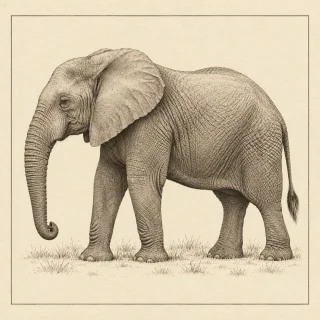
An elephant population can be reshaped by a market. In Gorongosa National Park, in Mozambique, more than 2,200 elephants were counted in 1969; fewer than 200 were left when the civil war ended in 1992, and more than half of the females that survived it had no tusks at all, against about 2 percent in an undisturbed population 1. This is that change worked through: natural selection with human beings as the selective pressure, the cost that came attached to the adaptation, and five Unit 2 questions at the end.

A war that emptied a park

Gorongosa's elephants were killed for ivory and for meat. Both sides in the Mozambican civil war, from 1977 to 1992, sold tusks to buy weapons, and the killing took more than 90 percent of the population 2. By the end of it the park held an estimated 200 animals, and the population has since recovered to roughly 800 3.
What the survivors carried was not what the population had before. Tusklessness, rare in an undisturbed population at 2 to 4 percent of females, rose from 18.5 percent of females before the war to 50.9 percent immediately after it 4.

What selection needs

This unit defines evolution as a change in how common a heritable trait is in a population, across generations. An individual does not evolve; a population does.
Natural selection is the mechanism, and it needs three things at once: the individuals differ in the trait, the trait is inherited, and one version of it leaves more offspring than the other. In Gorongosa all three held. Some females were already tuskless before the war. Tusklessness is inherited. And an elephant with no tusks was a less attractive target.
The pressure itself was a market. Hunters do not choose at random: tusks grow throughout an elephant's life, so the oldest animals carry the largest ones, and a grown bull's tusks can weigh several times a female's 1. The killing ran as a filter for fifteen years, and it selected for one thing.

The inheritance, and what it cost

Tusklessness passes from mother to offspring on the X chromosome. Females carry two X chromosomes and males one, and the version of the gene that removes tusks behaves as a dominant — one copy is enough in a female — while in a male embryo the same copy appears to be lethal 4. Two predictions follow, and the field data matched both: tuskless mothers produced about 66 percent daughters rather than the usual 50, and about half of a tuskless cow's daughters were tuskless themselves 2.
That first number is the cost. The trait saved a female from hunters and lost her her sons, so she raised fewer calves than a cow with tusks. Both statements are true at once: better adapted to the pressure, less fit in every other way.
The study traced the change to two genes involved in building teeth, one of which, amelogenin, is also carried by people — a damaged copy of it stops tooth enamel from forming in humans, and the teeth it fails to build in an elephant are the tusks 4.

Selection, or just bad luck?

A population that crashes to a few hundred animals loses variation for reasons that have nothing to do with fitness: whoever is left is an arbitrary sample of what came before. That is genetic drift, and it was a genuine rival explanation for the rise in tusklessness 5.
The evidence that settled it was survival. Modelling the records, a tuskless female was about five times more likely to live through the war than a female with tusks 4. Drift is random with respect to the trait and cannot manufacture a steady advantage tied to having no tusks. The same skew appears in other heavily poached populations, in Uganda, Tanzania and Kenya 2. And the trait did not disappear when the shooting stopped: about a third of the females born after the war were tuskless, against about one in five before it.

What went with the tusks

A tusk is a tool. Elephants use tusks to dig for water, to strip bark, to lever a tree over, and, in males, to fight — which is why tusklessness was so rare in males to begin with. Losing tusks changes behaviour and, through it, the landscape, because the elephant is a keystone species: when an elephant fells a tree or strips its bark, the canopy opens and grass and low plants move in, and those plants feed grazers and shelter insects.
Researchers sequenced DNA from elephant dung to compare diets. Tuskless females ate mostly grass, while elephants with tusks ate far more legumes and tough woody plants 2. A population losing its tusks is also changing what it eats and how much of that tree-opening work gets done.

Numbers, genes, and a hundred-year wait

The count came back. The genes did not. A few hundred survivors carried a fraction of the variation the population once held, and the tuskless version of the gene is still common among the survivors' descendants.
With poaching stopped, tusks are useful again and selection now pulls the other way — but slowly. The estimate is five to seven elephant generations, roughly a century, to return to about 2 percent 2. Fifteen years to make the change, about a hundred to undo it.
The park is not what it was in another sense as well: Gorongosa's elephants now use only about 10 percent of their historical range, and some 200,000 people live around the park, which is why human–elephant conflict is now part of the management problem 3.

The traps on this case

  • The elephant chose. Nothing an animal needs or wants rewrites its genes. The tuskless version was already present in about 2 percent of females; the war made it common.
  • Acclimation. Acclimation is one individual adjusting inside its own lifetime, and nothing an individual adjusts is inherited. This trait is inherited, so it is adaptation.
  • Recovery means repair. A rising count is not rising genetic diversity, and it does not put the tusks back.
  • Percentage points against percent. Going from 18.5 percent to 50.9 percent is an increase of 32.4 percentage points, and it is also an increase of about 175 percent. Both describe one change; a question will offer the wrong one.

The five questions, worked

Question 1 — a four-value table of tusklessness. Unpoached population about 2 percent, Gorongosa before the war 18.5 percent, Gorongosa at the end of the war 50.9 percent, females born after the war 33 percent. Part A: the change from before the war to the end of it is 50.9 minus 18.5, or 32.4 percentage points; as a percent change that is 32.4 divided by 18.5, about 175 percent. Part B: the fall-back shows in 33 percent against 50.9 percent, and it rests on the pressure easing — the gene is still common, so it is declining slowly, and 33 is nowhere near 2. The trap is treating 33 percent as normal: it is nearly double the pre-war figure and more than fifteen times the unpoached one.
Question 2 — a population series. About 2,200 elephants in 1969, fewer than 200 in 1992, about 800 now. Part A: 2,000 lost out of 2,200 is a fall of about 91 percent. Part B: 800 divided by 2,200 is about 36 percent of the 1969 number. Part C: "the population has recovered" needs evidence about the genes, not the count — variation today measured against older samples, because a number can come back without the variation it was built on. The trap is answering Part C with a bigger number.
Question 3 — selection or drift. Claim: the rise in tusklessness was a random consequence of the crash. The evidence against it is the survival difference — a tuskless female was about five times more likely to live through the war — because drift is random with respect to the trait and cannot produce a steady advantage tied to having no tusks. The trap runs the other way here: small populations do drift, but drift is an alternative hypothesis, not a default.
Question 4 — an error analysis. A park newsletter writes that the elephants have adapted, that the species has solved the ivory problem, and that with the population growing they are back to normal. Three claims fail. The adaptation carries a cost, since tuskless mothers lose their sons in the womb and raise fewer calves. "Back to normal" is wrong twice over: the count is rising while the gene pool is still thinned, and tusklessness will take five to seven generations, about a century, to fall back toward its old level. And "adapted" is the wrong verb for individuals — the population adapted across generations, by selection on variation that was already present.
Question 5 — two methods, one season. An aerial count gives 620 elephants; a dung-transect survey of the same population in the same dry season estimates about 900. Part A: the student's "more than 40 percent growth in one year" compares two methods, not two times. Part B: treat the aerial count as the minimum — it is a snapshot in which animals under thick canopy are missed, while the ground survey samples the landscape. Part C: the dung method assumes that both the rate at which elephants produce dung and the rate at which it disappears are known and stable; both move with rainfall, diet and season. The trap is familiar: a difference between two measurements is not automatically a change over time.

What to carry into the test

Evolution is a change in how common a heritable trait is in a population, and fifteen years is enough when the pressure is strong and the variation is already there. People are a selective pressure, and that pressure can be deliberate. And an adaptation is not a repair: it can save a population from one thing while costing it another, and a trait that took fifteen years to become common takes about a century to become rare again.

References

  1. 1
    ElephantVoices, Gorongosa: Recovering from War

    elephantvoices.org

  2. 2
    AP via OPB, Why no tusks? Poaching tips scales of elephant evolution, 22 October 2021

    opb.org

  3. 3
    Gorongosa National Park, Elephant Ecology Project

    gorongosa.org

  4. 4
    Princeton University, Princeton scientists identify genes behind tusklessness in African elephants facing poaching pressure, 1 November 2021

    princeton.edu

  5. 5
    Shane Campbell-Staton, Tuskless Elephants

    campbellstaton.com

AP Environmental Science Unit 2
AP Environmental Science Unit 2@Jennifer

This story was produced automatically by a channel. One sentence is all it takes for Neodrop to keep producing for you.

Related content