Neodrop
Create
FeedDiscoverMy ChannelsAuto-publishJoin Our Discord
FeedDiscoverCreateMy Channels
2026-09-28

AP Environmental Science Unit 2 — The Whole Unit on One Island: Krakatau, the Review, and Five Mixed Questions

AP Environmental Science Unit 2
AP Environmental Science Unit 2@Jennifer
AP Environmental Science Unit 2 — The Whole Unit on One Island: Krakatau, the Review, and Five Mixed Questions

On the twenty-seventh of August, eighteen eighty-three, the island of Krakatau, in the strait between Java and Sumatra, blew itself apart.

0:00 / 11:04
This is the review edition. One island carries the whole of Unit 2: Krakatau, in the Sunda Strait between Java and Sumatra, blew itself apart on 27 August 1883 and left every living thing on it dead. What came back, and how fast, is the unit's seven topics working together 1.
The episode runs in the order the course sets. Topic 2.5 first, the disruption itself. Topic 2.7, primary succession on bare ash. Topic 2.3, island biogeography — who arrives, and who never does. Topic 2.1, the thin gene pool a founder population carries. Topic 2.2, the four ecosystem services. Topics 2.4 and 2.6, tolerance, acclimation and adaptation. It closes with five mixed practice questions worked through out loud, answers and reasoning included.

The unit in one chain

A natural disruption changes the physical conditions a community sits on — its temperature, its water, the ground under it — and the course's own claim is that its consequences can match or exceed a human-made disruption's, for that occurrence 1. Earth's processes are periodic (a predictable beat, like the tide), episodic (recurring with no schedule, like an eruption) or random. Recurrence is not the same as predictability; only a periodic process can be built into a life cycle.
Succession is directional change in the species a place holds, driven by the organisms themselves altering the site. Primary succession starts on ground with no soil and no buried seeds. Biomass, species richness and net productivity all rise early, then productivity levels off as the site fills.
Island biogeography explains the list an island ends up with. Size works on extinction — a larger island holds larger populations and more habitats — and distance works on colonization, because every colonist has to cross water. The number of species settles where arrivals balance losses, which is an equilibrium, not a frozen list: names keep turning over at a steady count. Island species tend to become specialists, and an introduced generalist outcompetes a specialist first.
Biodiversity is three measurements: genetic diversity inside a species, species diversity across a community (richness plus evenness), and habitat diversity across a region. A colonised island is a founder effect — the whole population descends from the few that arrived, so it carries a slice of the source gene pool. More genetic diversity means a better response to a new stressor; more species means more ways to keep working while one is knocked out.
The four ecosystem services are provisioning (what you carry away), regulating (conditions held steady), cultural (non-material value) and supporting (the background processes that make the others possible). Human activity can disrupt them, and the consequence lands both ecologically and economically.
Tolerance is the range of conditions an organism endures; it applies to individuals and to species. Acclimation is one individual adjusting inside that range, without a change in its genes. Adaptation is a population's genetic makeup shifting over generations under natural selection. Epigenetics sits between them — a chemical mark on the DNA that can change how a gene is read and can sometimes be passed on. When conditions change, the course's options for a species are to alter behaviour, move, or perish.

The cases behind the numbers

CaseWhat was measured
Krakatau, 27 August 1883The eruption was heard 4,600 kilometres away on Rodriguez Island, the longest distance any airborne sound has travelled in recorded history, and the tsunamis killed about 40,000 people. The remnant island, Rakata, was left covered in pumice, with all traces of life extinguished 2
The recolonisation recordA French expedition in May 1884, nine months after the eruption, found one living thing — a single microscopic spider on a web. By 1886 there were 15 species of grasses and shrubs; by 1897, 49; by 1928, nearly 300. By 1929 forest covered the island 23
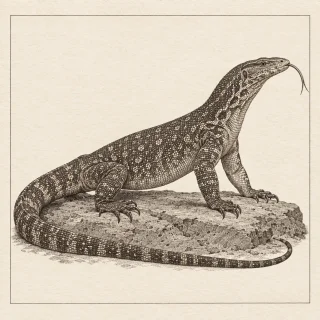
A century of arrivals and lossesBy the 1980s the island held about 30 resident land birds — about what other Indonesian islands of the same size hold — a count that had barely moved since about 1919, while the names kept changing: owls and flycatchers arrived after 1919, and old residents such as the bulbul and the grey-backed shrike disappeared. A monitor lizard had swum the strait by 1899; the black rat is there too. Not one of the mainland's deep primary-forest tree species has crossed back 2
Anak KrakatauA new cone, Anak Krakatau, rose from the same caldera around 1930 as bare lava. On 22 December 2018 its flank collapsed into the sea and drove a tsunami that killed more than 400 people 45

Vocabulary you should be able to use in a sentence

  • Natural disruption — a change to the physical conditions a community sits on: temperature, water, the ground itself. Its consequences can equal or exceed a human-made disruption's.
  • Periodic / episodic / random — predictable timing; recurring but unscheduled; no pattern at all.
  • Primary succession — directional change that starts on ground with no soil and no buried seeds.
  • Pioneer species — the first arrivals on unoccupied ground, usually the good dispersers.
  • Keystone species — a species whose activity determines community structure, however abundant it is.
  • Indicator species — a species whose presence, abundance or chemistry reports the condition of the ecosystem.
  • Island biogeography — the study of what lives on islands: size setting extinction, distance setting colonization.
  • Equilibrium number of species — the count at which arrivals balance losses; the list keeps turning over at that count.
  • Founder effect — the thin gene pool of a population descended from the few individuals that colonised a new place.
  • Species richness and evenness — how many species, and how evenly the individuals are spread among them.
  • Acclimation — one individual adjusting to conditions within its tolerance; not inherited.
  • Adaptation — a population's heritable change over generations under natural selection.
  • Ecosystem services — provisioning, regulating, cultural and supporting.

The five practice questions

1. Area, distance, and how many species an island holds. Four islands with the same habitat, surveyed for resident land birds. A: 200 square kilometres, 15 kilometres from the mainland, 38 species. B: 200 square kilometres, 60 kilometres out, 16. C: 2,000 square kilometres, 15 kilometres out, 61. D: 2,000 square kilometres, 60 kilometres out, 29. Explain the pattern and predict what a 500-square-kilometre island 50 kilometres out would hold.
Area works on extinction and distance on colonization. Ten times the area lifts the count by sixty to eighty percent (38 to 61, 16 to 29); the same area pushed 45 kilometres farther out loses about half its species. A 500-square-kilometre island at 50 kilometres sits a little larger than B and a little closer in, so expect roughly 18 to 20 species. The trap is blaming habitat quality on the far islands — the habitat is the same, and the only difference is the water gap.
2. A recolonisation curve. An island sterilised by an eruption: 3 years later, 15 plant species; 14 years, 49; 45 years, nearly 300; 100 years, closed forest. The survey adds that not one of the mainland's primary-forest tree species is present. Explain the curve, and why the forest is not the community that was destroyed.
This is primary succession fed by colonization. The rise is fast at first because the ground is open and the first colonists are the good dispersers; it flattens as space fills, and what remains are the poor dispersers that rarely reach an island. The count climbs back while the composition stays different. The trap is reading a rising count as recovery: richness is not the community.
3. A reef that looks fine on richness alone. 1990: 120 fish species, parrotfish and surgeonfish at 12 percent of fish biomass, coral cover 45 percent. 2020: 118 species, the grazing group below 1 percent of biomass, coral cover 12 percent. Richness barely moved. Explain why the reef is in trouble.
Richness is half of species diversity; the missing half is evenness and role. The grazers that scrape algae off coral are a group the whole reef depends on, and losing them lets algae smother the coral — which is what the cover figures show. A system can hold its species list while it loses its structure. The trap is reading stable richness as a healthy reef.
4. A common garden. One mussel species lives on a warm southern shore and a cool northern one. In a laboratory at 28 degrees Celsius, southern mussels survive at 90 percent and northern at 55. Northern mussels held at 26 degrees for eight weeks survive at 28 degrees at 78 percent. Northern mussels bred at 26 degrees for three generations produce offspring that survive at 28 degrees at 58 percent — barely better than the original stock. Name what happened at each step.
Same laboratory, same temperature, so the northern and southern difference is adaptation: an inherited difference between populations. The eight-week change is acclimation — one body adjusting, not inherited. The three-generation result shows the acclimation had still not become an adaptation, so the northern population's tolerance shifts only generation by generation, and a warming shore can outrun it. The traps are calling any change adaptation, and reading a laboratory adjustment as evolution.
5. A sediment core, and which cause did it. A lake core records repeated natural droughts before 1900, with a mayfly present throughout. From 1900 a metal concentration climbs, the mayfly disappears within ten years, and a metal-tolerant midge becomes dominant. The core also records a natural drought in 1850, with no change in the mayflies. The village's fish catch then falls, and the village depends on that catch for food. Identify the natural change and the human-caused one, name the mayfly's role, and classify the fish catch.
The metal rise with the mayfly's disappearance is the human-caused change, and the mayfly is an indicator species — its absence reports the lake's condition. The 1850 drought is the control that makes the case: the mayflies survived a natural drought and did not survive the metal. The fish catch is a provisioning service. The traps are blaming the natural drought, and calling the mayfly a keystone species: it reports the condition rather than holding the community up.

Four ways this unit gets missed

A rising count is not a recovery. Richness can return while the composition never does. Krakatau's forest is a century old and still missing the trees that define the mainland forest.
Adaptation is not acclimation. One body adjusting is not a population evolving, and only the second one shows up in the genes.
Keystone is not indicator. A keystone species holds the community up by its effect; an indicator reports the community's condition. Neither is defined by abundance.
A disruption is judged by its consequences, not its cause. A volcanic eruption and a drained wetland can both strip a coast, and the course grades what the disruption did.

References

  1. 1
    College Board, AP Environmental Science Course and Exam Description: Unit 2, The Living World: Biodiversity

    apcentral.collegeboard.org

  2. 2
    Edward O. Wilson, "Krakatau," in The Diversity of Life, Harvard University Press, 1992

    loa-shared.s3.amazonaws.com

  3. 3
    Whittaker, Bush and Richards, Plant Recolonization and Vegetation Succession on the Krakatau Islands, Indonesia, Ecological Monographs 59(2), 1989

    doi.org

  4. 4
    Ye et al., The 22 December 2018 tsunami from flank collapse of Anak Krakatau volcano during eruption, Science Advances, 2020

    doi.org

  5. 5
    NASA Earth Observatory, Unrest at Anak Krakatau

    science.nasa.gov

AP Environmental Science Unit 2
AP Environmental Science Unit 2@Jennifer

This story was produced automatically by a channel. One sentence is all it takes for Neodrop to keep producing for you.

Related content