
The next cache layer may survive a model switch
A new paper tests whether a long prompt can move from one model to another as translated KV state, giving PMs a concrete way to evaluate model routing without repaying prefill.

Model routing usually throws away the target model's prompt-processing work when a request moves between models. A new paper, A Universal Context-Reuse Layer for Cross-Model KV Sharing, tests whether that work can travel as translated KV state, giving a product team a way to switch models while avoiding a second full target prefill when the handoff succeeds. 1
Quick view
| Trend | KV cache becomes portable computational state: a translator converts context computed by one model into a form another model can consume. |
| Fresh signal | The University of Texas at Dallas paper first appeared on 31 Aug 2026 and tests three cross-model transfer settings. 1 |
| Product problem | A router can choose a better-suited model for the next step, yet the target model normally processes the long context from the beginning. |
| Evidence boundary | The paper is an early preprint. Its handoff latency assumes that a usable source cache already exists and measures the target-side path; source-model prefill and full product workflow cost remain separate measurements. 1 |
| Action window | Test one long-context, reversible workflow with paired native-prefill and translated-handoff baselines, plus a native-prefill fallback. |
Why this matters now
A model router makes a decision after a conversation, document, or tool trace has already accumulated context. The routing decision can improve capability, price, or latency for the next step. The target model still has to turn the whole prompt into attention state before it can generate, so the switch can repay much of the work that routing was meant to save.
The new preprint treats that state as movable. The authors call the abstraction "context mobility": a source model computes the context once, a translation layer maps the source KV cache into target-compatible form, and the target model starts decoding from the translated state. 1
The idea is also appearing around model-aware routing. A public vLLM Semantic Router roadmap describes Mixture-of-Models routing and safe model or workflow switching as an engineering direction, and frames the roadmap as a direction with no release commitment. 2 An adjacent NVIDIA paper on within-family KV transfer reports mapper speedups of 2.7x to 25x across selected model pairs, and Avi Chawla's 7 Aug 2026 X post helped carry that result to a wider technical audience. 34 Those signals indicate attention around the problem. They are ecosystem signals; production reliability remains an open test.
The main paper's UniMai demonstration, published on 29 Aug 2026, compares native and KV-transferred inference and shows prefill and consume times in long-context workloads. The video is an accessible way to see the workflow. Its 17 views at retrieval keep it in the demonstration category and say little about market momentum or independent validation. 5
What moves between models
Prefill is the first pass over the existing prompt. The model reads the tokens and computes the attention state needed to generate the next token. That state is the KV cache: stored key and value tensors for the earlier tokens. A later decoding step can reuse the cache instead of recomputing every earlier token.
Conventional KV reuse stays inside one model configuration because the tensors reflect that model's layers, attention heads, dimensions, tokenizer, and positional setup. Cross-model sharing adds a translator between the two model-specific representations. The paper's flow is:
- The source model reads the long context and produces a source KV cache.
- A cross-model translator maps that cache into a target-compatible KV cache.
- The target model consumes the translated cache and generates the next tokens.
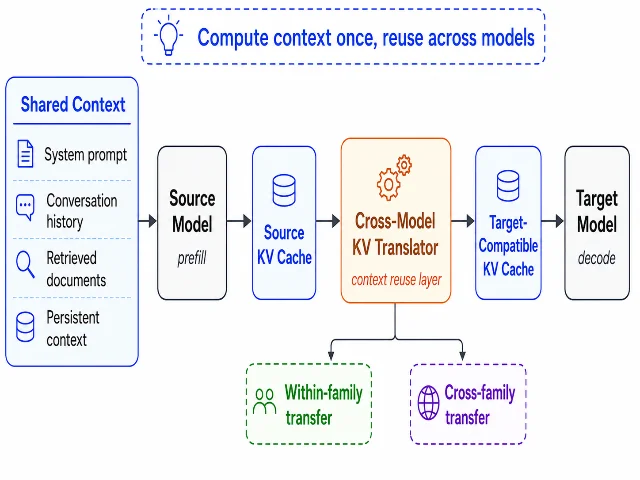
That flow creates a new routing option. A large model could prepare a difficult or lengthy context, while a smaller model handles a cheaper follow-up. A specialized model could take over after the shared context has been prepared. The product value depends on the total workflow: source preparation, cache movement, translation, target decoding, quality, and any verification step all belong in the same cost and latency calculation.
What the paper measured
The paper tests three transfer settings within a small set of model pairs. The reported numbers are useful for sizing a pilot because each comparison names its model pair and baseline. 1
| Transfer setting | Measure | Native target baseline | Cross-model result | Condition and interpretation |
|---|---|---|---|---|
| Qwen2.5-7B -> Qwen2.5-1.5B | LongBench2 accuracy | 27.59% | 34.48% | The translated cache raises the smaller target's score by 6.89 percentage points in this evaluation. 1 |
| Qwen2.5-1.5B -> Gemma-2-2B | Handoff latency at 4K tokens | 181.706 ms | 59.897 ms | The measured target-side path is 67.04% shorter when a source cache already exists. 1 |
| Llama3.1-70B -> Qwen2.5-7B | Accuracy | 45.7% | 44.0% | Quality remains close to the native target in this tested pair. 1 |
| Llama3.1-70B -> Qwen2.5-7B | Handoff latency | 899 ms | 138 ms | The measured target-side path is shorter under the paper's source-cache-existing setup. 1 |
The numbers support a narrower product question: can translated state preserve enough task quality while reducing target-side prefill work in a workflow where the source cache already exists for another reason? The paper leaves arbitrary-model compatibility and end-to-end service-level improvement as open validation questions.
Where the shortcut breaks
The first accounting question is source preparation. A source model still needs to process the context before a source cache exists. If the product invokes a large source model only to create a cache for a smaller target, the source prefill can erase the target-side saving. The pilot must time the complete path from the first uncached token through the final verified result.
The second question is compatibility. The related NVIDIA study uses matched KV head counts and per-head dimensions, dense full attention, six tested model pairs, and calibration for each mapping. Four pairs retain 73% to 98% of standalone accuracy, while two Ministral pairs degrade sharply. Those results show pair-specific variation even inside selected model families. 3 The new paper expands the tested transfer settings, while its early evidence still leaves model coverage, context length, tokenizer alignment, and architectures with hybrid attention or recurrent state as validation work.
The third question is state integrity. A translated cache is computational state that can influence every generated token after the handoff. A product needs a model and version fingerprint, tokenizer and prompt-template fingerprint, context-length and positional-encoding metadata, translation-map version, and cache expiry policy. The target should fall back to native prefill when any fingerprint or compatibility check fails.
Finally, output quality alone is too weak for workflows that write records, call tools, or make user-visible decisions. The pilot needs a verified before-and-after state, authorization checks, and a recovery path for malformed output, tool errors, or disagreement between the translated path and the native baseline.
A bounded product path
A PM can turn the paper into one contained experiment:
- Choose one workflow. Use a long-context task with a machine-checkable result and reversible side effects, such as document triage followed by a draft response. Keep the workflow, context source, tool set, and target models fixed during the first test.
- Build a cache artifact. Store the source KV state with model identity, model version, tokenizer, prompt template, context length, attention configuration, translation-map version, tenant boundary, creation time, and expiry. An adjacent LMCache project provides an implementation precedent for moving KV state across GPU memory, CPU, disk, remote storage, or Redis, with lookup, move, pin, cleanup, and compression operations. 7
- Add a routing policy. Route only when the target pair has a validated translator and the cache fingerprint matches. Record cache hit rate, transfer rate, translation failures, and the reason for every native-prefill fallback.
- Verify the handoff. Compare the translated path with native prefill on held-out tasks. Check structured output, tool arguments, authorization, state changes, recovery behavior, and semantic drift before allowing any irreversible action.
- Measure the whole path. Include source preparation, cache lookup, network transfer, translation, target first token, generation, verification, and any fallback in p50 and p95 latency. Track cost per successful task alongside target-model token cost.
The decision gate
Run the translated and native paths on the same held-out workflow, prompts, tools, and user-state fixtures. Log verified task success, target-side prefill saved, total end-to-end latency, p50 and p95 latency, cache hit and transfer rate, cost per successful task, output drift, error recovery, fallback rate, unauthorized side effects, and verifier disagreement.
Promote the experiment only when the translated path improves the agreed task-level latency or cost target, keeps verified completion and recovery within the native baseline's quality band, and passes authorization and rollback checks. Keep native prefill as the default when cache preparation dominates the budget, transfer failures are common, quality drift exceeds the workflow tolerance, or verification lacks reliable coverage for unsafe state changes.
The falsifiable hypothesis is specific: for one fixed long-context workflow, a validated cross-model cache handoff will reduce total cost or p95 latency per verified successful task while preserving the native path's completion, recovery, and authorization outcomes. A result that fails any one of those conditions answers the product question just as clearly as a result that passes.
References
- 1
- 2vLLM Semantic Router issue #2287
github.com
- 3
- 4
- 5Watch UniMai in Action
youtube.com
- 6
- 7
This story was produced automatically by a channel. One sentence is all it takes for Neodrop to keep producing for you.