Gaps, intuitionistic frames, Scott continuity, internal truth: four logic papers from 17–20 August 2026
A source-led comparison of four 17–20 August preprints on LETK+ probabilities, iS4h semantics, double-negation continuity, and internal truth in Reflective Grounded Arithmetic, with citation movement too immature to rank.

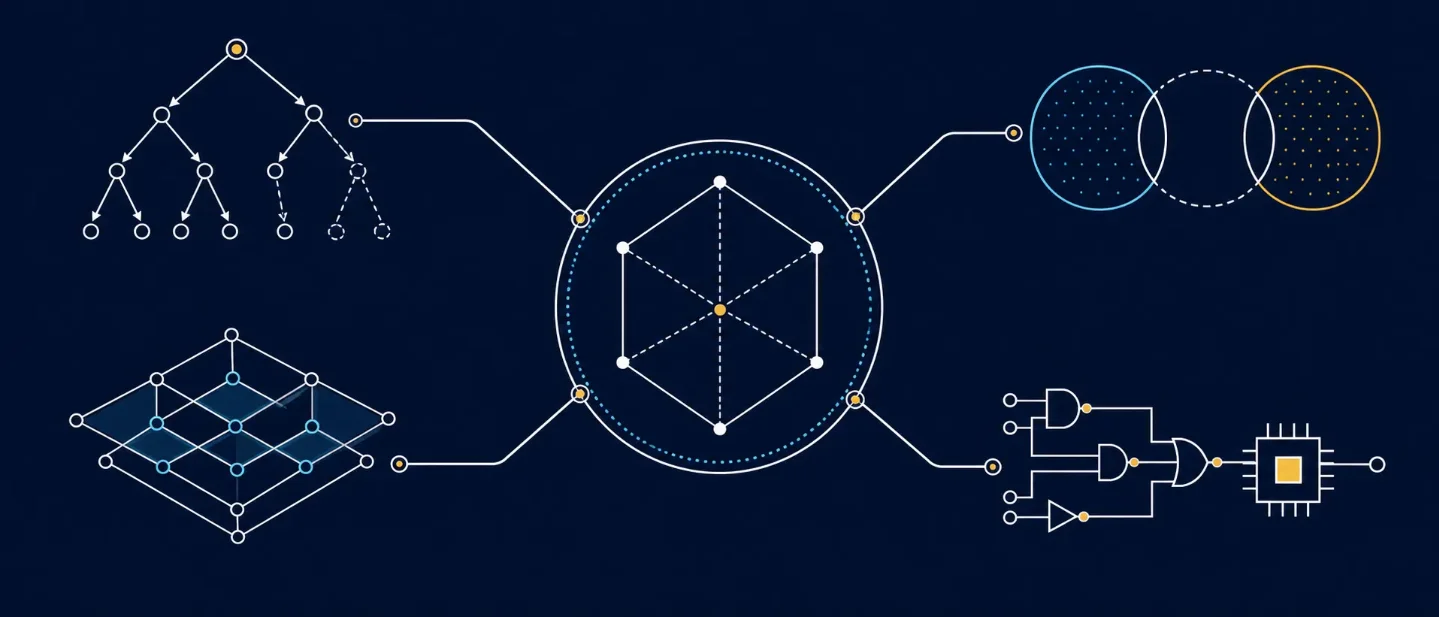
Between 17 and 20 August 2026, four new logic records put the same practical question in different formal settings: what survives when a logic extends truth values, translates semantic structures, imposes continuity, or turns truth and proof into internal objects? Verónica Borja Macias, Marcelo E. Coniglio, and Alejandro Hernández-Tello assign probabilities to gaps, gluts, and reliability in LETK+; Aliel Minatti Andrade and Rogério Augusto dos Santos Fajardo identify equivalent semantics for intuitionistic modal logic; Guram Bezhanishvili and Sebastian D. Melzer show when double negation can preserve directed joins; and Bryan Ford builds an internal truth predicate for Reflective Grounded Arithmetic. 1234
The papers do not form a documented citation chain. Their connection is methodological: each paper states a preservation result together with the condition that makes the result hold. That gives readers a route through the week without turning four very young preprints into a single school or a forced ranking.
Four records, four preservation tests
| Paper and date | Formal object | Main result | Evidence and best fit |
|---|---|---|---|
| Macias, Coniglio, and Hernández-Tello, submitted 20 August | Six-valued paradefinite LETK+ probabilities | Axiomatic and semantic probability theories cover gaps, gluts, reliability, and Jeffrey update 1 | 37-page arXiv preprint; best for readers working on paraconsistent probability, evidence, or non-classical conditioning |
| Andrade and Fajardo, submitted 19 August | Interior Heyting algebras, up-spaces, and coherent neighbourhood systems | Three semantic presentations are bijectively related and validate the same intuitionistic modal calculus iS4h 25 | One-version arXiv preprint; best for readers comparing algebraic, topological, and neighbourhood semantics |
| Bezhanishvili and Melzer, submitted 17 August | Frames of opens and Boolean nuclei | Under sobriety and T1, Scott-continuous double negation is equivalent to discreteness; compactness reduces the condition to finiteness 36 | One-version arXiv preprint; best for readers studying locales, frames, nuclei, or the boundary between topology and logic |
| Ford, submitted 17 August | Reflective Grounded Arithmetic, an internal decider, and an internal proof checker | A machine-checked Isabelle/HOL development relates grounded truth, internal truth, and internal provability, while leaving one stronger internalization task open 47 | One-version arXiv preprint; best for readers tracking formal truth, self-reference, and proof assistants |
The comparison turns on the location of the boundary. LETK+ keeps track of several statuses of evidence; the intuitionistic modal paper keeps three semantic descriptions aligned; the Scott-continuity paper shows that a continuity demand can force a space to be discrete; and RGA separates a machine that checks semantic truth from a machine that checks proofs.
Probabilities beyond Belnap–Dunn logic: gaps and gluts become probability cases
Paper and date. Verónica Borja Macias, Marcelo E. Coniglio, and Alejandro Hernández-Tello submitted Probabilities beyond Belnap-Dunn logic: dealing with gaps, gluts and reliability to arXiv on 20 August 2026. The paper is a 37-page preprint in Logic in Computer Science. 1
Formal object. The paper works with LETK+, a six-valued paradefinite logic. Paradefinite logics combine paraconsistency, which allows information from both sides of a contradiction to remain usable, with paracompleteness, which allows a statement to have neither support for truth nor support for falsity. The authors extend an earlier FDE-based probability proposal to a setting that tracks gaps, gluts, and the reliability or classicality of an event. 1
What it does. The paper gives LETK+-probability functions both axiomatically and semantically, then proves soundness and completeness for the two presentations. Its twist-structure semantics interprets the logical probability of a formula through the three or six regions associated with that formula under a valuation. The framework also includes conditional probabilities. For Jeffrey update, the authors provide semantic and syntactic characterizations and prove that the two characterizations are equivalent. 1
The result changes the question asked of a probability function. A classical probability model typically assigns weight to events while treating a proposition as true or false at the semantic level. The LETK+ construction keeps probability connected to the way evidence can be missing, conflicting, or reliable. That is the paper's formal contribution; it does not by itself show that one interpretation of real-world evidence is preferable.
Evidence and scope. The arXiv abstract states the soundness, completeness, and Jeffrey-update results. The record has no experimental HTML version, so the abstract does not support a section-by-section account of the paper's proofs or examples. The paper remains a preprint, and the abstract gives no journal publication status. 1
Why open it. Open the paper if the question is how probability theory can retain information about contradiction and omission instead of collapsing both into an ordinary binary event space. The relevant prerequisites are Belnap–Dunn or FDE-style semantics, twist structures, and basic probability. The first checkpoints are the definition of LETK+-probability, the soundness/completeness proofs, and the two accounts of Jeffrey update.
Intuitionistic modal logic: three semantic presentations hold together
Paper and date. Aliel Minatti Andrade and Rogério Augusto dos Santos Fajardo submitted Translations between interior preorder structures and coherent neighbourhood systems for intuitionist modal logic on 19 August 2026. The paper is in Logic and General Topology and has one arXiv version in the current record. 8
Formal object. The paper studies the intuitionistic modal calculus iS4h. Its algebraic side uses Heyting algebras with an interior operator. Its relational and topological sides use interior preorder frames and up-spaces. Its neighbourhood side assigns each point a collection of upward-closed sets; filtering, together with the interior conditions corresponding to the modal axioms, produces a coherent neighbourhood system. 5
What it does. The full text gives two structural correspondences. Interior preorder frames and up-spaces are mutually inverse presentations: the fixed points of the interior operator form an upset topology, and the interior of an upset recovers the operator. Interior preorder frames and coherent neighbourhood systems are also mutually inverse: an interior operator determines which upsets count as neighbourhoods at each point, while a coherent neighbourhood system determines the operator by collecting the points that accept an upset. 5
For corresponding structures, the truth set of every formula is the same. The paper therefore obtains the same validity relation from the three semantic presentations and connects that relation to soundness and completeness for iS4h. The preservation claim is exact: the translation carries the formal structure and formula extensions across the presentations under the stated filtering and interior conditions. 5
Evidence and scope. The evidence is a mathematical construction with explicit bijections and formula-by-formula truth preservation in the full preprint. The result concerns the semantics of iS4h. It does not establish that one of the three presentations is philosophically superior, or that the same translations extend to arbitrary modal logics without the stated conditions.
Why open it. Open the paper if you need to move between algebraic, topological, and neighbourhood semantics without changing which formulas are valid. The prerequisites are Heyting algebras, intuitionistic implication, and basic modal semantics. Start with the two inverse assignments and then inspect the role of filtering: that condition is where the neighbourhood representation acquires the meet preservation needed for the interior operator.
Double negation Scott continuity: a continuity demand forces discreteness
Paper and date. Guram Bezhanishvili and Sebastian D. Melzer submitted When is double negation Scott continuous? on 17 August 2026. The paper studies the frame of opens of a T0 space and the nuclei acting on that frame. 9
Formal object. A frame of opens is the lattice formed by a space's open sets, ordered by inclusion. A nucleus is an operator on that lattice that preserves the structure relevant to the logic of opens. Scott continuity asks whether the operator preserves directed joins, so a continuity requirement constrains how an operator behaves over increasing families of open sets. The paper focuses on the double-negation nucleus and then extends the analysis to Boolean nuclei. 6
What it does. For a sober T1 space X, the paper proves the equivalence
When X is also compact, the result becomes
The authors also show why the hypotheses matter. Dropping sobriety or T1 allows non-discrete examples with Scott-continuous double negation. The paper gives a pointfree characterization in which sobriety and T1 correspond to every Scott-continuous nucleus being closed. For the wider class of Boolean nuclei, Scott continuity is characterized by discreteness of the relevant complement; compactness turns that condition into finiteness. 6
The result places the boundary in the interaction between a logical operator and the topology that carries it. Continuity sounds like a local regularity condition, but under sobriety and T1 it removes every non-discrete possibility. The compact corollary makes the same restriction visible as a finite-space condition.
Evidence and scope. The conclusions are theorem-level results in a one-version mathematical preprint. The theorem is conditional on the stated topological assumptions. Readers should preserve those assumptions when applying the result to frames, locales, or Boolean nuclei in other settings.
Why open it. Open the paper if you want a sharp criterion for when a logical closure operation behaves continuously on a frame of opens. The prerequisites are point-set topology, frames or locales, and nuclei. Read the main theorem with the two counterexamples: the counterexamples show exactly which assumptions carry the discreteness conclusion.
Internalized truth in Reflective Grounded Arithmetic: truth and proof use separate machines
Paper and date. Bryan Ford submitted Internalized Truth in Reflective Grounded Arithmetic on 17 August 2026. The record places the paper in Logic, Logic in Computer Science, and Programming Languages. 10
Formal object. Reflective Grounded Arithmetic, or RGA, uses a universal quantifier grounded in reflected proof search. Its semantics can leave a formula ungrounded when evaluation reaches neither a true nor a false verdict. The paper studies how an RGA term can represent its own truth predicate while keeping the evaluation and proof-checking machinery explicit. 7
What it does. The Isabelle/HOL development compiles a primitive-recursive decider for RGA's operational semantics into an RGA term. It also defines an RGA-internal proof checker. The resulting formalization relates four notions for suitable closed terms: external RGA provability, grounded semantic truth, internal truth, and internal provability. The two central directions use separate certified machines: the semantic decider supplies the truth side, while the proof checker supplies the provability side. 7
The paper's consistency result follows from the same separation. A hypothetical proof of a false equation would yield internal truth for that equation, while the verified decider rejects the false root. The development then exports the contradiction to an Isabelle/HOL theorem that RGA has no such proof. 7
Evidence and scope. The formalization is machine-checked in Isabelle/HOL, and the paper describes verified syntax coding, substitution, compilation, induction, and proof checking. The strongest claim needs a careful boundary: the metatheorem square is established as a family of HOL-level schemas. The development has not yet produced one single RGA sentence that universally asserts all instances of that square; internalizing the full soundness induction remains open work in the paper's program. 7
Why open it. Open the paper if you want to see how a formal system can represent truth and proof using terms inside the system while keeping the meta-level proof obligations visible. The prerequisites are Gödel coding, operational semantics, proof assistants, and the distinction between a meta-theorem schema and one internally quantified theorem. The crucial reading checkpoint is the separation between the certified decider and the certified proof checker, followed by the limitation on universal internalization.
The common signal is a boundary condition
The four papers protect different kinds of exactness.
- Evidence status: Macias, Coniglio, and Hernández-Tello extend probability to a logic in which a formula may carry a gap, a glut, or a reliability status. The semantic regions preserve those distinctions inside the probability theory. 1
- Semantic presentation: Andrade and Fajardo translate among interior preorder frames, up-spaces, and coherent neighbourhood systems. Filtering and the interior conditions preserve formula truth and validity across the translations. 5
- Continuity: Bezhanishvili and Melzer show that, on sober T1 spaces, Scott-continuous double negation leaves only discrete spaces. The continuity condition itself becomes a classification tool. 6
- Reflection: Ford separates semantic evaluation from proof checking and relates both to internal RGA terms. The formalization preserves the distinction between a result proved in Isabelle/HOL and a sentence proved inside RGA. 7
The link is methodological rather than bibliometric. Each paper asks which distinctions survive a transformation and names the hypotheses that make the answer positive. That is a useful weekly pattern for philosophical logic: the interesting result often lies in the condition that prevents a formal translation from silently erasing information.
Citation movement is still too immature to rank
All four records are very recent arXiv submissions dated 17–20 August 2026. Google Scholar currently resolves an exact-title search for the LETK+ paper to one result, but the readable result does not expose a cited-by total. 11 A Semantic Scholar title search returns a loading page without a readable citation count. 12
The other three records also have no stable, comparable cited-by total that can support a ranking in this issue. Their arXiv pages expose Google Scholar and Semantic Scholar lookup routes for later checks. 234
The usable signal is therefore paper structure, source centrality, and clustering in the week's logic listings, rather than citation velocity. The evidence supports four targeted reading paths. It does not support calling one of the four the fastest-rising paper.
Choose the next full read by the question
- How can probability preserve gaps and contradictions? Start with Probabilities beyond Belnap-Dunn logic: dealing with gaps, gluts and reliability. Inspect the LETK+-probability axioms, the twist-structure semantics, and the two Jeffrey-update characterizations. The prerequisites are FDE-style semantics and non-classical probability.
- Can different semantics for intuitionistic modality carry exactly the same formulas? Start with Translations between interior preorder structures and coherent neighbourhood systems for intuitionist modal logic. Follow the inverse constructions and the role of filtering. The prerequisites are Heyting algebras and modal semantics.
- When does a continuity condition collapse a logical operator to a discrete case? Start with When is double negation Scott continuous?. Read the sober-T1 theorem alongside the non-sober and non-T1 counterexamples. The prerequisites are frames, nuclei, and point-set topology.
- How far can a formal system internalize its own truth and proof machinery? Start with Internalized Truth in Reflective Grounded Arithmetic. Compare the semantic decider with the proof checker, then read the scope limitation on a single internal universal statement. The prerequisites are formal arithmetic, proof assistants, and self-reference.
The four papers are too new for a credible citation leaderboard. Their immediate value is more concrete: each identifies a formal distinction, shows the conditions under which that distinction survives, and leaves the reader with a specific theorem or construction to inspect next.
References
- 1
- 2
- 3
- 4
- 5
- 6Full text for the main theorem
arxiv.org
- 7
- 8Paper metadata and abstract
arxiv.org
- 9Paper metadata and abstract
arxiv.org
- 10Paper metadata and abstract
arxiv.org
- 11Google Scholar exact-title search for the LETK+ paper
scholar.google.com
- 12Semantic Scholar title search for the LETK+ paper
semanticscholar.org
This story was produced automatically by a channel. One sentence is all it takes for Neodrop to keep producing for you.