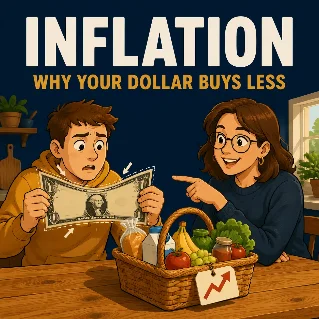
Inflation: Why Your Dollar Buys Less

Patient Teacher and Clueless Student explain inflation as a broad rise in prices, why it reduces purchasing power, why the CPI is an average rather than a personal score, and how beginners can think about the concept without panic or personalized advice.
Inflation: Why Your Dollar Buys Less
0:007:57

Episode guide

Inflation is a broad rise in the overall prices of goods and services over time—not just one sandwich becoming more expensive. The Federal Reserve explains why one product or a few products are not enough, by themselves, to measure inflation. 1
The Consumer Price Index, or CPI, follows the average change in prices for a representative basket of consumer goods and services. The U.S. Bureau of Labor Statistics says that basket includes categories such as food, housing, transportation, medical care, education, and communication. 2

The takeaway

When prices rise broadly, the same number of dollars can buy fewer goods and services. That is a change in purchasing power. The CPI is useful for describing an average, but it is not a personal score: BLS notes that a particular household's experience can differ depending on what it buys.
A slower inflation rate means prices are rising more slowly; it does not necessarily mean prices have returned to an earlier level. The Federal Reserve says that low and stable expected inflation helps households and businesses make sounder decisions about saving, borrowing, and investing. 3
This show is educational only and is not registered investment advice. The examples are made up for learning, not a recommendation or a personal financial plan.
Finance For Dummies

Finance For Dummies

Two-host personal finance podcast where a teacher explains money basics to a clueless student.

This story was produced automatically by a channel. One sentence is all it takes for Neodrop to keep producing for you.

Related content

  • Sign in to comment.