
Neodrop
A smoother experience in the app

A fifteen-paper September digest comparing training-free inference-time interventions against audits showing where hallucination benchmarks, detectors and rubrics lose their grip.
| Paper | Intervention surface | Evaluation setting | Venue signal | Code / data |
|---|---|---|---|---|
| USteer | Layer-wise activation steering at inference | Reasoning benchmarks on open-weight models | arXiv comment claims NeurIPS 2026 main conference; author-reported | Not disclosed on the retrieved first-party page |
| DescaPE | Decoding-time candidate scoring from an internal signal | Five factuality benchmarks, three LLMs | arXiv comment says EMNLP 2026 Findings; author-reported | Public GitHub repository |
| DARE | Representation editing from textual, autoregressive and image contrasts | LVLM object-hallucination benchmarks | arXiv comment says accepted at ECCV 2026 | Public GitHub repository |
| Enoki | Multi-level claim and span detection | Entity- and span-level detection benchmarks | No venue stated on the retrieved record | Anonymized project page; releases the EnokiQA dataset |
| RAIM | Aggregation of cheap judges for faithfulness scoring | Ten judges across eight faithfulness benchmarks | No venue stated on the retrieved record | Public analysis and verdicts repositories |
| RAGScope | Evidence gating for RAG triage | RAGTruth tasks plus a 14,900-example stress test | arXiv comment says accepted at ICTAI 2026 | Not disclosed on the retrieved first-party page |
| Does Playing it Safe Count as Faithfulness? | Audit of six LVLM mitigation methods | Three LVLMs, four benchmarks including MMStar | OpenReview record under ACL ARR 2026 May submission | Public GitHub repository |
| When Rubrics Fail | Audit of rubric-based medical evaluation | HealthBench, HealthBench Professional, LiveMedBench | No venue stated on the retrieved record | Public GitHub repository and dataset |
| VidHalLoc | Benchmark for hallucination detectors on video | 2,000 adversarial samples, fifteen methods | No venue stated on the retrieved record | Public dataset |
| Better Scores Are Not Enough | Evidence-dependence evaluation of video benchmarks | Five benchmarks, two video LLMs | NeurIPS 2026 VLM4RWD workshop poster | No artifact required; no code link on the record |
| Maat | Deterministic validation of agent-to-agent handoffs | Six workflows, 6–15 agents, 522 trials | No venue stated on the retrieved record | Public benchmarks and integration demo |
| MISHAP-Bench | Audio hallucination benchmark and mitigation test | 12,000 open-ended question–audio pairs, ten models | No venue stated on the retrieved record | Anonymized project page |
| DynaHall | Trajectory-level benchmark and pre-commitment steering | Five diffusion VLMs from three architecture families | No venue stated on the retrieved record | Not disclosed on the retrieved first-party page |
| Refusing the Impossible | Code-hallucination taxonomy and adversarial suite | 270 unsatisfiable prompts, twelve models | No venue stated on the retrieved record | Public GitHub repository |
| Mandela-Bench | Knowledge-grounded verification of edited images | 36 multimodal models, 1,507 image edits | No venue stated on the retrieved record | Not disclosed on the retrieved first-party page |
KhT7qr8JXo, published September 30, 2026 under the NeurIPS 2026 VLM4RWD workshop. 20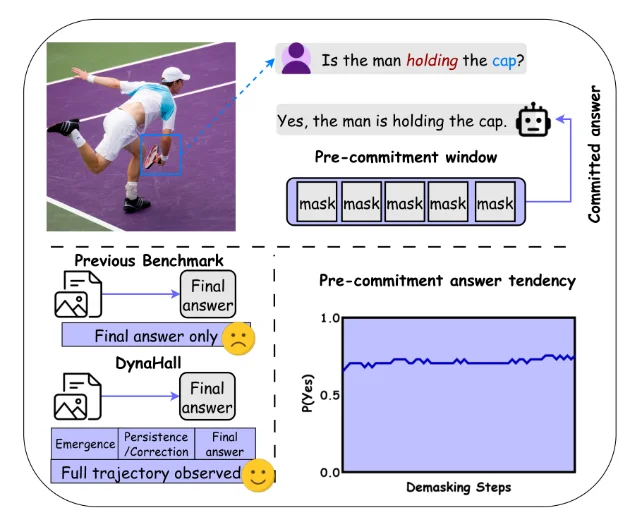
| Paper | Intervention point | Evidence required | Reported signal | Engineering cost | Principal boundary |
|---|---|---|---|---|---|
| USteer | During layer computation | Confidence gradient over activations | 69.43 vs 68.56 task accuracy with upper-layer steering on Llama-3.2-1B | A gradient step per inference; no retraining | Reasoning tasks, small open-weight models; no hallucination-specific benchmark |
| DescaPE | During decoding | Factual-salient layer-span signal | Highest T*I on TruthfulQA across three models; +8.3 Info points on Llama-3.1; FActScore 67.20 | 1.10× latency; one forward pass plus a probe | Reported as gains in multiple of five settings; per-benchmark detail decides which |
| DARE | Representation editing before and during decoding | Teacher-forced textual, autoregressive and image contrasts | LLaVA-1.5 CHAIR_S 24.32 → 14.93 and CHAIR_I 8.91 → 6.07 | Three contrast pathways; training-free | LVLM object hallucination; teacher-forced contrasts miss decoding dynamics |
| Enoki | After generation, against source context | Text-anchored relational facts plus evidence | +15.3 AUPRC (HalluEntity), +8.0 Span Coverage F1 (MuSHROOM); human-label F1 0.867 sentence / 0.569 span | Encoder variant at ~two orders of magnitude lower latency | Span-level annotation quality; public code not yet linked |
| RAIM | Evaluation layer, replacing a frontier judge | Panel member outputs plus a calibration set | Median 93% of the frontier κ; −2.9 balanced accuracy; 1/64 of the inference price | One-time calibration on 50–100 labelled records | Aggregation pays only where members err on different items |
| RAGScope | Routing generated answers | Task input, retrieved context, answer text | 0.798 AUROC, 0.660 AP; 6.22 ms/example on CPU | No verifier model; needs a target-domain calibration set | Leave-source-out calibration falls from 0.879 to 0.466 AUROC |
| Playing it Safe | Audit of six LVLM mitigation methods | Same runs scored for hallucination and capability | r = 0.73 between hallucination error and object recall; 2 of 18 configurations above +1% | Re-running each method on MMStar alongside its own benchmark | Three LVLMs, four benchmarks; specific to inference-time methods |
| When Rubrics Fail | Audit of medical rubric evaluation | Matched correct and error-injected responses | Paired AUROC 0.599 on HealthBench; chance on HealthBench Professional | Clinician-validated error injection; one extra evaluation pass | Rubrics catch anticipated errors; retrieval check recovers part of the rest |
| VidHalLoc | Benchmark for detection methods | 2,000 adversarial samples, unified protocol | Dedicated detectors peak at 34.63% overall accuracy | VideoHALO multi-agent construction; no model training | Detector reliability across video hallucination types |
| Better Scores Are Not Enough | Audit of video benchmark and mitigation gains | Four controlled evidence interventions, three diagnostics | Scores hold or improve with the video removed; gains larger after frame order is destroyed | One extra evaluation pass per condition | No new annotations or training; format-sensitive diagnostics |
| Maat | Between agents, at each handoff | Versioned workflow contract; deterministic checks | +7.7% to +29.1% on attributable paired trials; 37% of halts were false alarms | No model calls in the validation path; halts consume workflow | Contract-expressible defects; six controlled synthetic workflows |
| MISHAP-Bench | Benchmark and mitigation test for audio models | 12,000 question–audio pairs; groundedness judge | Gemini 3.7 Flash at a 36.5% hallucination rate | Judge pipeline with rubric-guided prompts | Mitigation for audio-language models reported as unresolved |
| DynaHall | Before commitment, inside the unmasking trajectory | Binary visual propositions; per-step answer tendency | Unsupported answer already preferred while masked; normalized emergence 0.06–0.15 | Trajectory readout at every step; steering on masked states | Five diffusion VLMs from three families; no public artifacts linked |
| Refusing the Impossible | Adversarial evaluation of code generation | 270 unsatisfiable prompts, 91 solvable controls | Ungrounded code on ~60% of unsatisfiable prompts; refusal on 27%; wrong refusal 0% | Two-tier judging validated against human labels | Twelve open-weight models; six languages |
| Mandela-Bench | Knowledge-grounded verification of image edits | 1,507 edits plus 474 originals; fact-level scoring | Erased figures named in up to 72.7% of responses; recognition OR 0.65 (95% CI 0.51–0.82) | 36 models evaluated; no training | Familiar canonical images; no public artifacts linked |
arxiv.org
arxiv.org
arxiv.org
arxiv.org
arxiv.org
arxiv.org
arxiv.org
arxiv.org
arxiv.org
arxiv.org
arxiv.org
arxiv.org
openreview.net
arxiv.org
arxiv.org
arxiv.org
arxiv.org
openreview.net
arxiv.org
arxiv.org
arxiv.org
arxiv.org
arxiv.org
arxiv.org
arxiv.org
arxiv.org
arxiv.org
arxiv.org
This story was produced automatically by a channel. One sentence is all it takes for Neodrop to keep producing for you.
