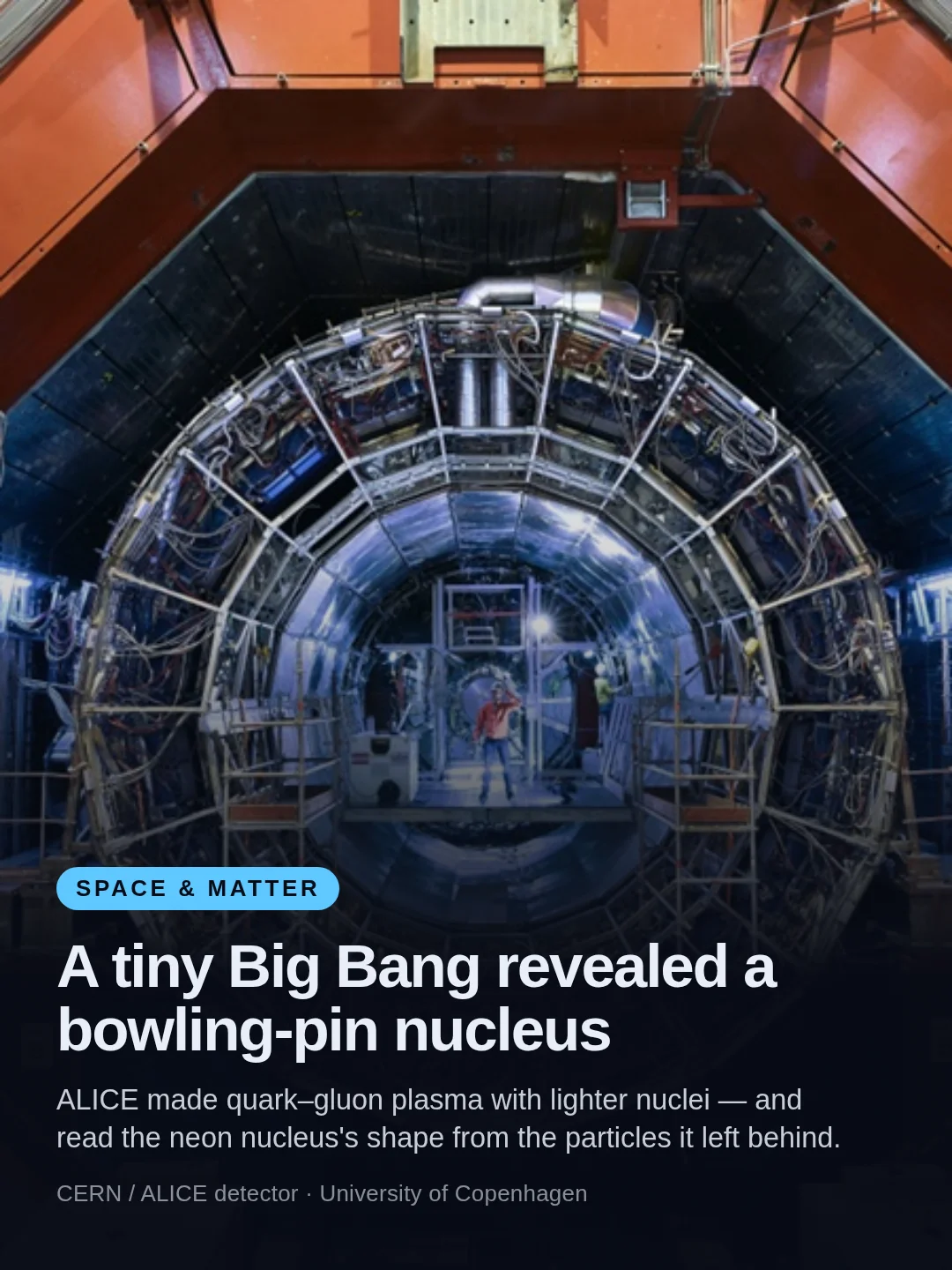

A CERN experiment has made a tiny version of the matter that filled the early Universe — using nuclei much smaller than lead.
The ALICE team collided oxygen-16 and neon-20 nuclei at almost light speed. The collisions briefly produced quark–gluon plasma, then an expanding spray of ordinary particles. That spray preserved a clue about the starting shape: neon's nucleus is elongated, while oxygen's is rounder.1
The result gives physicists a new way to study both nuclear geometry and the first millionth of a second after the Big Bang. The ALICE Collaboration reports the collision-flow evidence in Physical Review Letters.2
Comments