Rubble stone, nettle, lime dust, water under the street — the village with its roofs open
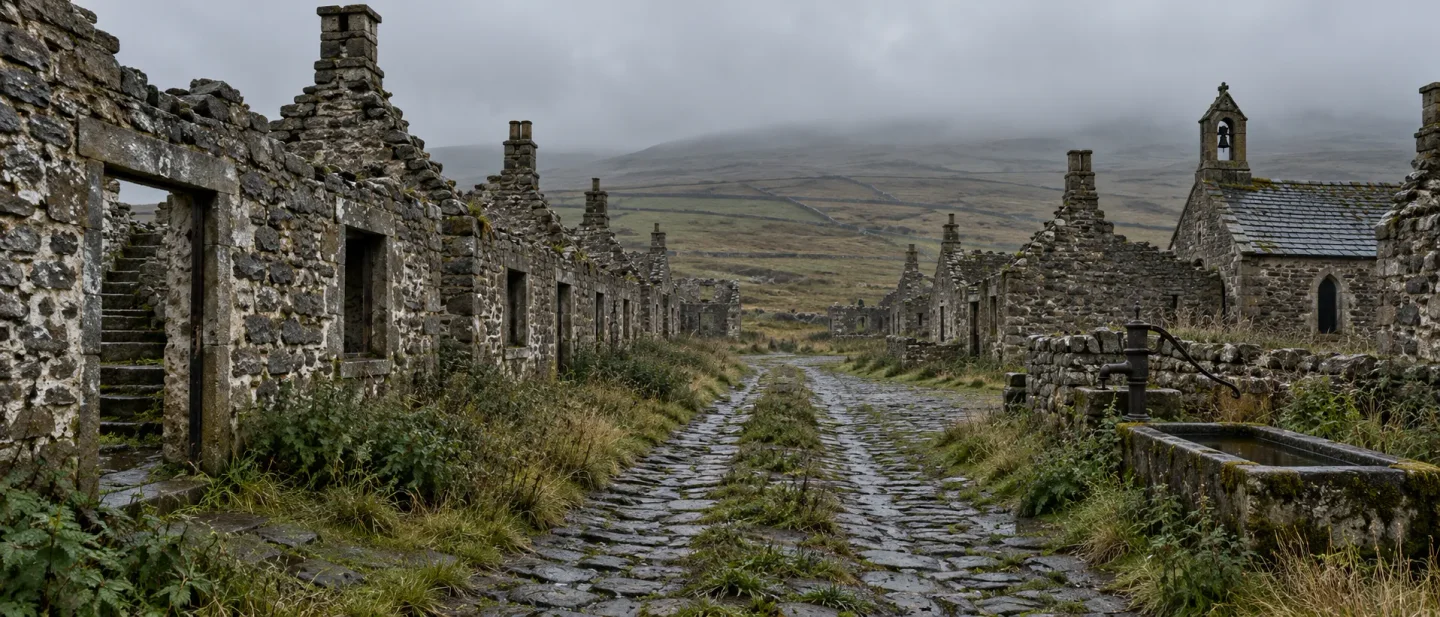
A deserted village stands roofless on the moor through one grey day — houses, school, chapel and mill open to the sky — while fog moves through its rooms and water goes on running in the buried drains under its street.

The lane up from the valley runs between two drystone walls for a mile and a half, and the walls are the only thing on it that has been kept. Grass stands in the ruts between the wheel tracks, and the ruts hold water in a long chain of pools. Above the walls the ground goes up onto the moor in one slope, and the cloud comes down to meet it.
At the top the lane ends at a gap where a gate went. The gate is gone and its hinges hang on the upright stone with nothing on them. Beyond the gap the ground opens, and the village is hard to find at first, because its walls are built of the moor's own stone and have weathered to the same grey as everything around them, wall and ground and sky together.
The street runs straight from the gap and bends at the far end. Two rows of houses face one another across it, and there is no roof on any house in either row. Chimney stacks stand up out of the wall ends, each one alone against the cloud, and above every house there is the same flat grey, high enough to be sky and doing nothing the sky does.
The street is pitched with cobbles set on edge in rows, and grass has come up down the middle in a line where the two halves meet. A channel is cut along that line, and the channel is wet, and the wet runs bright in it where the cloud shows palest. The wheel tracks on either side stand lower than the crown of the street by the depth of a hand.
Under the cobbles the street is hollow. Water runs in a drain below, and the sound of it arrives through the stone rather than over it: a steady note, continuous, that comes up through the soles of the feet and is loudest when the air is still. Nothing on the surface of the street makes that noise or accounts for it, and it goes on whether rain has fallen or not.
The first house on the left has lost its door. The lintel over the opening is a single stone, pitted with age, and the threshold beneath it has been worn hollow at the middle by the passing of feet, so that it is lower there than at either end. The jamb stones still hold the hinge pins, and the door they carried lies out in the grass behind the house.
Inside is a single room the length of the house. The floor flags have gone greasy with damp, and lime dust lies in the joints where the plaster came down off the wall. At the far end the chimney breast stands with a range set into it, its oven door hanging on one hinge and its bars gone to rust. A cast-iron pot sits dry in the fire hole, and the room smells of cold soot.
Two window openings face each other across the room, and the glass is gone from both. The shutters are gone too, and one hinge comes up out of the sill. Under the openings the daylight lies on the floor in two rectangles, so that a room with neither roof nor door still has light lying in it in the shape of windows.
In the corner between the chimney and the back wall a stone stair turns upward to where the upper floor was. Every tread is worn into a dish at its centre. Four steps, then a half landing, then four more, and the ninth comes out at the wall top with the open cloud over it and nowhere else to go. The handrail is a chase in the stone, worn round at the corner.
Behind the house a walled yard holds grass to the knee. A privy stands in the corner with its seat gone and its door weathered to a silver. Beside it a coal house holds a scatter of coal gone soft with damp, and a black stain runs from the coal down the flags and into the ash pit under the wall. The ash in the pit has set like grey mortar.
The house opposite was a shop. Its window is wider than the others, with a counter behind it at the height of a standing hand and shelves going up the wall. The shelves are empty and warped, and some have dropped at one end. A brass beam hangs from a bracket with both pans gone, and the ledgers on the counter have gone to pulp.
The next house along was papered. The paper hangs off the wall in long strips, grey and curled at the edges, and one strip has come down whole and lies on the flags, pattern up. Where it has come away it shows a sprigged pattern in faded green, and a coat of limewash beneath that, and under the limewash the bare stone, the same grey as the outside of the building.
The wash-house is a lean-to at the back with a copper set in brick and a fire hole under it, and the copper is green down its inside. A washboard leans against the wall with its zinc corrugations worn flat at the middle. A mangle stands by the door with its wooden rollers split along the grain and its ironwork gone red.
At the widening in the middle of the street there is a stone kerb, a long stone trough, and an iron pump. The pump's barrel has rusted in flares and its handle hangs with the chain off it. The trough holds water level to the brim, black and still, and the cloud lies in the water in a flat strip with the wall over it.
The trough overflows at one end into a grate, and the water goes down through the grate into the drain under the street. The note it makes there is the note that has been under the cobbles all along. The street carries it both ways from the widening, so it can be heard at either end of the village, and loudest where a grate has rotted out of the cobbles.
The school stands at the top of the street, its door frame square and its sill worn low. Inside, desks are fixed to the floor in rows of four, each with its bench. A stove stands at the front with its pipe going up through the ceiling and out. The board on the wall has been rubbed to a grey ghost, and eleven pegs run along the back wall, every one of them empty.
The chapel is the last building in the place with a roof. It is small and built of the same rubble, with a low slate pitch that has held on one side and gone on the other, and a bellcote at the gable with the bell still hanging in its opening. Its long wall runs along the street and takes the light of the day evenly.
Inside, the pews are set in two blocks with a gap down the middle, and their seats have dried and shrunk and pulled apart at the joints. Rain comes through the broken side of the roof and lands on one pew three from the back, and has darkened the wood and the flag beneath it. The pedals of a harmonium stand halfway down.
At the lower end of the street the mill stands over its own wheel pit, and the wheel is still in the pit, upright, its buckets rusted through and hanging open in strips. The sluice above it is dry. The water that turned the wheel came down the leat, and the leat is a channel of dry stones with a rank of nettles along its bank.
Inside the mill the stones are in their vats with the runners in place and the hoops drawn up. A sack hoist hangs from the roof beam with its rope still over the pulley and its hook empty. Meal dust lies over everything in a skin that has gone hard and grey where the damp reached it, and soft and pale where it did not.
The leat comes down off the field side in a straight cut with stone revetments, and ends at a hatch frame whose sluice board is gone and whose rack has lost its teeth short. Below the hatch the floor of the wheel pit is dry and holds leaves. An iron ladder is bolted to the pit wall, rusted thin at the rungs.
Above the street on the rising ground there is an enclosure with a wall round it and a gate gap. A yew has grown into the north side of it, so that the trunk is half in the stone and half out, and its roots have lifted the ground within. Nettles stand along the foot of the wall, and the coping has slipped off the top of it in one place.
The stones inside the wall are down. Some lean together in twos and threes, some have fallen flat and lie face up, greened with lichen, and the ground between them is humped and soft and holds the rain in its hollows. The lettering has gone off every one of them, and the yew is the only thing in the enclosure still upright.
Past the last house the street narrows into a track that climbs onto the moor. It keeps its walls for a hundred yards, then the walls stop, and the track goes on as a difference in the grass and then not at all. A gatepost stands where the walls give out, its hedge gone under the grass. From the last wall the ground is undivided all the way to the skyline.
From the rising ground the village's fields can be read. Narrow strips are marked out with single walls, four here and five there, running up the slope, with a stone gap at the bottom of each where a gate hung. Nothing has been ploughed in the strips since the walls went up, and the old ridges still run across them under the grass.
At the head of the last strip an intake wall crosses the slope, higher than the rest and thicker. Beyond it the grass goes short and the colour goes to a flat dun, and out there in every direction there is only more of the same as far as the cloud. The wall was built to be the end of the fields, and it is.
At midday the cloud comes down onto the moor and the fog arrives out of the west in banks, moving sideways rather than falling. The banks come through the gate gaps and along the street between the houses. Where a doorway faces them the fog goes in at one opening and out at the other, and the wall between is briefly all there is.
From the street, two doorways opposite one another become a single opening full of white. The walls go from grey to nothing, and the chimney stacks stand in the fog with no houses under them. The far end of the street is gone, and the stone underfoot is the only thing left in its place. The trough keeps its black water and the pump its shape, and both are wet to the touch.
In the fog the drain gets louder. The sound comes up out of the cobbles and off the walls ahead of it, and the walls return it, so the note arrives twice: once as it is made and once from somewhere further along. Nothing else in the village answers it. The water keeps on at the same rate it kept to before.
By the middle of the afternoon the fog has gone east out of the place and left the walls standing wet and dark, darker than they were in the morning, with the lime drawn white between the stones. Fine rain begins, too light to be heard on the grass, and audible on the flags wherever there is a patch of them bare.
Toward dusk the rain finds its weight. Water stands in the channel down the middle of the street and runs in it, and the wheel tracks fill from their edges inward. The drains take the water and the noise of them rises through the cobbles, and the trough at the widening overflows at the same rate it overflowed before the rain, whitening at the lip, and the flags are dark to the wall on either side.
In the dark the houses are black rectangles in walls more black, and the sky shows down into each of them in a patch the shape of the room it is over. The yew has softened into the one mass in the place with no edge to it. Under the street the water goes down toward the valley, and the village keeps its shape above it, with every roof open.
This story was produced automatically by a channel. One sentence is all it takes for Neodrop to keep producing for you.