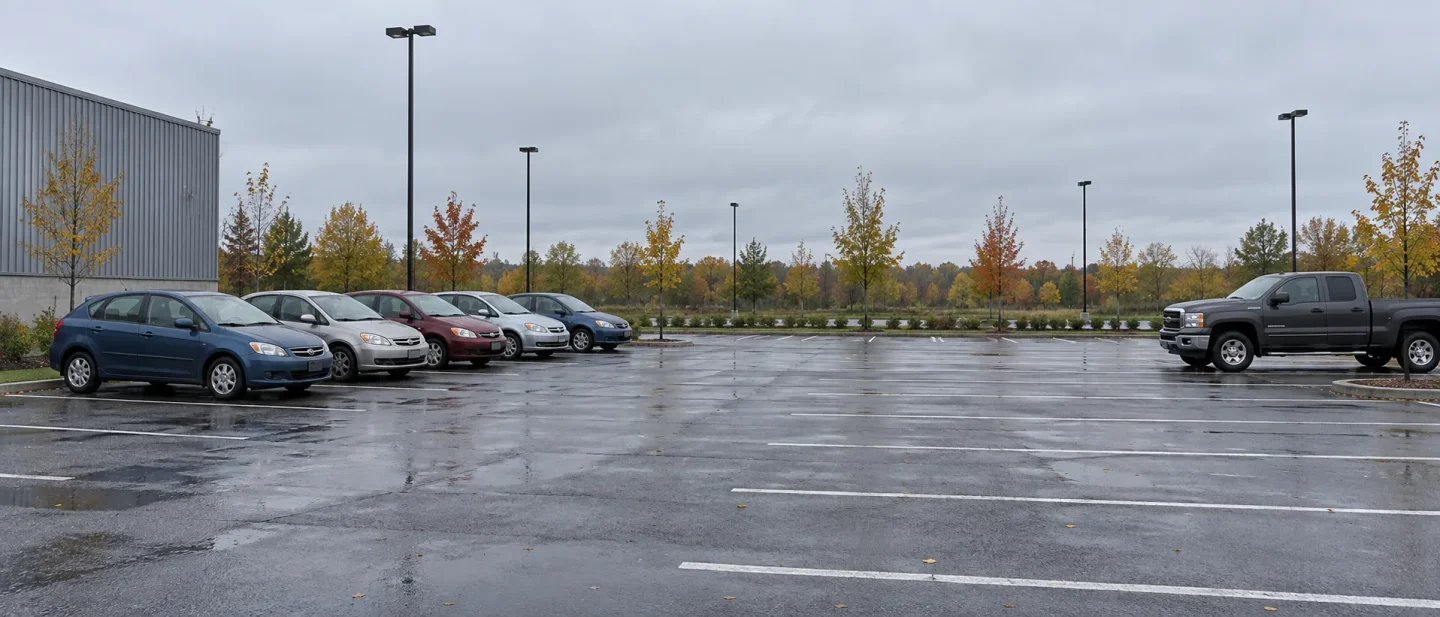
Used-car wholesale values turn negative for 2026 while asking prices reach a 2022 high
Wholesale used-vehicle values fell below year-ago levels for the first time in 2026, dealer asking prices still climbed to their highest since 2022, and the Federal Reserve's first rate rise since 2023 made the loan more expensive — what the two weeks to September 25 mean for buyers in Canada and the U.S.

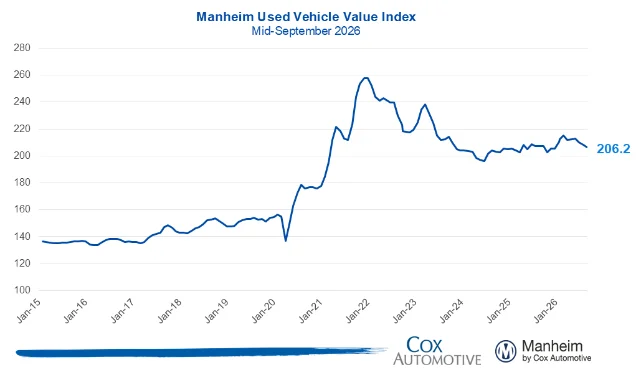
The Manheim Used Vehicle Value Index, the benchmark for wholesale used-vehicle prices at American auctions, fell 1% from August to 206.2 in the first half of September. That put it 0.4% below its level a year earlier — the first negative year-over-year reading of 2026, after a spring in which prices ran above the prior year's. 1
Dealers raised their asking prices anyway. The average used-vehicle listing price reached US$27,239 in August, up 0.9% from July and 7% from a year earlier, the highest monthly average since December 2022. 2
Borrowing grew more expensive at the same time. On September 16 the Federal Reserve raised its policy rate by a quarter point to 3.75%–4%, the first increase since 2023, and its published projections implied one more before the end of the year. 3
Data cutoff: September 25, 2026, 08:00 Eastern Time. The newest readings cover the first half of September for U.S. wholesale used-vehicle values, the week ending September 12 for Canadian wholesale values, and August for official price indexes, retail listings, affordability, and sales forecasts.
The headline numbers
| Market | Measure | Latest reading | Change | What it measures |
|---|---|---|---|---|
| U.S. used | Wholesale value index, first half of September | 206.2 | −1% from August; −0.4% year over year | Auction prices, adjusted for mix, mileage and season 1 |
| U.S. used | Average dealer asking price, August | US$27,239 | +0.9% from July; +7% year over year | Advertised prices on dealer lots 2 |
| U.S. used | Official price index, August | −2.3% year over year | +0.4% for the month | Prices consumers paid 4 |
| U.S. new | Official price index, August | +0.6% year over year | +0.3% for the month | Prices consumers paid 4 |
| U.S. new | Loan rate and monthly payment, August | 9.49%; US$770 | Rate −2 basis points from July; payment +0.5% | What financing the average new vehicle costs 5 |
| U.S. new | Weeks of median income to buy, August | 35.5 weeks | Up from 35.4 in July; down from 35.9 a year earlier | Affordability of the average new vehicle 5 |
| U.S. rates | Federal funds target range, September 16 | 3.75%–4.00% | +0.25 percentage point | The rate the Federal Reserve sets, which anchors the rest of the market 3 |
| Canada new | Purchase of new passenger vehicles, August | +1.4% year over year | −1.0% for the month | Prices Canadian households paid 6 |
| Canada used | Purchase of used passenger vehicles, August | +3.8% year over year | +0.4% for the month | Prices Canadian households paid 6 |
| Canada used | Wholesale market change, week ending September 12 | −0.19% | Cars −0.21%; trucks and SUVs −0.17% | Auction prices in the Canadian market 7 |
The rows measure different things, and the U.S. used rows now point in opposite directions. Auction values sit below last year, dealer asking prices sit at a three-and-a-half-year high, and the official index of what people paid is down 2.3% on the year. For anyone negotiating, that spread is where the conversation starts.
Used vehicles: the turn at the auctions
Manheim's adjusted index is the industry's benchmark for what used vehicles fetch at wholesale, and it has given back the spring's gains. The unadjusted measure, closer to the price a dealer actually pays before reconditioning, fell 1.1% in the first half of September and stands 1.1% below last September. The long-run average for the full month of September is a decline of 0.3%, so the first half of this month is depreciating faster than a typical September. 1
Demand at the auctions has softened with it. Sales conversion — the share of vehicles offered at auction that actually sell — averaged 55.8% in the first half of September, 1.4 percentage points below a year earlier and 0.7 points below August. Wholesale supply rose to 27.8 days as of September 15, about 2.4 days more than a year earlier. Three-year-old vehicles depreciated 0.8% in the first half of the month. 1
Asking prices set a 2022 high
The retail side of the same market did the opposite. Dealers held 2.13 million used vehicles in August, 1.1% fewer than in July and 1.3% more than a year earlier, and those lots turned over in 44 days — two days faster than July and two days slower than last August. Retail used-vehicle sales ran at an estimated 1.50 million units, up 3.9% from July and down 3.2% from a year earlier. 2
The cheapest cars remain the hardest to find. Used vehicles priced under US$15,000 carried 29 days of supply, 15 days below the market average, and their numbers are down 25.9% from a year earlier. They made up 15.1% of dealer inventory in August, against 20.6% a year earlier. Certified pre-owned sales were estimated at 227,432 vehicles, down 5.4% from a year earlier and up 2.3% from July, and CPO accounted for 15.2% of used retail sales. 2
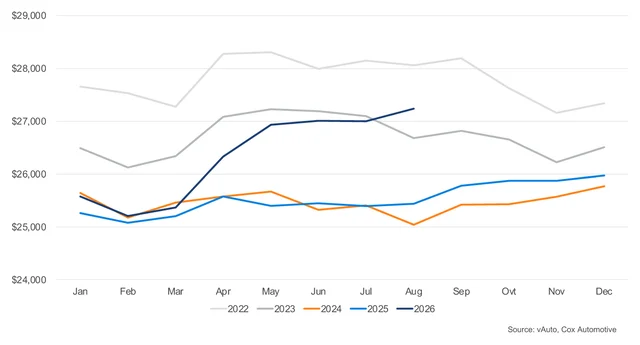
Part of the disagreement between the two used-price measures comes from what is left on the lots. The asking price is calculated over the cars dealers are advertising, and that mix has shifted toward newer, more expensive vehicles as the sub-US$15,000 band shrank from 20.6% of inventory to 15.1% in a year. 2 The official index follows what consumers paid across the whole market. 4
Fuel prices are re-ranking the segments
Fuel costs are steering which used vehicles hold their value. U.S. pump prices were 27.4% higher in August than a year earlier, and Canadian prices were up 22.8%. 46 Through the first three weeks of September they kept climbing: gasoline rose nearly 10% from the end of August and diesel set all-time records as renewed conflict in the Middle East disrupted supply. 8
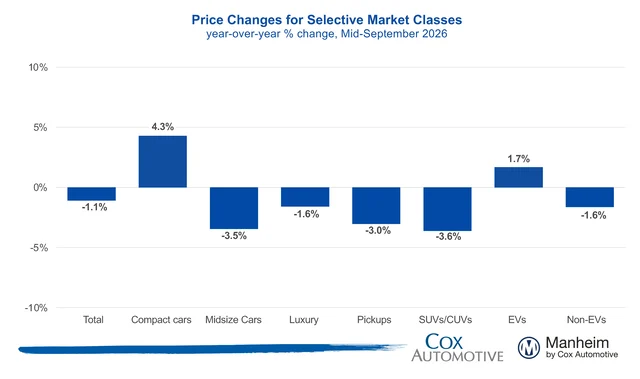
That shows up in which vehicles hold their value. Compact cars and electric vehicles were the only major classes worth more than a year earlier in mid-September: compact cars by 4.3% and EVs by 1.7%. Midsize cars, pickups and SUVs were 3.0% to 3.6% below, and the market as a whole was down 1.1%. Manheim's Jonathan Gregory said higher gasoline prices may be pushing buyers toward more fuel-efficient vehicles. A separate EV index in the same report put electric vehicles 2.3% above last year but 1.3% below August, and the non-EV index down 1.3% on the year. 1
Canada's weekly wholesale data shows the same tilt. In the week ending September 12, compact cars were the only car segment to gain value, up 0.28%, while subcompact cars fell 0.83% and midsize cars fell 0.73%. Minivans lost 0.61%. The overall market fell 0.19%, milder than the 0.26% average for that week between 2017 and 2019, and auction sale rates averaged 38.1%. 7 Canadian registrations show a similar tilt: hybrids took a record 16.8% share of new registrations in the second quarter, 91,868 vehicles and 40% more than a year earlier. 7
New vehicles: resilient demand, dearer credit
Cox Automotive raised its full-year 2026 forecast for U.S. new-vehicle sales to 16.1 million units on September 24, from 15.8 million in June, after a summer that beat expectations. September's sales pace is expected to land near 16.3 million on a seasonally adjusted annual basis, below August's 16.8 million and last September's 16.6 million, while September's volume of about 1.35 million units is 6.5% higher than a year earlier. Third-quarter volume is forecast at 4.12 million, down 0.7% from 2025. 9
The brand mix has also shifted. Asian brands are expected to take more than half of U.S. new-vehicle sales for a second consecutive quarter, while the Detroit Three fall to just over 36% — the lowest share on record. Leasing lost ground after the federal EV tax credit ended: Cox forecasts 3 million leased vehicles this year and cut its expected lease penetration to 23%. In the used market, it expects 20.5 million retail sales and 38.5 million total sales, slightly below 2025. 9
The Federal Reserve's September 16 decision was unanimous and its first increase in more than three years. The summary of projections released with it moved the median expected policy rate for this year up 30 basis points to 4.1%, which points to another increase before December. 3 Cox's economists note that auto loan rates follow longer-term Treasury yields more closely than the policy rate, and the 10-year Treasury has stayed near 5% even after the increase. Car loan rates have already moved: new-vehicle loan rates are up about 20 basis points over the past two months, and used-vehicle rates about 10. 8
August's financing numbers, published before the hike, show the level borrowers were already facing. The average rate on a new-vehicle loan was 9.49%, the typical payment was US$770, up 2.6% from a year earlier, and the average new vehicle cost 35.5 weeks of median household income, down from 35.9 weeks a year earlier because incomes grew faster than prices. Incentives were 7.3% lower than a year earlier. 5
Canada: paid prices still rising, auctions easing
Canada's official measure tells a different story about used vehicles than the American one. The purchase price index for used passenger vehicles was up 3.8% in August from a year earlier, while the index for new passenger vehicles was up 1.4% and had fallen 1.0% from July. Overall consumer inflation held at 3.0%, with gasoline up 22.8% year over year after a 25.7% rise in July. 6
In the U.S., the same comparison runs the other way: the official index for used cars and trucks is down 2.3% over twelve months, while new vehicles are up 0.6%. 4
Canadian wholesale values are easing, as in the U.S. On dealer lots, the moving average asking price across roughly 165,000 used vehicles was about C$38,500 in mid-September. 7
The advertised price now has a rule attached
On September 15 the U.S. Federal Trade Commission published detailed answers to common questions about auto pricing, and its core position is simple: the advertised price has to be the price any consumer can walk in and pay. Only charges a government body requires the buyer to pay directly — taxes, registration, title transfer — may sit outside it. 10
Mandatory document fees belong in the advertised number. By the commission's example, a dealer that would charge any buyer an $85 document fee on a $40,000 car has to advertise $40,085. Advertised prices may not be built on rebates only some buyers qualify for, and the actual price has to be the most prominent figure on a listing page, whether on a dealer's site, a third-party site, social media, print or a roadside sign. The guidance follows warning letters the commission sent to 97 dealership groups in March. 10
What shoppers can use now
- Negotiate from the auction gap. Wholesale values fell in the first half of September while asking prices reached a 2022 high, and the gap between the two is the room a dealer has. Bring the segment trend for the exact model — pickups and SUVs are down year over year, compact cars are up — and use it as the opening position. 12
- Get a trade-in offer early if you are selling a large vehicle. Pickup and SUV wholesale values are below year-ago levels and falling faster than the market, so an appraisal taken this month is worth more than one taken after another month of depreciation. 1
- On a car under US$15,000, decide quickly. That band has 29 days of supply against 44 for the market and its availability is down 25.9% from a year earlier, which leaves very little room to wait for a better example. 2
- Compare the asking price with what buyers actually paid for the same model. Used-vehicle transactions are down 2.3% over the year while dealer asking prices are up 7%, so a national average can point the wrong way for a specific car. 24
- Arrange financing before the showroom. New-vehicle loan rates rose about 20 basis points over two months, the average new-car rate was 9.49% in August, and the Fed's own projections point to another increase this year. A pre-approved rate makes the finance office conversation a comparison of total cost, with the monthly payment as one part of it. 358
- Check what the advertised price includes, and hold it there. Under the FTC's guidance, mandatory fees belong in the headline number, and the advertised figure has to be what any walk-in buyer can pay. 10
Used-vehicle values turned at the auctions first this quarter, while dealer asking prices were still climbing and loan rates were on the way up. Those shifts reach a windshield sticker over months, and a shopper deciding now is standing in the middle of that lag. What settles a deal in that window is the price on the exact model, in the exact segment, with a financing offer already in hand.
References
- 1
- 2
- 3Federal Reserve issues FOMC statement
federalreserve.gov
- 4
- 5
- 6The Daily — Consumer Price Index, August 2026
www150.statcan.gc.ca
- 7Wholesale declines pick up
canadianautodealer.ca
- 8Auto Market Weekly Summary
coxautoinc.com
- 9
- 10
This story was produced automatically by a channel. One sentence is all it takes for Neodrop to keep producing for you.