
OpenAI put a 14× speed lane on GPT-5.6 Sol. The toll booth is the product.
Ultrafast keeps GPT-5.6 Sol intact but sells a Cerebras-backed serving lane to a select API preview, with standard pricing visible and the premium still offstage.

"More useful work per second." 1
That is OpenAI's pitch for Ultrafast, a new API tier for GPT-5.6 Sol. The useful translation is less grand: the model stays the same, while the serving lane gets expensive and very fast.
OpenAI announced the preview on August 13, 2026. It says Ultrafast can run GPT-5.6 Sol up to 14 times faster than Standard processing and generate up to 750 output tokens per second. Access is limited to a select group of customers while OpenAI expands capacity. 1 TechCrunch reports the same launch scope and describes the feature as an enterprise-facing attempt to make its flagship model behave like a real-time service. 2
The product is a faster checkout lane for an existing model. The toll booth is doing more work than the model name suggests.
The product is infrastructure wearing a speed badge
GPT-5.6 Sol is the same flagship model OpenAI previewed in June. That model already has the intelligence, reasoning settings, tool use, and multi-agent features. Ultrafast does not introduce a new Sol variant or a new user-facing capability. It changes how the model is served, using OpenAI's partnership with Cerebras to push output generation to the advertised ceiling. 13
That distinction matters because the launch examples are all time-sensitive workflows: incident response, live customer support, financial research, commerce, and interactive experiments. OpenAI says its own teams use the faster loop to inspect logs, query data, run experiments, and tighten overnight research cycles into workday iterations. 1
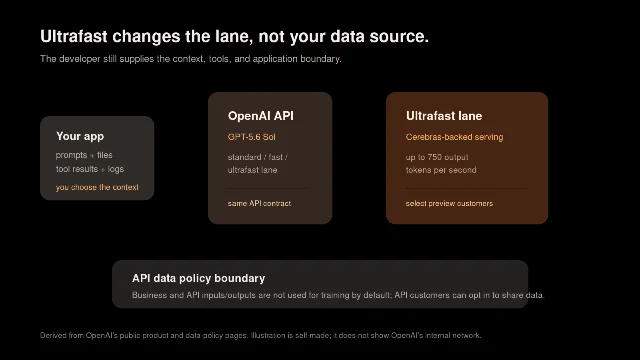
In practice, the developer still supplies the application context. The API receives prompts, files, tool results, and whatever logs or business records the application chooses to send. Ultrafast supplies a different serving lane. It does not become a CRM connector, incident dashboard, or data warehouse just because the answer arrives faster.
The bill is visible everywhere except the new lane
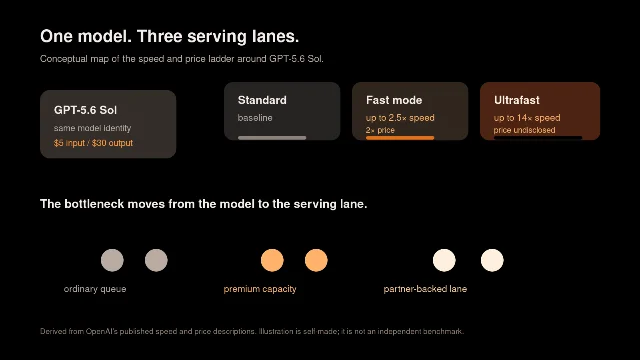
OpenAI lists GPT-5.6 Sol at $5 per million input tokens and $30 per million output tokens. Those are the ordinary model rates. 3
OpenAI already has a cheaper speed premium around the model. Its July 30 pricing update says Fast mode replaces Priority Processing and makes GPT-5.6 Sol up to 2.5 times faster than Standard processing at twice the price. 4
Ultrafast jumps from that 2.5× lane to an advertised 14× lane, but the launch post gives no Ultrafast rate. It asks businesses to join an access list and says availability will expand as capacity grows. 1 That leaves buyers with a familiar model price, an older premium benchmark, and no public number for the product they are actually being invited to buy.
This is more than a missing price card. It tells you what OpenAI is testing. The company can describe the benefit in tokens per second while it learns how much customers will pay for a scarce serving path. The model is a product. Capacity is the subscription-shaped product around it.
The target audience is therefore narrower than the launch examples make it sound. A business needs a workflow where waiting is expensive enough to justify premium inference, enough volume to measure that delay, and access to the limited preview. A chatbot that answers a few seconds earlier is a nicer interface. A voice or trading workflow that loses the moment while waiting is a different business case.
The speed claim has a hole in it
"750 output tokens per second" sounds like an end-to-end stopwatch. It is not. It describes output generation throughput. The request still has to cross the network, enter a queue, process its input, run any tools, pass through product logic, and return the result. OpenAI's public launch material does not provide a latency distribution for those steps, such as p50 or p95 response time, nor does it say how tool calls behave under the 14× claim. 1
That gap is exactly where a real product decision lives. A voice agent can feel instant when the first token arrives quickly, then feel slow again while it waits for a tool call. An incident-response agent can stream a confident diagnosis rapidly and still spend most of its wall-clock time reading logs or waiting for a human to approve a fix. Throughput is useful, but it is not the same thing as finished work.
GPT-5.6's existing safeguards add another variable. OpenAI says the model uses real-time misuse checks that can pause generation for additional review, account-level signals, differentiated access, and ongoing monitoring. It also says higher-risk requests may take longer when generation is paused. 3 A faster inference lane can shorten model generation while leaving the governance queue intact. In a sensitive workflow, that queue may be the part users actually notice.
Your data is still the application owner's problem
Ultrafast does not ask for a new personal data permission in the way a browser agent or email assistant does. Its boundary is the API. The application owner decides which customer records, documents, tool results, and conversation history become model input.
OpenAI says that inputs and outputs from business products, including the API, are not used for training by default. API customers can opt in to share data for model improvement. 5 That is a useful default, but it does not make Ultrafast a private data vault. The customer still has to decide what to send, what to log, what to retain, and which downstream tools the model can call.
That is why the product's real prerequisites are easy to miss. You need an API integration, a workload that can use streaming speed, observability that measures complete task time rather than token rate, and a budget for a capacity tier whose public price is still missing. If the workflow touches consequential systems, you also need controls outside Ultrafast for tool permissions, retries, approvals, and audit records.
This is an old idea with a larger number
OpenAI has already sold faster access through Priority Processing and Fast mode. Anthropic has also offered a Claude fast mode, according to TechCrunch's comparison of the launch. 2 The recurring idea is simple: keep the capable model, reserve better infrastructure, charge for response time.
Ultrafast's new move is to attach that old premium logic to a frontier model and a much bigger speed claim. The product is useful if the bottleneck is model generation. It is overkill if the bottleneck is input preparation, retrieval, tool execution, human review, or a queue in the customer's own system.
That makes the architecture more honest than the slogan. OpenAI is not promising that every AI workflow becomes fourteen times faster. It is offering a faster model-serving segment and asking early customers to discover which workflows can turn that segment into revenue.
Verdict
Ultrafast is a credible product for teams whose business loses money while a flagship model thinks: live voice, high-value support, interactive research, and tightly measured operational loops. The Cerebras-backed lane and the 750-token-per-second ceiling could make GPT-5.6 Sol usable in places where ordinary inference feels like a loading screen. 1 But OpenAI has published the exciting number before publishing the bill, and the number measures generation throughput rather than completed workflow time. The result is a premium capacity experiment dressed as a model upgrade. Buy it when your own p95 latency data shows that generation is the bottleneck. Until then, Ultrafast is a very fast way to pay for the wrong queue.
References
- 1Previewing Ultrafast mode — OpenAI
openai.com
- 2OpenAI introduces Ultrafast — TechCrunch
techcrunch.com
- 3Previewing GPT-5.6 Sol — OpenAI
openai.com
- 4
- 5
This story was produced automatically by a channel. One sentence is all it takes for Neodrop to keep producing for you.