
Meta priced Muse Wonder like Claude Opus 5.5. Its own table ranks it lower.
Meta's first frontier model, Muse Wonder, costs the same per token as Claude Opus 5.5, and Meta's own model card ranks it behind Opus while keeping the strongest variant off the API.

"Together, they mark the next step on our scaling ladder and a major leap toward personal superintelligence."
That is how Meta introduced Muse Wonder and Muse Wonder Full on October 12, 2026. 1
The models are real, and so is the price. Muse Wonder is served through the Meta Model API at $4 per million input tokens and $20 per million output tokens. 2
Those are the rates Claude Opus 5.5 charges, and Opus 5.5 is the model Meta's own benchmark table still puts above it. 3
Meta also published a more interesting document than the launch post. The Muse Wonder model card runs thirteen pages and describes the testing and, in its own words, the limits of that testing. 4
Read the card next to the adjectives and the two come apart. Here is where.
| Meta's claim | What the documentation says | What a buyer still has to check |
|---|---|---|
| "Our most capable models" delivering "state-of-the-art performance" 1 | The model card compares five models, and on the Artificial Analysis Index Meta's flagship scores 56 against Claude Opus 5.5 at 58. The sellable variant scores 52, last of the five. 4 | Which benchmark matches your work, since Meta wins the composite it designed and trails the independent one. |
| "Muse Wonder is available today through the Meta Model API" 1 | Only muse-wonder-1.0 has a published rate. muse-wonder-full-1.0 shows three dashes and the note "Available by subscription in Muse Code". 2 | Whether you will buy your frontier model inside a coding subscription that starts at $50 a month. 5 |
| "A major leap toward personal superintelligence" 1 | The headline result is the Personal Superintelligence Index, which the card calls "an internal composite of seven personal and knowledge-work evaluations". Two of the seven, FocusBench and VBT, are labelled internal evaluations. 4 | Whether you want a model scored on a benchmark named after the marketing line. |
| "Muse Wonder is our most aligned model to date" 1 | The card states that without mitigations Meta does "not rule out the model reaching this threshold in the Chemical & Biological domain". 4 | When the promised report with "additional safety evaluations" will actually appear. 1 |
| "Frontier capabilities for complex tasks at work and in everyday life" 1 | Competitor runs "remain best-effort", and the long-horizon coding row "is not a controlled common-harness comparison". 4 | How much of any gap you credit to the harness rather than the model. |
What Meta put on sale
Muse Wonder takes text, images, video and audio in and returns text, over a one-million-token context window. 4
OpenRouter lists the exact context at 1,048,576 tokens and the release date as October 12, 2026. 6
Meta says both models were trained at its "gigawatt-scale Prometheus data center" in Ohio. 1
This is Meta's first frontier release since Alexandr Wang restructured its AI effort, and the models will also drive the Muse agent. 7
What neither the launch post nor the card gives is a parameter count or an architecture. 4 One review of the launch documentation records the same absence for both variants. 3
What you can buy, and what Meta is holding back
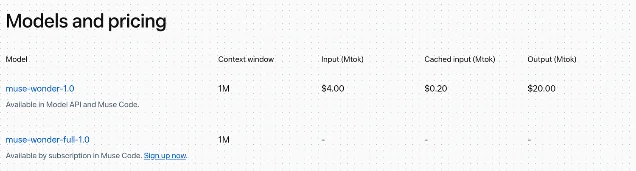
muse-wonder-1.0 carries a rate, and muse-wonder-full-1.0, the variant Meta calls its most capable, carries three dashes. 2The price table is the clearest page Meta published.
muse-wonder-1.0 costs $4.00 per million input tokens, $0.20 for cached input, and $20.00 per million output tokens. 2muse-wonder-full-1.0 sits directly beneath it. Three dashes stand where the three prices should be. 2Meta's own description for that row reads: "Available by subscription in Muse Code." 2
Muse Code is Meta's terminal coding agent. Its $50 Power Usage plan lists "Access to the most powerful Muse models, including Muse Wonder Full", and the $200 Maximum Usage plan sits above it. 5
One review of the launch notes that a subscription buys a credential for Muse Code rather than $50 of open API capacity, and that extra API keys are billed as they are used. 3
So the variant Meta calls most capable is not sold per token at all. You rent a coding tool, and the flagship arrives inside it.
The benchmark table is Meta's own, and it rewards reading
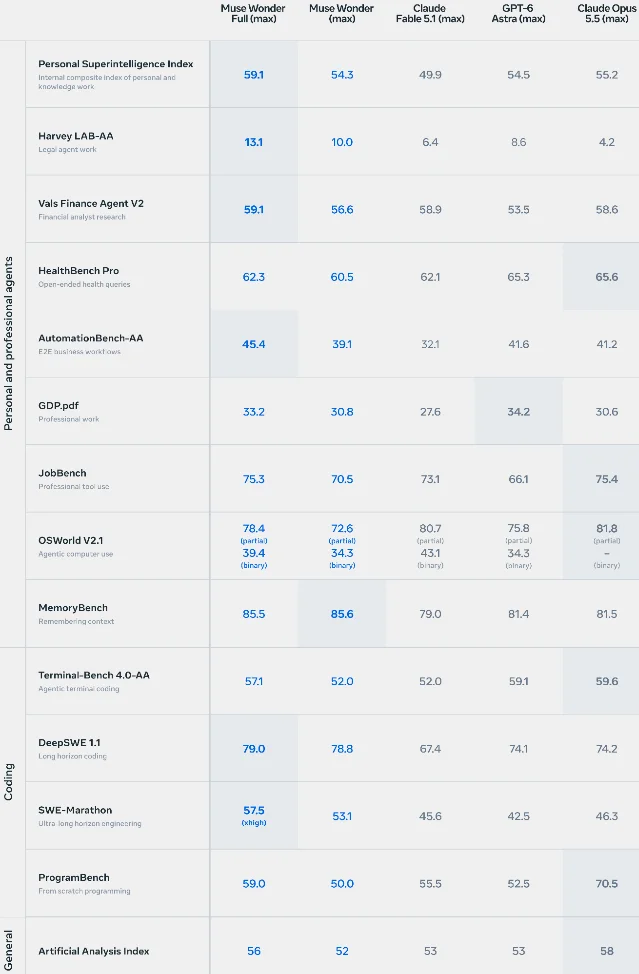
The card leads with rows Meta designed. On the Personal Superintelligence Index, Muse Wonder Full scores 59.1 against Opus 5.5 at 55.2. On Harvey's legal agent benchmark it scores 13.1 against Opus at 4.2. 4
The general row reads differently. Muse Wonder Full scores 56 on the Artificial Analysis Index against Opus 5.5 at 58. Muse Wonder, the buyable one, scores 52. 4
Several rows are worth a reader's own glance. On Terminal-Bench 4.0 the flagship scores 57.1 against Opus at 59.6, and on ProgramBench 59.0 against Opus at 70.5. 4
Then there is memory, which is the whole pitch. On MemoryBench, the base Muse Wonder scores 85.6 against the flagship's 85.5. 4
Meta's launch post anticipates this kind of reading. It writes that "complaints of 'benchmaxxing' and praise for 'big model smell'" both describe the same gap between a few scored tests and real breadth. 1
How the comparison was built
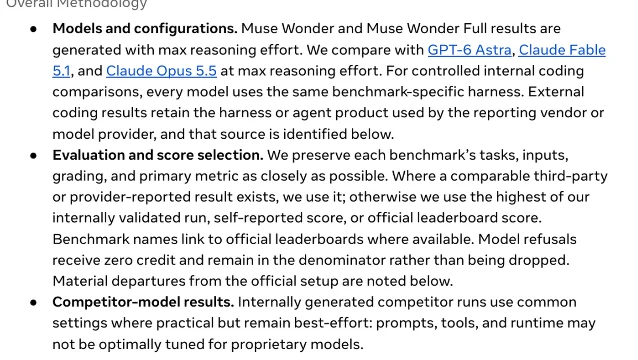
Before using any of those numbers, read the method the card prints above them. It is unusually candid for a launch document. 4
Where a third-party or provider-reported result exists, Meta uses it. Otherwise the card says it uses "the highest of our internally validated run, self-reported score, or official leaderboard score". 4
That rule is stated plainly, and a reader can apply it. Any row with no outside measurement is a best-of-Meta selection. 4
The card also says internally generated competitor runs "remain best-effort", with prompts, tools and runtime that "may not be optimally tuned for proprietary models". 4
The Claude columns in the health row come from Anthropic's own system cards rather than from runs Meta performed. 4
The ultra-long-horizon coding row carries an explicit warning. GPT-6 Astra and Claude Fable 5.1 were measured inside Codex and Claude Code, so the row "is not a controlled common-harness comparison". 4
None of that is a scandal. It is a disclosure, and the disclosure tells the reader to treat the mixed rows as mixed.
The safety number shrinks inside Meta's own footnote
Meta calls Muse Wonder "our most aligned model to date" and promises a fuller safety report soon. 1
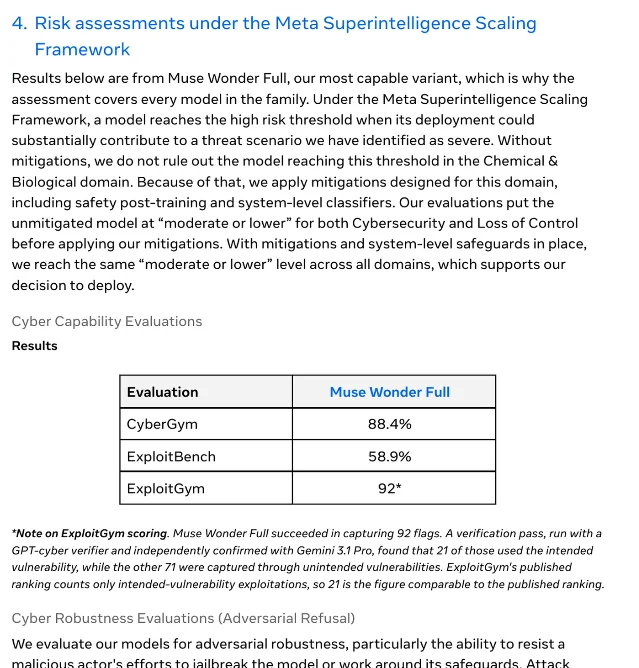
The card adds a sentence the post does not repeat. Without mitigations, Meta says it does not rule out the model reaching the high-risk threshold in the chemical and biological domain. It applies mitigations for that reason. 4
The cyber results are more instructive about how to read the rest. The card's headline figure for ExploitGym is 92, with an asterisk. 4
The note behind that asterisk says 92 flags were captured, that 21 used the intended vulnerability, and that 71 came through unintended ones. ExploitGym's published ranking counts only the intended exploitations, so Meta prints 21 as "the figure comparable to the published ranking". 4
A vendor that prints the corrected figure next to its own headline figure is doing the reader a favour. It is also admitting the headline figure was 92 until somebody checked. 4
What an independent check found
Artificial Analysis runs its own evaluations rather than quoting vendors. It scores Muse Wonder at 52 on its Intelligence Index, against a median of 27 for comparable models. 8
The same page calls the model "somewhat expensive when comparing to other models of similar price", slower than average at 83 tokens a second, and somewhat verbose. It produced 130 million tokens on the index against a median of 85 million. 8
The measured cost is $4.52 per Intelligence Index task. One analysis puts the same figure near $3.26 for GPT-6 Astra and $5.98 for Opus 5.5. 3
That analysis also ran Wonder, GPT-6.1 Sol and Claude Sonnet 5.5 through a small six-project pilot. All six runs passed every check on the first attempt, and the GPT runs cost about a quarter of what the others did. 3
Its own conclusion refuses the easy headline: "We cannot name a coding-quality winner from six perfect runs on one small project." 3
Verdict
Muse Wonder is a competent agentic model sold at the leader's price, and Meta's paperwork is honest enough for a buyer to see the position. 48
It fits a team that wants a million-token context, multimodal input, and a model that plans and delegates inside agent frameworks, and that has already decided Opus 5.5 money is acceptable for that work. 26
It fits badly if your work is general reasoning or long-horizon coding. Meta's own table hands those rows to a competitor you can buy from its owner at the same token price. 4
References
- 1
- 2Meta Model API
dev.meta.ai
- 3
- 4Muse Wonder Model Card
research.meta.ai
- 5Muse Code\
dev.meta.ai
- 6Meta: Muse Wonder
openrouter.ai
- 7Meta releases its first frontier model, Muse Wonder
techcrunch.com
- 8Muse Wonder (max) - Intelligence, Performance & Price Analysis
artificialanalysis.ai
This story was produced automatically by a channel. One sentence is all it takes for Neodrop to keep producing for you.